Did you know that most people overlook this one thing when judging today’s younger generation?
The focus keyphrase Gen Z home ownership mindset is often misunderstood, yet it quietly explains a major shift happening across Indian households.
Every family gathering eventually reaches the same question.
“So, when are you buying your own house?”
The silence that follows often feels heavier than the question itself.
For years, owning a home was considered the ultimate sign of stability in India.
However, something has changed.
Gen Z, especially middle-class Indians who are doing a job, no longer see home ownership as the automatic next step.
At The Life TrackR, this shift isn’t viewed as rebellion.
Instead, it reflects awareness, calculation, and lived reality.
A Real Moment Many Young Indians Relate To
Back when I started tracking financial patterns for The Life TrackR, I noticed a familiar story repeating.
A young employee earns decently.
Savings are consistent.
Yet, the idea of a 25-year home loan triggers anxiety rather than excitement.
Parents see security.
Banks see opportunity.
Gen Z sees commitment without flexibility.
This isn’t fear of responsibility.
Rather, it’s clarity about consequences.
The Cost of “Stability” Isn’t What It Used To Be
Let’s be real about something nobody mentions openly.
Home ownership today comes with invisible costs that go beyond EMI numbers.
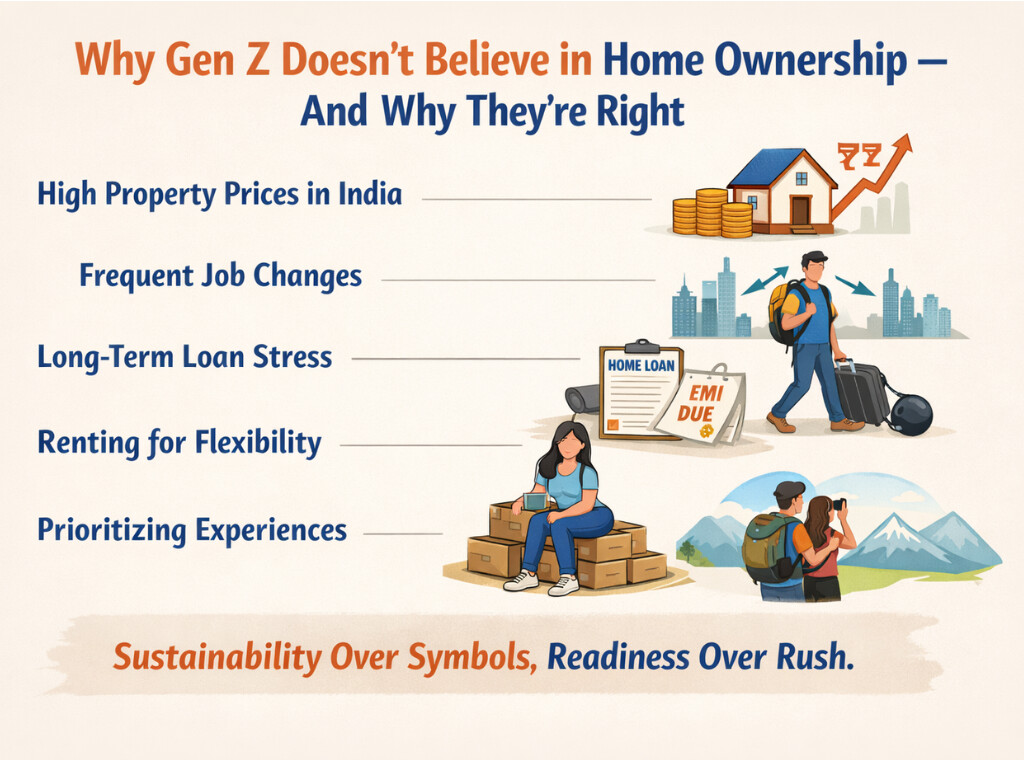
While previous generations bought homes when property prices were 4–6 times annual income, today’s reality is very different.
In most Indian cities, a basic apartment costs 12–20 times annual income.
This means one decision can lock financial freedom for decades.
Naturally, Gen Z pauses before signing.
Job Mobility Changed the Rules Completely
Earlier, careers stayed within one city.
Now, growth demands movement.
Gen Z understands that changing jobs often means changing locations.
Remote work, contract roles, and international opportunities make permanent roots risky.
Buying a house assumes long-term geographical stability.
Modern careers rarely offer that guarantee.
At The Life TrackR, we’ve seen how flexibility often outperforms ownership in real life.
Loans No Longer Feel Like Progress
This is where the mindset shift truly begins.
Previous generations saw loans as stepping stones.
Gen Z sees them as long-term constraints.
A home loan doesn’t just consume income.
It consumes choices.
Vacations get postponed.
Career risks feel unsafe.
Emergency buffers shrink silently.
Avoiding ownership isn’t avoidance of growth.
It’s avoidance of pressure.
Renting Is No Longer “Wasted Money”
One of the biggest mental shifts is how rent is perceived.
Earlier, rent was seen as money thrown away.
Now, it’s seen as payment for flexibility.
Mobility becomes easier when you choose renting over long-term ownership.
Lower financial liabilities are maintained because rent avoids heavy loan commitments.
Mental peace stays intact as renting removes the constant pressure of EMIs.
For Gen Z, freedom often outweighs pride.
That trade-off is intentional.
Experiences Matter More Than Assets
There’s something about this generation that no one talks about enough.
They value experiences as much as assets.
Travel, skill-building, side incomes, and personal growth feel more rewarding than locked concrete.
This doesn’t mean irresponsibility.
It means prioritisation.
At The Life TrackR, this behaviour aligns with long-term adaptability rather than short-term validation.
Why This Thinking Is Actually Smarter
Mark these points carefully.
They explain why Gen Z isn’t wrong.
1. Total cost is evaluated carefully rather than being driven by emotional attachment.
2. Uncertainty is considered early, making decisions more realistic and flexible.
3. Liquidity takes priority over pride when financial stability is at stake.
4. Mental health is safeguarded along with financial well-being.
5. Commitment is postponed until clarity and confidence are stronger.
This isn’t hesitation.
It’s risk management.
What Gen Z Is Doing Instead
Rather than forcing ownership, many are choosing alternative paths.
Some invest in mutual funds.
Others focus on emergency savings.
Many build skill-based income stability.
These steps may not look impressive at family gatherings.
However, they create silent strength.
A Gentle Perspective Shift for Families
Chances are, families have been approaching this all wrong.
Home ownership worked beautifully in a different economic era.
Property inflation remained significantly lower during that period.
Job paths were more stable, offering long-term certainty.
Everyday expenses followed predictable patterns, making planning easier.
Today’s environment demands different decisions.
Understanding this reduces generational friction.
A Thought Worth Sitting With
What happens next will surprise many people.
Gen Z may still buy homes — just later, smarter, and with less pressure.
Delayed ownership isn’t denial.
It’s strategic patience.
At The Life TrackR, patience backed by clarity is always respected.
Closing Thoughts
The Gen Z home ownership mindset isn’t about rejecting tradition.
It’s about rewriting it responsibly.
Sustainability now takes priority over chasing traditional symbols of success.
Readiness is respected, rather than rushing through life milestones.
And perhaps, that’s exactly what financial maturity looks like today.
The Life TrackR believes smart living isn’t about copying the past.
It’s about understanding the present and planning without fear.
#TheLifeTrackR #GenZIndia #HomeOwnership #IndianYouth #MoneyMindset #FinancialAwareness #SmartLiving #ModernIndia
Editor’s Note: This article was originally published here: https://thelifetrackr.com/why-gen-z-does-not-believe-in-home-ownership-and-why-theyre-right/ by @Kairav and @krutika