
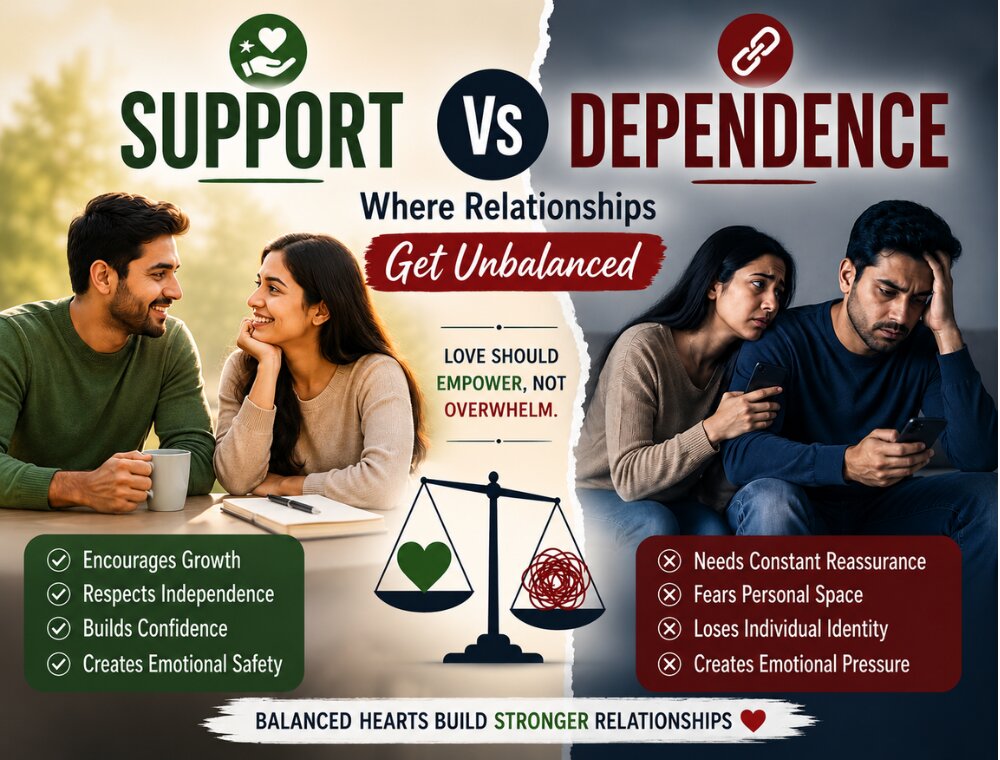
Ever wondered why some relationships feel comforting while others slowly start feeling exhausted? At first, everything may seem perfectly normal. One person constantly checks in, always wants to help, and becomes deeply involved in every decision. It can look like love, care, or emotional closeness. However, over time, something begins to change.
The conversations become heavier. Personal space starts disappearing. Decisions become difficult without the other person’s approval. Slowly, support turns into emotional dependence. That is where the real problem begins.
The focus keyphrase support vs dependence relationship is becoming increasingly important today because many people confuse emotional closeness with emotional reliance. While support strengthens relationships, dependence can quietly weaken individuality and emotional stability.
A healthy relationship should feel like a safe space, not an emotional burden. Yet many middle-class Indians balancing jobs, responsibilities, family pressure, and emotional expectations often fail to notice when relationships lose balance. The Life TrackR believes understanding this difference can completely change the quality of your emotional wellbeing.
Why Emotional Support Matters in Every Relationship
Every strong relationship needs support. Whether it is between partners, friends, siblings, or parents and children, emotional support helps people feel heard, respected, and valued.
Support means:
- Encouraging each other during difficult phases
- Respecting personal goals and independence
- Being emotionally available without controlling
- Helping without expecting emotional ownership
- Listening without judgment
Healthy support creates confidence. It allows both people to grow individually while staying emotionally connected.
For example, imagine someone preparing for a career change. Their partner motivates them, gives practical suggestions, and emotionally reassures them. At the same time, the individual still makes their own decisions confidently. This is support.
However, things become unhealthy when one person starts feeling emotionally incomplete without constant validation from the other person.
The Thin Line Between Support and Dependence
The difference between support and dependence is subtle. Therefore, many people fail to recognize it early.
Dependence starts when emotional needs become excessive and constant. Instead of sharing life together, one person slowly begins relying entirely on the other for emotional stability, confidence, happiness, or self-worth.
This imbalance can happen in romantic relationships, friendships, family bonds, and even workplace connections.
Signs That Support Is Turning Into Dependence
1. Constant Need for Reassurance
One person repeatedly seeks approval for every small decision. Without reassurance, anxiety increases quickly.
2. Fear of Personal Space
Healthy distance feels threatening instead of normal. Even a few hours without communication may create emotional panic.
3. Losing Individual Identity
Personal hobbies, friendships, and goals slowly disappear because the relationship becomes the center of life.
4. Emotional Responsibility Becomes One-Sided
One person feels responsible for fixing the other’s moods, stress, or happiness all the time.
5. Guilt Around Independence
Whenever someone wants alone time or personal growth, the other person feels rejected or abandoned.
These patterns may initially look like deep love. Nevertheless, they often create emotional pressure over time.
Why Emotional Dependence Happens
Emotional dependence rarely appears suddenly. In most cases, it develops gradually because of personal insecurities, past experiences, or emotional conditioning.
Common Reasons Behind Dependence
1. Low Self-Worth
People who struggle with confidence often seek emotional validation externally. As a result, relationships become their primary source of identity.
2. Fear of Abandonment
Past emotional pain, rejection, or unstable relationships can create fear of being left alone.
3. Lack of Emotional Boundaries
Many people are never taught how to maintain healthy emotional limits while staying caring and connected.
4. Stressful Lifestyle
Job pressure, financial responsibilities, and social expectations can increase emotional dependency because people seek constant emotional comfort.
5. Social Conditioning
Sometimes society romanticizes unhealthy attachment by calling it “true love” or “deep care,” especially in emotionally intense relationships.
How Unbalanced Relationships Affect Mental Wellbeing
At first, emotional dependence may feel comforting. Yet over time, it slowly creates emotional exhaustion for both people involved.
Emotional Effects on the Dependent Person
- Increased anxiety
- Fear of rejection
- Low confidence
- Overthinking
- Emotional insecurity
- Difficulty making independent decisions
Emotional Effects on the Supporting Person
- Mental exhaustion
- Emotional pressure
- Feeling trapped
- Loss of personal space
- Frustration and burnout
Eventually, resentment begins building silently. What once felt loving may start feeling emotionally draining.
The Life TrackR emphasizes that healthy relationships should improve emotional wellbeing, not damage it.
Healthy Relationships Encourage Growth, Not Emotional Control
One major misconception is believing that constant emotional attachment equals closeness. Actually, emotionally healthy relationships allow both people to maintain individuality.
Strong relationships are built on:
- Trust
- Communication
- Respect
- Emotional maturity
- Personal freedom
- Shared support
When two emotionally healthy individuals support each other, the relationship becomes stronger naturally.
On the other hand, dependence creates emotional imbalance because one person becomes emotionally responsible for the other’s inner stability.
A Situation Many People Quietly Experience
Imagine returning home after a stressful day at work. Instead of feeling relaxed, you immediately feel pressure to respond to emotional expectations, constant questions, or reassurance demands.
Slowly, even normal personal time begins feeling selfish.
At the same time, the dependent partner may genuinely feel anxious when communication reduces even slightly. Both individuals are emotionally struggling, but neither understands why the relationship suddenly feels heavy.
This is how emotional imbalance silently grows.
Many people ignore these signs because the relationship still contains love and care. However, emotional health requires balance alongside affection.
How to Build Healthy Emotional Boundaries
Healthy boundaries do not weaken relationships. Instead, they make relationships stronger and emotionally safer.
1. Encourage Individual Growth
Both individuals should maintain personal goals, hobbies, friendships, and routines.
2. Communicate Honestly
Open conversations reduce emotional misunderstandings. Express needs calmly instead of emotionally reacting.
3. Learn Emotional Self-Regulation
Not every emotional discomfort should depend on another person fixing it immediately.
4. Respect Personal Space
Alone time is healthy. Emotional independence improves long-term relationship stability.
5. Avoid Emotional Guilt
Wanting personal time does not mean reduced love or care.
6. Build Self-Confidence
The stronger your self-worth becomes, the healthier your relationships naturally become.
The Biggest Mindset Shift Most People Need
Many people believe relationships are about finding someone who “completes” them. However, emotionally healthy relationships are actually about two complete individuals supporting each other.
This small mindset shift changes everything.
Support says:
“I am here for you.”
Dependence says:
“I cannot function without you.”
That difference matters deeply.
The Life TrackR encourages people to build relationships based on emotional strength instead of emotional fear.
Practical Ways to Restore Balance in a Relationship
If you already notice unhealthy dependence patterns, do not panic. Relationships can improve when both individuals become emotionally aware.
Start With Small Changes
- Reduce overchecking habits
- Reconnect with personal interests
- Spend quality time outside the relationship
- Improve emotional communication
- Stop seeking constant validation
- Practice independent decision-making
Growth takes time. Still, small emotional changes create healthier relationship patterns gradually.
Why Emotional Independence Is Not Selfish
This is something hardly anyone talks about.
Emotional independence actually improves relationships because people stop expecting one person to fulfill every emotional need constantly.
Emotionally independent individuals:
- Handle stress better
- Communicate calmly
- Respect boundaries
- Maintain healthier expectations
- Build stronger emotional trust
Independence and emotional closeness can exist together beautifully.
What The Life TrackR Wants You to Remember
Relationships should feel emotionally safe, supportive, and balanced. They should inspire confidence instead of emotional fear.
If your relationship currently feels emotionally heavy, it does not automatically mean love is missing. Sometimes, it simply means emotional balance needs attention.
The Life TrackR believes self-awareness is the first step toward healthier emotional connections. Small emotional shifts today can completely improve relationship quality tomorrow.
Conclusion
The conversation around support vs dependence relationship is more important than ever because emotional imbalance often hides behind love and care. Healthy support strengthens individuality, while emotional dependence slowly weakens confidence and emotional stability.
Strong relationships are not built on constant emotional reliance. Instead, they grow through trust, respect, communication, and emotional balance. When both people feel emotionally secure individually, relationships naturally become healthier and happier.
The Life TrackR encourages everyone to create connections where love feels supportive rather than emotionally overwhelming. Because the healthiest relationships are not about losing yourself in someone else — they are about growing together while still remaining yourself.
#SupportVsDependence #HealthyRelationships #EmotionalBalance #TheLifeTrackR #RelationshipAdvice #MentalWellbeing #SelfGrowth #HealthyBoundaries #RelationshipGoals #LifeBalance
Editor’s Note: This article was originally published here: https://thelifetrackr.com/why-your-goals-keep-changing-and-how-to-stay-focused/ by @Kairav and @krutika