
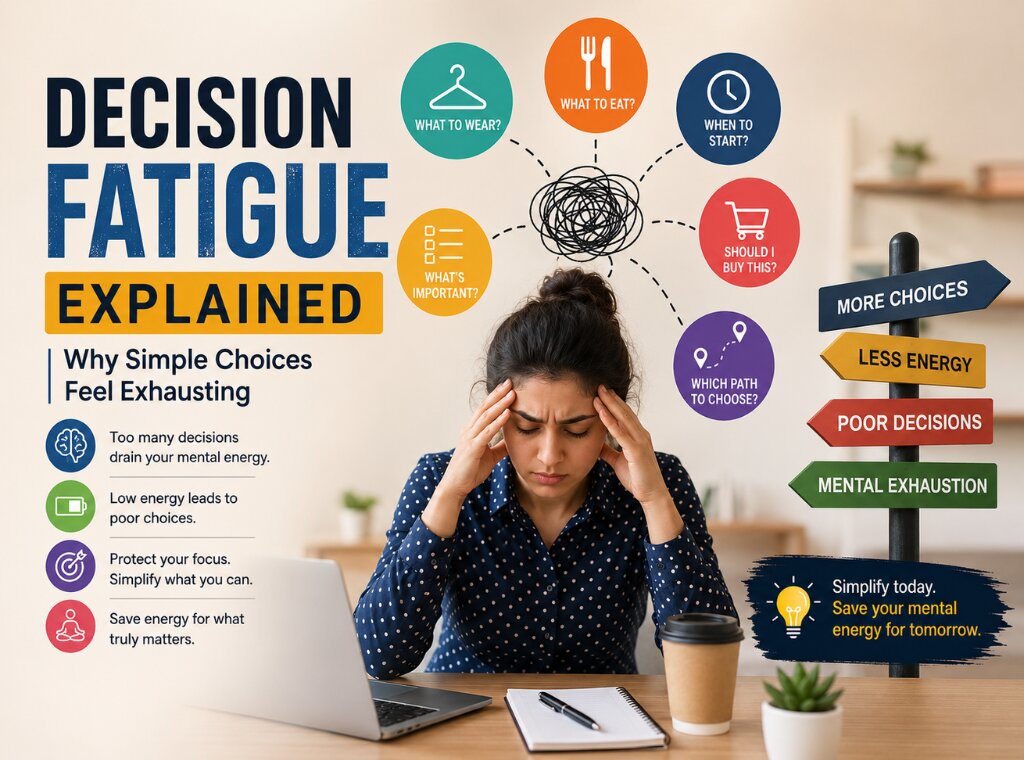
Have you ever wondered why deciding what to eat, what to wear, or whether to reply to a message suddenly feels overwhelming after a long day?
Many people believe they are simply becoming lazy or unmotivated. However, the real reason is often much deeper. Every decision you make throughout the day consumes mental energy. Consequently, by the time evening arrives, even the smallest choices can feel surprisingly difficult.
This is where the focus keyphrase, Decision Fatigue Explained, becomes important.
Imagine beginning your day feeling confident and focused. You complete your work, manage household responsibilities, and still have enough mental energy to make thoughtful decisions at night. While this may seem difficult, it becomes much more achievable once you understand how decision fatigue works.
Fortunately, decision fatigue is not permanent. Instead, it can be reduced by creating simple systems that protect your mental energy. Throughout this guide, The Life TrackR explains why your brain becomes exhausted, how it affects your daily life, and what practical steps you can take to make better decisions with less stress.
What Is Decision Fatigue?
Decision fatigue refers to the gradual decline in your ability to make good decisions after making many choices throughout the day.
Your brain treats every decision as work.
Some decisions are major, while others appear insignificant. Yet your brain still spends energy processing questions like:
- What should I wear today?
- Should I cook or order food?
- Which email should I answer first?
- Should I save or spend this money?
- Should I exercise now or later?
- Which TV show should I watch?
Although each decision seems small, hundreds of similar choices slowly reduce your mental capacity.
As a result, your brain begins searching for the easiest option instead of the best one.
A Situation That Feels Surprisingly Familiar
Imagine waking up with a clear plan for the day. You decide what to wear, prepare breakfast, choose your route to work, respond to messages, attend meetings, prioritize tasks, and handle unexpected requests. Later, you stop at a grocery store and compare prices, brands, and offers before returning home.
By evening, someone asks a simple question: “What would you like for dinner?”
Instead of answering immediately, you pause. Suddenly, choosing a meal feels exhausting. You are not confused about food. Rather, your mind has already spent most of its decision-making energy throughout the day.
This is how decision fatigue quietly influences everyday life without most people noticing it.
Why Your Brain Gets Tired of Making Decisions
Your brain has limited cognitive resources.
Every choice requires attention, comparison, evaluation, and judgment. Therefore, continuous decision-making gradually reduces mental efficiency.
Several factors make this happen:
1. Constant digital notifications
Emails, chats, and social media continuously demand decisions about whether to respond, ignore, or postpone.
2. Too many available options
Modern life offers endless choices for shopping, entertainment, food, and even productivity tools.
3. Frequent multitasking
Switching between different responsibilities forces your brain to repeatedly adjust priorities.
4. Unplanned routines
Without established habits, even ordinary activities require fresh decisions every day.
Consequently, mental energy disappears much faster than most people expect.
Signs You May Be Experiencing Decision Fatigue
Decision fatigue rarely appears all at once. Instead, it gradually affects both your thinking and behavior.
Common signs include:
- You delay simple decisions.
- You become more impulsive while shopping.
- You avoid making important choices altogether.
- You feel mentally exhausted despite limited physical activity.
- You repeatedly choose whatever seems easiest instead of what is best.
- You struggle to focus during conversations or work.
- You become more irritated by minor problems.
Recognizing these signs early allows you to make meaningful changes before mental exhaustion becomes overwhelming.
The Hidden Cost of Too Many Choices
Most people associate decision fatigue only with productivity. However, its effects reach much further.
It can influence:
1. Financial habits
Mental exhaustion often increases impulse spending because careful comparison requires additional effort.
2. Health decisions
People are more likely to skip exercise, order unhealthy food, or postpone healthy routines.
3. Relationships
Tired minds become less patient, leading to misunderstandings or unnecessary arguments.
4. Workplace performance
Poor concentration and slower decision-making reduce overall efficiency.
5. Personal growth
Important goals remain unfinished because every next step feels mentally demanding.
Eventually, the problem is not the number of tasks. Instead, it is the number of decisions required to complete them.
Why Successful People Simplify Everyday Decisions
Many highly productive individuals do not rely on extraordinary motivation.
Instead, they reduce unnecessary choices.
They often create systems like:
- Preparing clothes the night before.
- Planning meals in advance.
- Following consistent morning routines.
- Automating savings and bill payments.
- Using calendars instead of remembering everything.
- Creating weekly work priorities.
These habits reduce the number of decisions their brains must make each day.
As a result, more mental energy remains available for important responsibilities.
Practical Ways to Reduce Decision Fatigue
Fortunately, overcoming decision fatigue does not require dramatic lifestyle changes. Small improvements can produce noticeable results.
1. Build simple daily routines
When activities become habits, they no longer require conscious decision-making.
2. Plan tomorrow today
Preparing your schedule, clothes, or meals the previous evening reduces morning stress.
3. Limit unnecessary choices
Avoid spending excessive time comparing dozens of similar products or services.
4. Make important decisions earlier
Your mental energy is generally stronger during the first part of the day.
5. Write down recurring tasks
Lists reduce the mental effort of remembering everything.
6. Take regular mental breaks
Short pauses help your brain recover before continuing with more decisions.
7. Reduce digital interruptions
Turning off unnecessary notifications prevents constant attention shifts.
8. Create personal systems
Instead of deciding repeatedly, establish default rules for common situations.
Small Habits That Protect Your Mental Energy
Protecting your decision-making ability often begins with surprisingly simple habits.
Consider these daily practices:
- Drink water before starting work.
- Keep your workspace organized.
- Follow consistent sleeping hours.
- Prepare healthy snacks in advance.
- Batch similar tasks together.
- Review priorities once instead of repeatedly.
- Set fixed times for checking messages.
- Finish one task before beginning another.
Individually, these habits seem small. Together, they significantly reduce daily mental strain.
How Habit Tracking Makes Better Decisions Easier
One reason people feel overwhelmed is that they repeatedly ask themselves the same questions every day.
Habit tracking removes much of that uncertainty.
Instead of wondering whether you exercised, saved money, drank enough water, or completed important tasks, you simply record your progress.
Over time, your actions become automatic rather than dependent on daily motivation.
This is exactly where The Life TrackR becomes valuable.
By helping you monitor your daily routines, goals, finances, wellness, and productivity, The Life TrackR reduces unnecessary mental effort while encouraging consistent progress. Consequently, you spend less energy deciding what to do and more energy taking meaningful action.
A Different Way to Think About Decisions
Many people believe they need stronger willpower.
However, willpower is limited.
Systems are sustainable.
Instead of asking yourself dozens of questions every day, create environments where the right choice becomes the easiest choice.
For example:
- Keep healthy food visible.
- Schedule savings automatically.
- Use reminders for important habits.
- Prepare tomorrow before ending today.
- Follow simple routines instead of relying on motivation.
Eventually, fewer unnecessary decisions create greater mental freedom.
Conclusion
The focus keyphrase Decision Fatigue Explained reminds us that mental exhaustion is often caused by the countless small choices we make every day rather than by major life events. Therefore, simplifying your routines, reducing unnecessary decisions, and building supportive systems can help you preserve valuable mental energy for what truly matters.
At The Life TrackR, we believe lasting progress comes from consistency rather than constant effort. By organizing your habits, tracking your daily actions, and reducing mental clutter, you can make better decisions with greater confidence while enjoying a calmer and more productive life.
#DecisionFatigue #MentalEnergy #ProductivityTips #HabitTracking #SelfImprovement #WorkLifeBalance #Mindset #DailyHabits #TheLifeTrackR #PersonalGrowth
Editor’s Note: This article was originally published here: https://thelifetrackr.com/decision-fatigue-explained-why-simple-choices-feel-exhausting/ by @Kairav and @krutika