
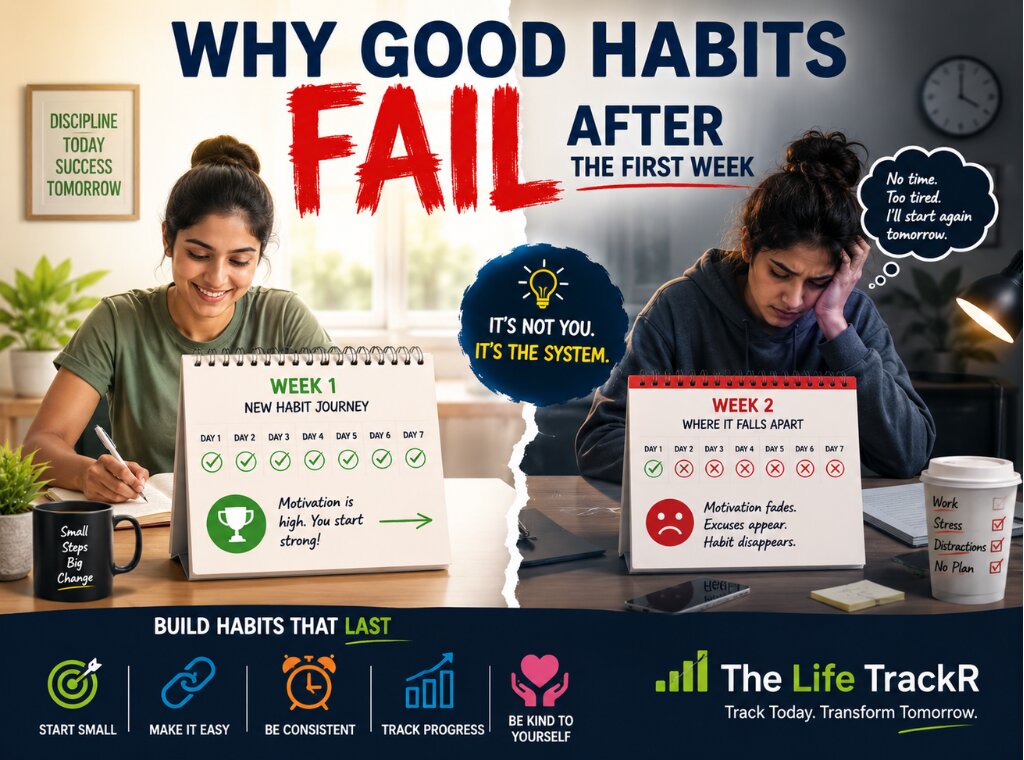
Have you ever wondered why Good Habits Fail First Week even when your motivation feels incredibly high? You buy a new notebook, download a habit tracker, promise yourself that this time will be different, and begin with full enthusiasm. For a few days, everything goes according to plan. However, something slowly changes. The excitement fades, interruptions appear, and suddenly the habit disappears from your routine.
If this sounds familiar, you are certainly not alone. In fact, the focus keyphrase Good Habits Fail First Week describes a challenge that affects people across every stage of life. Fortunately, the problem is rarely a lack of discipline. More often, the way habits are created makes them difficult to sustain.
The good news is that understanding why this happens can completely change your approach. The Life TrackR believes that lasting habits are built through smart systems rather than short bursts of motivation.
Why Most Good Habits Don't Last
1. The Excitement Fades Quickly
Starting a new habit feels exciting because your brain enjoys novelty. However, once the routine becomes familiar, the excitement naturally fades. Many people think the habit is failing, when in reality this is the stage where consistency matters more than motivation.
2. Big Goals Create Bigger Problems
Unrealistic goals, such as exercising for an hour daily or changing multiple habits overnight, often become overwhelming. Therefore, small, manageable habits are much easier to maintain and repeat consistently.
3. Motivation Isn’t Always Reliable
Motivation changes from day to day. Instead of depending on how you feel, build routines that continue even on busy or stressful days. Connecting a new habit to an existing routine makes it easier to remember and follow.
4. Don’t Let One Missed Day Stop You
Missing a workout or forgetting one healthy meal does not mean you’ve failed. The important rule is simple: never miss twice. Getting back on track quickly prevents one mistake from becoming a permanent habit.
5. Progress Takes Time
Real results rarely appear overnight. Whether you’re improving your health, finances, or productivity, small daily actions accumulate into meaningful long-term success. Patience is an essential part of habit building.
6. Focus on One Habit at a Time
Trying to improve every area of life at once often leads to burnout. Instead, master one habit before adding another. Likewise, create an environment that supports your goals by reducing distractions, keeping helpful reminders visible, and tracking your progress. Most importantly, celebrate consistency instead of perfection. Showing up every day—even for a few minutes—is what turns small actions into lifelong habits.
Practical Steps to Make Habits Last Beyond the First Week
If you want to avoid the common reasons why Good Habits Fail First Week, start with these simple strategies:
- Choose only one new habit at a time.
- Make the habit so easy that it feels impossible to skip.
- Connect it with an existing daily routine.
- Prepare your environment in advance.
- Track your progress every day.
- Accept occasional setbacks without quitting.
- Focus on consistency instead of perfection.
- Review your progress every week instead of every day.
These small adjustments significantly increase the chances of long-term success.
A Small Change in Thinking Makes a Big Difference
Many people believe successful individuals never struggle with habits.
Actually, they struggle just like everyone else.
The difference is that they expect setbacks instead of fearing them.
Rather than restarting every month, they simply continue where they left off.
That single mindset shift often separates temporary motivation from lasting transformation.
How The Life TrackR Can Support Your Journey
Building lasting habits becomes much easier when you can clearly see your progress instead of relying only on motivation. Tracking your daily actions helps you stay accountable, identify patterns, and recognize small improvements that might otherwise go unnoticed. Even on days when you feel less motivated, a visible record of your consistency can encourage you to keep moving forward. Over time, these small achievements build confidence and make positive habits a natural part of your routine.
The Life TrackR is designed to help you focus on steady progress rather than perfection. Whether you are working on improving your health, managing your finances, increasing productivity, or creating a better work-life balance, it helps you stay organized and committed to your goals. By celebrating every small milestone and monitoring your daily progress, The Life TrackR makes it easier to stay consistent, overcome setbacks, and transform simple daily actions into meaningful, lifelong habits.
Conclusion
The reason Good Habits Fail First Week is rarely because people lack determination or commitment. More often, habits fail because they are built on unrealistic expectations, temporary motivation, and routines that are difficult to maintain. When quick results do not appear, many people assume the habit is not working and stop before it has a chance to become part of their daily life. In reality, lasting habits are built through patience, consistency, and small daily improvements.
If you have struggled with Good Habits Fail First Week, remember that success comes from showing up consistently rather than doing everything perfectly. Focus on one habit at a time, make it easy to repeat, and celebrate every small win along the way. With the right mindset, practical systems, and regular progress tracking, The Life TrackR can help you transform short-term motivation into lifelong habits that improve your health, productivity, finances, and overall well-being.
Frequently Asked Questions
1. Why do good habits usually fail after the first week?
The initial excitement fades, while unrealistic goals and inconsistent routines make it difficult to continue.
2. Is motivation enough to build lasting habits?
No. Motivation helps you start, but consistent systems help you continue.
3. How many habits should I start at once?
It is usually better to focus on one habit before adding another.
4. What is the best way to remember a new habit?
Attach it to an existing daily routine, such as brushing your teeth or having breakfast.
5. Should I restart if I miss one day?
No. Simply continue the next day. Avoid missing the habit twice in a row.
6. Does habit tracking really work?
Yes. Tracking provides visible progress, improves accountability, and encourages consistency.
7. How long does it take to build a habit?
The time varies from person to person, depending on the habit and consistency.
8. How can The Life TrackR help with habit building?
The Life TrackR helps you monitor daily progress, stay consistent, and build sustainable routines through regular tracking.
#GoodHabits #HabitBuilding #DailyHabits #Consistency #Productivity #PersonalGrowth #SelfImprovement #HealthyRoutine #Mindset #TheLifeTrackR
Editor’s Note: This article was originally published here: https://thelifetrackr.com/why-good-habits-fail-after-the-first-week/ by @Kairav and @krutika