
Have you ever wondered why some habits stay with you for years while others disappear after just a few days? Most people believe they need more motivation, stronger willpower, or perfect discipline. Surprisingly, that is rarely the real problem.
The focus keyphrase Habit Stacking Everyday Examples offers a much simpler approach. Instead of forcing yourself to remember a new habit, you attach it to something you already do every day. As a result, your brain finds it easier to repeat the new behavior without feeling overwhelmed.
Rather than changing your entire lifestyle overnight, you make small improvements that naturally become part of your routine. Over time, these tiny actions create remarkable results. At The Life TrackR, we believe lasting success begins with simple systems instead of temporary motivation.
Why Starting New Habits Feels Difficult
Many people begin with excitement. They buy planners, set ambitious goals, and promise themselves that this time will be different.
Unfortunately, everyday life quickly gets in the way.
Work deadlines appear unexpectedly. Family responsibilities demand attention. Mobile notifications interrupt focus. Consequently, even the best intentions slowly fade away.
The issue is often not laziness. Instead, the new habit has no fixed place in the daily routine. Therefore, the brain treats it as optional.
Habit stacking solves this problem by giving every new habit an existing “home.”
What Is Habit Stacking?
Habit stacking is a simple habit-building technique where you perform a new habit immediately after an existing one.
The formula looks like this:
After I complete my current habit, I will perform my new habit.
Since the first habit already happens automatically, it becomes a reliable reminder for the second one.
As a result, remembering becomes easier, and consistency improves without relying on motivation alone.
Why Habit Stacking Works
Your brain enjoys routines.
When behaviors occur in the same sequence repeatedly, they gradually require less mental effort. Therefore, adding a small habit after an existing one feels much more natural than creating an entirely new routine.
Habit stacking also offers several benefits:
- Reduces decision fatigue.
- Makes habits easier to remember.
- Builds consistency through repetition.
- Requires very little extra time.
- Encourages gradual long-term improvement.
Most importantly, success comes from repeating small actions rather than making dramatic changes.
Habit Stacking Everyday Examples
1. Morning Routine
Instead of relying on memory or motivation, connect small habits to actions you already perform every morning. This approach makes healthy routines feel natural rather than forced.
Examples include:
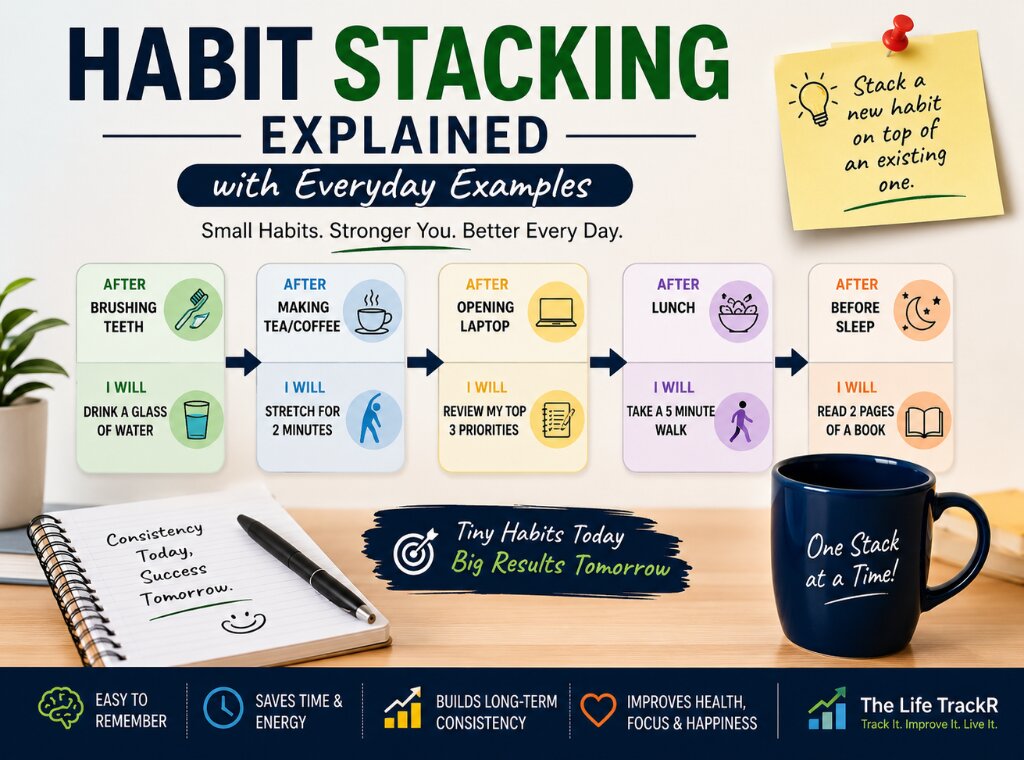
- After brushing your teeth, drink one glass of water.
- After drinking water, stretch for two minutes.
- After stretching, write one gratitude note.
- After writing, review your top three priorities.
Within just a few minutes, you build momentum and begin the day with positive actions before work even starts.
2. During Office Hours
Busy workdays often leave little room for self-care. However, habit stacking allows healthy behaviors to fit naturally into your existing schedule without disrupting productivity.
Try these combinations:
- After opening your laptop, review today’s task list.
- After sending an important email, take three deep breaths.
- After finishing every meeting, write one action item.
- After standing up for tea, walk for two minutes.
These simple routines help improve focus, reduce stress, and keep your workday organized.
3. Healthy Eating Habits
Making healthier food choices becomes much easier when they are linked to routines you already follow every day.
For example:
- After preparing breakfast, add one fruit.
- After lunch, take a five-minute walk.
- After filling your water bottle, drink several sips immediately.
- After dinner, avoid checking your phone for fifteen minutes.
Over time, these small actions support better nutrition and healthier daily habits.
4. Better Evening Routine
A consistent evening routine prepares both your body and mind for restful sleep while helping you unwind after a busy day.
Simple habit stacks include:
- After dinner, reduce your screen brightness.
- After brushing your teeth, read two pages of a book.
- After placing your phone on charge, avoid social media.
- After turning off the lights, practice one minute of slow breathing.
When repeated consistently, these tiny habit stacks become automatic and create lasting improvements in your overall well-being.
How to Create Your Own Habit Stack
Creating a successful habit stack is surprisingly simple.
Step 1: Identify Existing Habits
Choose activities you never forget.
Examples include:
- Brushing your teeth
- Drinking morning tea
- Locking the front door
- Starting your computer
- Eating lunch
- Charging your phone
These become reliable anchors.
Step 2: Add One Small Habit
Avoid choosing something difficult.
Instead, start with actions that require less than two minutes.
Examples:
- Drink water.
- Stretch.
- Read one page.
- Write one sentence.
- Organize your desk.
Small wins build confidence.
Step 3: Repeat Daily
Consistency matters far more than intensity.
Missing one day is normal. However, returning the next day keeps the routine alive.
Common Mistakes to Avoid
Many people unintentionally make habit stacking harder than necessary.
Avoid these mistakes:
1. Stacking Too Many Habits
Adding six or seven new behaviors at once quickly becomes overwhelming.
Start with only one.
2. Choosing Unstable Anchor Habits
Your anchor should happen every day.
For example, brushing your teeth works better than going to the gym because it happens consistently.
3. Expecting Instant Results
Habits grow gradually.
Although progress may feel slow initially, repeated actions eventually become automatic.
4. Making the Habit Too Big
A five-minute habit is easier to maintain than a one-hour commitment.
Small success creates long-term momentum.
Why Small Habits Create Big Results
Many people underestimate the power of tiny improvements.
Reading one page every day eventually becomes several books each year.
Saving a small amount regularly gradually builds financial security.
Walking for ten minutes daily often develops into an active lifestyle.
The results may not appear immediately. Nevertheless, consistent repetition compounds over time.
That is why successful people often focus on systems instead of motivation.
How The Life TrackR Can Support Your Habit Journey
Building habits becomes much easier when you can see your progress.
The Life TrackR helps you organize routines, monitor consistency, and stay committed to your goals without making the process complicated.
Instead of chasing perfection, you focus on making steady improvements every day. Those small victories gradually become meaningful life changes.
Conclusion
The focus keyphrase Habit Stacking Everyday Examples shows that creating better habits doesn’t require extraordinary effort. By attaching one small action to an existing routine, you reduce mental effort while increasing consistency.
Remember, lasting success rarely comes from massive changes. Instead, it grows from small actions repeated every day. The Life TrackR encourages you to begin with one simple habit stack today, because tomorrow’s achievements are built on today’s small, consistent actions.
#HabitStacking #DailyHabits #Productivity #SelfImprovement #HealthyHabits #TheLifeTrackR #WorkLifeBalance #PersonalGrowth #RoutineBuilding #SuccessHabits
Editor’s Note: This article was originally published here: https://thelifetrackr.com/habit-stacking-explained-with-everyday-examples/ by @Kairav and @krutika