
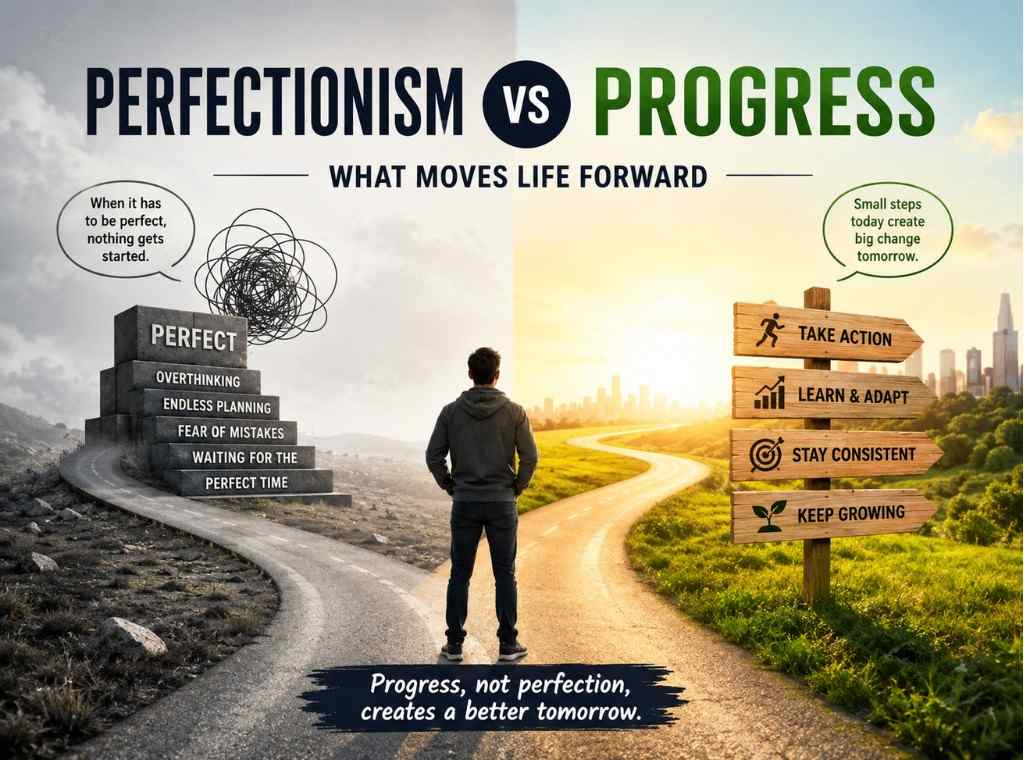
Did you know that sometimes the person trying hardest to get everything right can end up moving the slowest?
Imagine reaching home after a long commute with an idea you have wanted to start for months. Perhaps you want to exercise regularly, learn a new skill, organise your finances, improve your sleep, or finally begin a personal project.
You open your phone to research the “best” approach. Soon, you have watched several videos, compared multiple methods and created the perfect plan.
Yet you still haven’t started.
Meanwhile, someone else begins with an imperfect 15-minute effort. Their plan isn’t impressive. Their routine isn’t perfectly organised. However, they repeat it.
A few weeks later, something interesting happens.
The person who waited for perfection is still preparing, while the person who accepted imperfect action has already improved.
That is where the Perfectionism vs Progress Mindset becomes important. Progress does not require you to lower your standards. Instead, it asks you to stop making perfection the entry requirement for action.
Why Perfectionism Can Feel Like a Good Thing
Perfectionism can easily disguise itself as ambition.
You may think:
- “I just want to do it properly.”
- “I’ll start when I have enough time.”
- “I need a better plan first.”
- “I don’t want to make mistakes.”
- “Once everything is organised, I’ll begin.”
These thoughts sound responsible. However, when preparation repeatedly replaces action, perfectionism becomes a barrier.
For someone balancing a job, commute, household responsibilities, finances and family commitments, waiting for ideal conditions can make important personal goals almost impossible to begin.
There will always be a busy period, an unexpected expense, a tiring evening or another responsibility demanding attention.
Therefore, instead of asking, “How can I do this perfectly?”, ask:
“What useful action can I realistically take today?”
That small change can completely alter your relationship with progress.
Perfectionism and High Standards Are Not the Same
Wanting quality is not a problem.
High standards can encourage you to prepare carefully, learn from mistakes and produce better work. Perfectionism becomes harmful to progress when mistakes feel unacceptable or when anything less than the ideal result feels like failure.
For example, wanting to exercise four times a week is a reasonable goal.
However, thinking, “I missed one workout, so this week is ruined,” turns a small interruption into a much bigger setback.
Similarly, creating a monthly budget is useful. Spending slightly more than planned does not mean budgeting has failed.
High standards guide improvement. Perfectionism can make improvement feel insufficient.
That distinction matters.
The Hidden Cost of Waiting for Perfect Conditions
Perfectionism does not always appear in obvious ways. Often, it hides within ordinary everyday decisions. You might keep editing an email that is already good enough, spend weeks researching an online course without enrolling, or create a detailed fitness schedule but delay starting because your routine is not yet perfect.
Similarly, you might wait for a higher salary before starting to save or avoid sharing an idea because someone could criticise it. Individually, these choices may seem harmless. However, when repeated over months or years, they can create a significant opportunity cost because you lose the learning that only action can provide. Planning can help you understand what might happen, but taking action shows you what actually happens—and that experience is what helps you improve.
Progress Creates Information
Here is a useful way to think differently about mistakes: an imperfect attempt gives you valuable data. Suppose you decide to wake up earlier but struggle after several days. Instead of telling yourself, “I have no discipline,” look at what actually happened. Perhaps you were sleeping too late, your target was unrealistic, you needed better preparation the night before, or your current schedule simply required a different routine.
In this way, an unsuccessful attempt can teach you something useful. Therefore, failure does not always take you backwards; sometimes, it reveals the adjustment you need to make next. This is why progress can be more powerful than endless preparation. Every attempt gives you an opportunity to learn, adjust and continue moving forward.
Why Small Progress Works Better in Real Life
Most people do not have unlimited time or energy.
After working hours, commuting and handling everyday responsibilities, a complicated self-improvement routine can quickly become difficult to maintain.
Therefore, sustainable progress should fit into your existing life.
Consider these examples:
- Fitness: A 15-minute walk is better than postponing exercise until you can manage an hour-long workout.
- Money: Saving ₹500 consistently can be more useful than waiting until you can invest a large amount.
- Learning: Reading five pages regularly can eventually finish several books.
- Sleep: Going to bed 20 minutes earlier is still improvement.
- Digital habits: Reducing unnecessary screen time gradually may be easier than attempting an extreme digital detox.
- Organisation: Cleaning one drawer is progress even when the entire home isn’t organised.
Small actions may appear insignificant in isolation. However, repeated actions accumulate.
Stop Using All-or-Nothing Thinking
When perfectionism takes control, it tends to see every outcome in only two ways: perfect or failed. However, real life offers far more possibilities. Even when you are behind schedule, you can still move forward. After missing a routine, you can begin again. Similarly, a financial mistake can become an opportunity to improve next month’s spending, while one unproductive evening does not define you as an unproductive person.
As circumstances change, your goals can change too. Therefore, instead of measuring your life against an impossible standard of perfection, compare your current behaviour with where you started. Ask yourself, “Am I moving in a better direction?” If the answer is yes, then your progress matters. What moves life forward is not doing everything perfectly, but continuing to improve one step at a time.
A Practical Progress-First System
Understanding perfectionism is useful, but real change happens when you turn that understanding into simple actions. Instead of trying to transform everything at once, use practical strategies that make progress easier to maintain.
1. Define the Minimum Action
Create a smaller version of every important goal for busy or low-energy days. Instead of exercising for an hour, aim for 10 minutes of movement. Rather than reading a chapter, read two pages. Small actions help protect consistency.
2. Set a Starting Time
A deadline tells you when something should be completed, whereas a starting time encourages action. Instead of planning to finish a course this month, decide when you will begin your next learning session.
3. Use the 80% Rule
Not everything needs to be perfect. If a task is accurate, useful and complete, additional polishing may not add meaningful value. Ask, “Will more effort genuinely improve the result?”
4. Track What You Complete
Instead of focusing on unfinished tasks, record what you accomplished. Small wins provide visible evidence that you are moving forward. The Life TrackR encourages focusing on patterns and consistency rather than one imperfect day.
5. Create a Restart Rule
Missing a routine once does not mean you have failed. Make restarting your next priority rather than trying to compensate with extreme effort. Simply return to the routine and continue.
6. Review Instead of Judge
Replace “Why am I so bad at this?” with “What made this difficult, and what can I change?” This turns setbacks into useful information and helps you make better adjustments.
What Progress Actually Looks Like
Progress rarely looks like a perfectly rising line.
It may look like:
Start → Improve → Struggle → Adjust → Restart → Improve Again
That pattern is normal.
There may be periods when work becomes demanding. Family responsibilities may increase. Your motivation may fall. Unexpected expenses may disrupt financial plans.
Progress means learning how to continue despite those fluctuations.
Sometimes moving forward means doing more.
At other times, it simply means not giving up completely.
When Perfection Really Does Matter
“Progress over perfection” should not mean becoming careless.
Some situations require extremely high accuracy, especially where safety, health, finances, legal responsibilities or major workplace decisions are involved.
The goal is not to eliminate careful thinking.
Instead, recognise where precision is genuinely necessary and where perfectionism is simply delaying action.
A presentation may need proofreading.
It probably doesn’t need 17 rounds of tiny formatting changes.
A financial decision deserves research.
It does not necessarily require months of hesitation before you begin saving anything.
Apply precision where consequences demand it. Apply progress where repetition creates improvement.
Make Progress Visible with The Life TrackR
One reason perfectionism becomes frustrating is that gradual improvement can be difficult to notice.
Tracking changes that.
When you record habits, routines or goals, you begin seeing evidence that individual days cannot show you.
One missed day becomes a small gap rather than proof of failure.
Ten completed days become visible progress.
A month of small improvements becomes a pattern.
Therefore, tracking should not become another standard you need to perform perfectly. Use The Life TrackR as a simple reflection tool rather than another scoreboard for judging yourself.
The objective is awareness, not perfection.
Conclusion: Choose Movement Over Perfect Timing
The biggest lesson from the Perfectionism vs Progress Mindset is simple: your life rarely changes because you finally discover the perfect plan.
It changes because you begin.
Then you learn.
You adjust.
And you continue.
You don’t need the perfect fitness routine to take a walk. You don’t need a huge salary to start building better money habits. You don’t need unlimited free time to learn something useful.
So, when perfectionism tells you to wait until everything is right, choose one realistic action instead.
The Life TrackR can help you notice those small actions, recognise your consistency and keep moving in a better direction.
Because progress does not ask you to be perfect.
It simply asks you to keep moving.
#PerfectionismVsProgress #PersonalGrowth #SelfImprovement #Productivity #Consistency #GoalSetting #HealthyHabits #TheLifeTrack
Editor’s Note: This article was originally published here: https://thelifetrackr.com/perfectionism-vs-progress-what-moves-life-forward/ by @Kairav and @krutika