
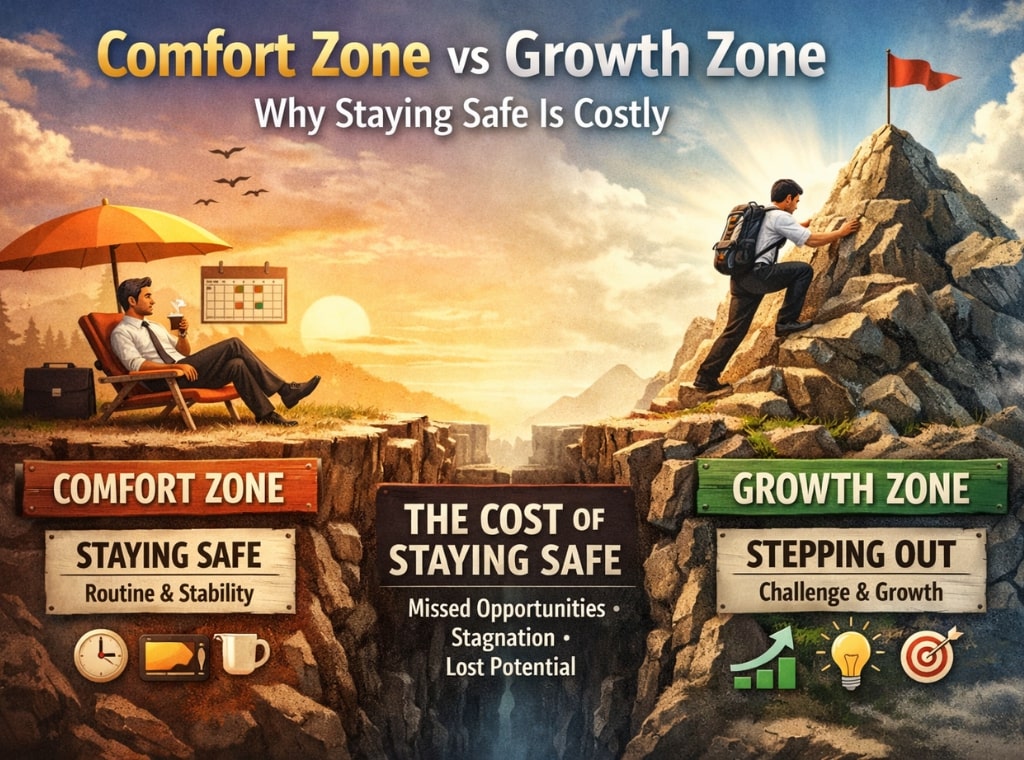
Did you know that most people overlook this one thing—the comfort zone growth cost is invisible until years have already passed? At first, staying safe feels sensible. Life feels predictable. However, beneath that calm surface, something slowly begins to shrink. Over time, ambition softens, confidence plateaus, and energy quietly fades. This is where the real story begins.
For many middle-class Indians who are doing a job, routine becomes survival. Bills get paid, responsibilities are managed, and days repeat with discipline. Yet, somewhere between stability and silence, growth stops knocking. At The Life TrackR, this pattern appears often—not as failure, but as postponed potential.
A Familiar Day That Feels Secure but Heavy
Back when I started observing daily patterns closely, I didn’t expect this to happen, but it did. Every morning looked productive on paper. Tasks were completed, meetings were attended, and deadlines were met. Still, something felt unfinished by evening.
Although nothing was technically wrong, motivation felt thinner each week. Comfort had replaced curiosity. Safety had replaced challenge. Slowly, the days became lighter in risk but heavier in meaning.
If this sounds familiar, you’re not the only one. Many people confuse stability with progress. Unfortunately, comfort rarely announces when it becomes costly.
Why the Comfort Zone Feels So Convincing
The comfort zone doesn’t trap people through fear alone. Instead, it reassures them. Familiar routines reduce mental effort. Known environments protect confidence. Predictable outcomes avoid embarrassment.
However, while comfort preserves energy in the short term, it quietly limits growth in the long term. Skills stop stretching. Decision-making weakens. Eventually, even simple changes feel overwhelming.
At The Life TrackR, this insight shifts everything—comfort isn’t the enemy, but staying there permanently is.
The Hidden Cost of Staying Safe
Chances are, you’ve been approaching safety the wrong way. While staying safe feels responsible, the hidden cost appears later.
Growth demands discomfort before it delivers clarity. When discomfort is avoided, learning slows down. As a result, adaptability weakens. Over time, confidence becomes dependent on familiar outcomes rather than personal capability.
This is why the comfort zone growth cost isn’t immediate. Instead, it accumulates silently through missed chances, delayed decisions, and untaken risks.
What the Growth Zone Actually Looks Like
Contrary to popular belief, the growth zone isn’t chaotic. It’s structured discomfort. It involves intentional effort, small risks, and repeated exposure to unfamiliar situations.
Growth doesn’t require dramatic leaps. Instead, it begins with slight expansions—new responsibilities, honest feedback, or learning a skill that feels uncomfortable at first.
Once you learn this, you never see stagnation the same way again.
Why Growth Feels Uncomfortable at First
The brain prefers certainty. Therefore, growth feels unsafe initially. Mistakes feel personal. Progress feels slow. However, discomfort is not danger—it’s adjustment.
Each time discomfort is faced instead of avoided, resilience strengthens. Confidence becomes internal rather than situational. Over time, challenges stop feeling threatening and start feeling manageable.
This one shift changes everything.
How Staying in the Comfort Zone Affects Long-Term Confidence
Ironically, avoiding challenges reduces confidence. While comfort protects self-image temporarily, it prevents proof of capability.
Confidence grows from evidence, not reassurance. Without new experiences, the mind lacks proof. As a result, self-doubt quietly increases, even when performance remains acceptable.
At The Life TrackR, this pattern reveals a powerful truth—confidence isn’t built by staying safe, but by surviving discomfort repeatedly.
A Practical Way to Step Into Growth Without Burnout
The easiest way to shift zones isn’t dramatic change. It’s controlled expansion.
Start by choosing one area where discomfort feels manageable. Then, introduce a small challenge consistently. Over time, what once felt uncomfortable becomes normal.
Growth doesn’t demand chaos. It requires intention.
How The Life TrackR Helps Redefine Growth
At The Life TrackR, growth is tracked through actions, not outcomes. Instead of chasing motivation, the focus remains on consistency.
When actions are tracked daily, growth becomes visible. This visibility reduces fear. Gradually, discomfort feels purposeful instead of threatening.
This is how sustainable progress is built—quietly, steadily, and intentionally.
A Thought Worth Carrying Forward
Staying safe feels smart today. However, growth ensures relevance tomorrow. The comfort zone growth cost isn’t measured in failure, but in unused potential.
At The Life TrackR, growth begins when comfort stops being the goal and becomes the foundation.
Conclusion
Looking back, one of the biggest regrets people share isn’t failure—it’s staying comfortable for too long. The comfort zone growth cost quietly limits confidence, learning, and long-term satisfaction. However, growth doesn’t demand fear. It asks for intention. When comfort supports stability and growth introduces challenge, progress becomes inevitable. With the right tracking and mindset, expansion feels possible—one step at a time.
#ComfortZone #GrowthMindset #PersonalGrowth #CareerClarity #LifeTracking #TheLifeTrackR #SelfDevelopment #DailyGrowth
Editor’s Note: This article was originally published here https://thelifetrackr.com/comfort-zone-vs-growth-zone-why-staying-safe-is-costly/ by @Kairav and @krutika