
Introduction: The Tiredness That Refuses to Leave
Did you know that most people overlook this one thing—not all tiredness comes from the body?
You sleep on time.
You wake up after a full night’s rest.
Yet somehow, the heaviness remains.
Instead of feeling refreshed, your mind feels slow.
Tasks that once felt simple now feel overwhelming.
Motivation quietly disappears.
If mental fatigue vs physical tiredness has ever confused you, you’re not alone. In fact, many Indians who are doing a job assume sleep is the solution, while the real problem stays untouched. At The Life TrackR, this pattern appears repeatedly—not as laziness, but as misunderstood exhaustion.
What happens next might surprise you.
When Rest Works… and When It Doesn’t
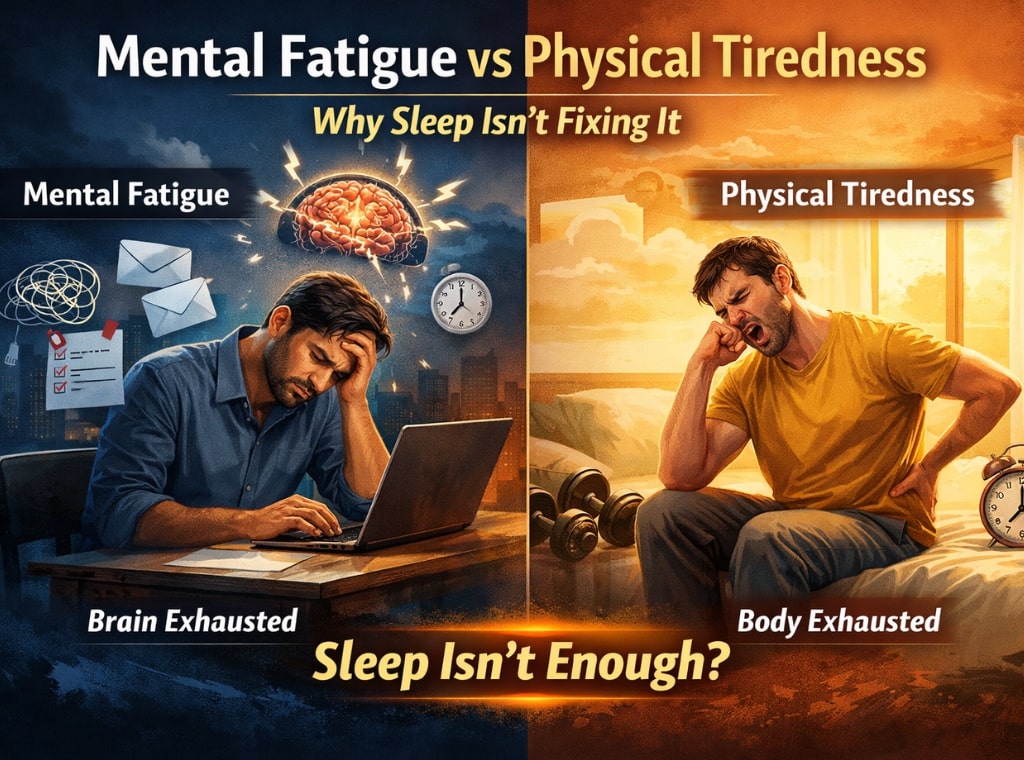
Physical tiredness is easy to recognise.
Your body aches.
Your muscles feel weak.
Movement feels heavier than usual.
In these moments, sleep works like magic.
A good night’s rest repairs muscles, restores energy, and resets the body.
However, mental fatigue plays by different rules.
Even after sleeping well, your thoughts feel cluttered.
Decision-making becomes draining.
Small conversations feel mentally expensive.
Although the body is rested, the mind is still running.
This is where most people get stuck—trying to fix a mental overload with physical rest alone.
A Real-Life Situation We Rarely Talk About
Let’s be real about something most people don’t say out loud.
After office hours, the day doesn’t really end.
Emails linger in the mind.
Unfinished tasks replay silently.
Tomorrow’s responsibilities start early—in your head.
Looking back, one of the biggest regrets many people share at The Life TrackR is believing that sleep alone could undo an overloaded day.
Despite resting properly, they felt:
- Emotionally drained
- Easily irritated
- Mentally disconnected
Eventually, even weekends stopped feeling refreshing.
That’s when the realisation hit—the body was tired sometimes, but the mind was exhausted almost always.
Understanding the Difference That Changes Everything
Physical Tiredness: The Body’s Signal
Physical tiredness comes from:
- Long working hours
- Physical travel and commuting
- Lack of proper sleep
The solution is straightforward:
- Sleep
- Nutrition
- Basic physical recovery
Once addressed, energy usually returns quickly.
Mental Fatigue: The Invisible Drain
Mental fatigue builds silently through:
- Continuous screen exposure
- Constant problem-solving
- Emotional pressure
- Lack of mental closure
Unlike physical tiredness, mental fatigue doesn’t switch off automatically.
Even while sleeping, the brain stays alert.
Thoughts keep looping.
Stress hormones remain active.
That’s why sleep alone doesn’t feel enough.
Why Sleep Isn’t Fixing Mental Fatigue
Here’s something hardly anyone realises, but it makes all the difference.
Sleep restores the body.
Mental fatigue needs mental recovery.
Without addressing:
- Emotional overload
- Information excess
- Unfinished mental loops
Sleep becomes incomplete recovery.
As a result:
- You wake up tired
- Focus remains low
- Productivity drops
Chances are, you’ve been approaching tiredness all wrong.
The Silent Signs You’re Mentally Fatigued
Mental fatigue doesn’t announce itself loudly.
Instead, it whispers through everyday struggles.
You may notice:
- Forgetting small things
- Feeling detached during conversations
- Losing interest in things you once enjoyed
- Feeling tired even on lighter days
If this sounds familiar, you’re not the only one.
At The Life TrackR, these signals are often the first signs people ignore—until burnout follows.
What Actually Helps When the Mind Is Tired
1. Create Mental Endings to Your Day
One quick fix for anyone facing mental fatigue is closure.
Before the day ends:
- Write down unfinished tasks
- Acknowledge what went well
- Decide what can wait
This signals the brain that it’s safe to rest.
2. Reduce Information Intake, Not Just Work
Mental fatigue grows faster with constant input.
Instead of scrolling endlessly:
- Sit quietly for a few minutes
- Listen to calm music
- Step away from screens
Silence helps the brain reset.
3. Shift from Reaction to Reflection
Once you learn this, you never see tiredness the same way again.
Ask yourself:
- What drained me today mentally?
- What can I simplify tomorrow?
Reflection reduces mental clutter over time.
Why Ignoring Mental Fatigue Makes Everything Harder
Avoid this if you actually want to see results.
Ignoring mental fatigue leads to:
- Emotional burnout
- Reduced confidence
- Constant irritation
- Loss of clarity
Over time, even sleep quality drops.
Mark my words—addressing mental fatigue early is smarter than pushing through it.
A Healthier Way to Think About Rest
Rest isn’t only about lying down.
Recovery isn’t only about sleep.
Sometimes, rest means:
- Saying no
- Slowing mental pace
- Creating boundaries
This one shift changes everything.
At The Life TrackR, progress begins when people stop fighting tiredness and start understanding it.
Conclusion: Listening to the Right Kind of Tiredness
Understanding mental fatigue vs physical tiredness changes how you recover, work, and live.
Sleep fixes physical tiredness.
Mental fatigue needs awareness, boundaries, and intentional recovery.
Once you stop treating all tiredness the same way, energy returns naturally.
At The Life TrackR, this understanding becomes the foundation for sustainable balance—not forced hustle.
#MentalFatigue #PhysicalTiredness #WorkLifeBalance #IndianWorkLife #TheLifeTrackR #DailyEnergy #MindHealth
Editor’s Note: This article was originally published here https://thelifetrackr.com/mental-fatigue-vs-physical-tiredness-why-sleep-isnt-fixing-it/by @Kairav and @krutika