
Did you know that most people overlook this one thing—planning more does not always mean feeling more stable?
At the beginning of every month, many of us sit with notebooks, apps, and reminders open.
Tasks are written carefully.
Timelines are fixed confidently.
However, a few unexpected meetings, family needs, or health issues later, the entire plan feels broken.
If this sounds familiar, you’re not the only one.
For many middle-class Indians who are doing a job, planning often becomes a source of pressure instead of peace. At The Life TrackR, this pattern appears again and again—not because people lack discipline, but because they misunderstand where stability actually comes from.
And here’s the surprising truth.
Planning vs flexibility stability is not about choosing one side. Instead, it’s about learning how both work together.
When Planning Feels Like Control but Creates Stress
Let’s be real about planning for a moment.
Planning gives us a sense of certainty.
It feels responsible.
It feels mature.
Yet, over time, excessive planning starts doing something strange.
It makes us rigid.
The Foundation That Planning Provides
Planning plays an important role, and it deserves respect.
First, it helps establish direction.
When you plan, you decide what truly matters, where your time should go, and what deserves priority. This baseline prevents daily chaos and mental overload.
Secondly, planning reduces avoidable risk.
By thinking ahead, you prepare for known challenges—deadlines, expenses, workloads, or personal commitments. This foresight creates a safety net.
Additionally, planning improves efficiency.
Clear steps reduce confusion, wasted effort, and repeated decisions. For someone balancing work, family, and personal growth, this structure is necessary.
At The Life TrackR, structured planning is often the starting point for building clarity.
However, structure alone is not enough.
When Over-Planning Quietly Becomes a Problem
What happens when life doesn’t follow the plan?
Meetings extend unexpectedly.
Commute time increases.
Energy levels drop without warning.
Suddenly, the plan feels like a failure.
Over-planning creates a fragile system.
The moment one assumption breaks, everything feels off-track.
Instead of adjusting calmly, many people react with guilt or frustration.
This is where stability starts slipping.
Why Flexibility Is Not Laziness
There’s a common belief that flexibility means being careless.
That belief is incorrect.
Flexibility is not about avoiding responsibility.
It’s about responding intelligently.
How Flexibility Supports Stability
Flexibility allows room for reality.
When new information appears, flexible systems adapt instead of resisting.
When opportunities emerge, flexibility helps you act instead of ignoring them.
Moreover, flexibility builds resilience.
Rigid plans often collapse when conditions change. Flexible approaches bend, absorb impact, and continue forward.
Most importantly, flexibility encourages learning.
Every adjustment becomes feedback.
Every deviation becomes insight.
At The Life TrackR, this adaptive mindset often marks the difference between burnout and sustainable progress.
The Real Secret: Stability Lives in the Middle
True stability does not come from perfect plans.
It comes from systems that can survive change.
This is where planning vs flexibility stability becomes powerful.
A Framework That Is Firm Yet Open
The most stable approach is clear about direction but open about methods.
Goals remain steady.
Values stay non-negotiable.
However, the path remains adjustable.
This “loose but tight” structure ensures consistency without rigidity.
Why Anti-Fragile Systems Work Better
Some systems don’t just survive change—they improve because of it.
These are anti-fragile systems.
Instead of breaking under stress, they grow stronger through adjustment.
They expect uncertainty rather than fearing it.
At The Life TrackR, tracking habits, effort, and reflection—rather than rigid outcomes—creates this exact balance.
Planning as a Living Process, Not a Fixed Promise
Planning should evolve.
Rather than creating one perfect plan, stability grows through repetition:
- Plan
- Act
- Observe
- Adjust
This cycle reduces emotional pressure.
It also keeps momentum alive.
Weekly reviews work better than daily judgment.
Monthly reflection feels safer than constant correction.
Why Empowered Flexibility Matters at Work and Home
Stability strengthens when people trust themselves.
When you know your priorities clearly, you can make small adjustments without feeling lost.
Instead of asking, “Did I follow the plan?”
You begin asking, “Did I protect what matters today?”
This shift alone changes how stress feels.
A Simple Example That Changes Perspective
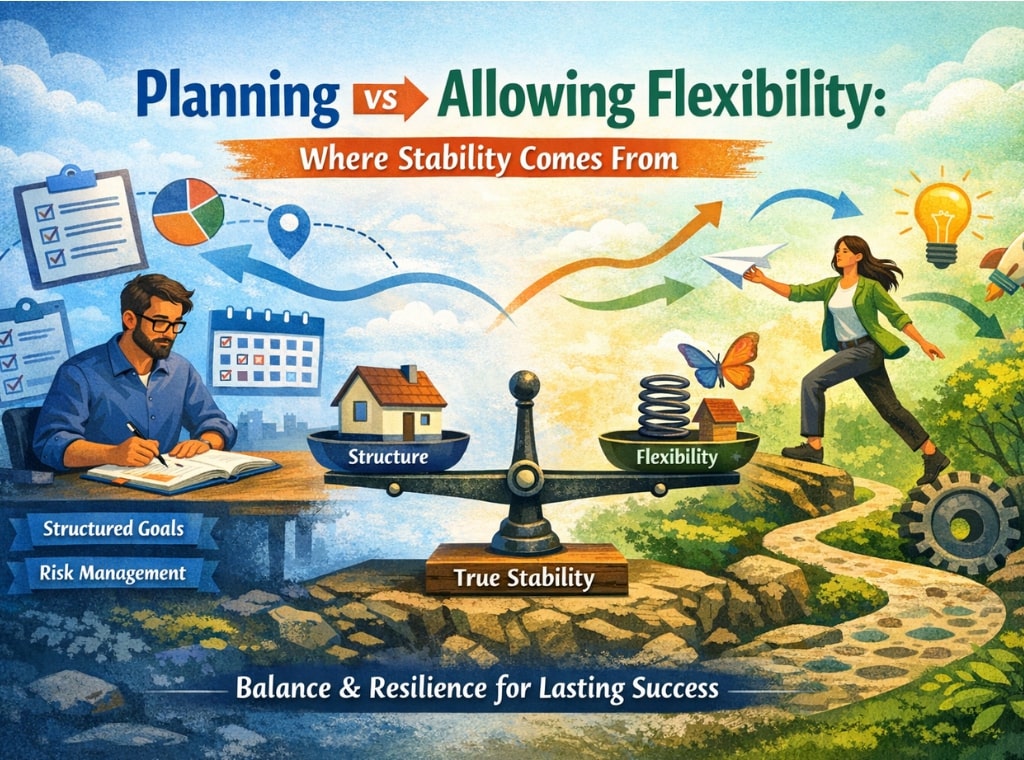
Planning everything gives you the walls of a house.
Flexibility gives you shock absorbers during an earthquake.
Both are necessary.
One without the other creates risk.
That’s the essence of planning vs flexibility stability.
Practical Ways to Balance Planning and Flexibility
1. Plan Outcomes Loosely, Actions Clearly
Define what success looks like.
Keep daily actions flexible based on energy and reality.
2. Build Buffer Time
Leave space between tasks.
This reduces panic when delays happen.
3. Review, Don’t React
Evaluate weekly.
Adjust calmly instead of emotionally.
4. Track Effort, Not Just Results
At The Life TrackR, tracking effort creates consistency even on imperfect days.
Final Thoughts
If you’ve been struggling to feel stable despite careful planning, you’re not failing.
You’re just missing flexibility.
Planning vs flexibility stability is not a conflict—it’s a partnership.
When structure gives direction and flexibility gives resilience, stability becomes natural.
At The Life TrackR, this balance isn’t about perfection.
It’s about progress that survives real life.
And once you experience that, planning stops feeling heavy—and starts feeling supportive.
#PlanningVsFlexibility #StabilityInLife #WorkLifeClarity #BalancedLiving #DailySystems #PersonalGrowthJourney #LifePlanning #AdaptiveMindset #SustainableGrowth #SelfImprovement #WorkLifeBalance #LifeTracking #GrowthMindset #TheLifeTrackR
Editor’s Note: This article was originally published here https://thelifetrackr.com/planning-everything-vs-allowing-flexibility-where-stability-comes-from/ by @Kairav and @krutika