
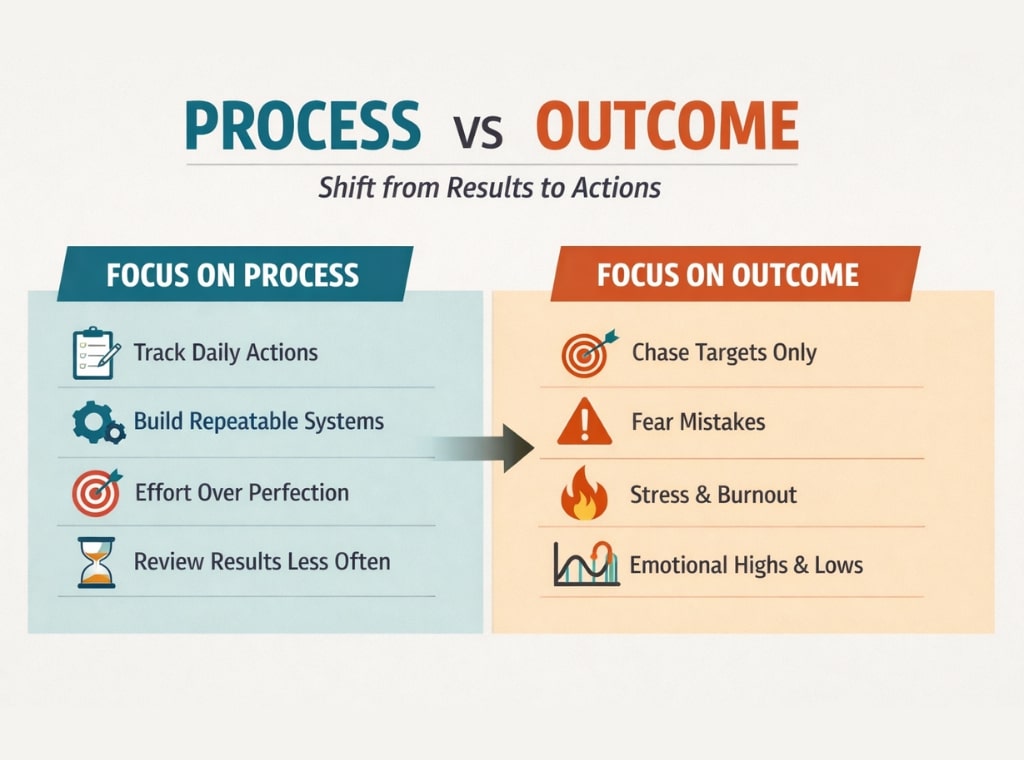
Did you know that most people overlook this one thing—process over outcome growth is often the missing link behind stalled progress?
With every month, a new target appears.
Along with it comes a number to chase.
Soon after, results feel necessary to prove.
However, somewhere between planning and execution, pressure quietly builds. Days become rushed, mistakes feel heavier, and learning slows down. If this sounds familiar, you’re not the only one.
For many middle-class Indians who are doing a job, growth often feels tied to outcomes—appraisals, KPIs, promotions, or monthly targets. At The Life TrackR, this pattern appears repeatedly. Not because people lack effort, but because attention is placed on the finish line instead of the road leading there.
And surprisingly, that’s where growth begins to slow.
A Real Day That Looks Successful but Feels Empty
Looking back, one of my biggest regrets was assuming results meant progress.
There was a phase when every week was measured by outcomes alone.
Deadlines met.
Targets achieved.
Praise received.
Yet, something felt off.
Skills weren’t improving steadily. Confidence fluctuated with every result. Worse still, one bad week felt like failure, even when effort stayed consistent.
This is where most people get stuck. Outcomes create short-term validation, but they rarely build long-term capability. As a result, growth becomes fragile instead of stable.
Why Outcomes Feel So Powerful at First
Let’s be real about outcomes.
Clear actions make progress visible.
Defined metrics make results measurable.
Consistent effort naturally leads to rewards.
Because of this, the mind naturally chases results. However, what’s rarely discussed is the hidden cost of outcome obsession.
When results become the primary focus:
- Learning takes a back seat
- Fear of mistakes increases
- Risk-taking disappears
- Growth becomes conditional
Instead of asking, “What did I practise today?”, the mind keeps asking, “Did I win or lose?”
Over time, this thinking quietly slows progress.
The Silent Strength of Process Thinking
Process thinking works differently.
It shifts attention from what you get to what you repeat.
At The Life TrackR, this shift changes everything. Growth stops feeling like pressure and starts feeling like momentum. Rather than chasing motivation, consistency begins to carry the weight.
Here’s what focusing on the process actually does:
- Builds skills regardless of immediate results
- Reduces emotional ups and downs
- Creates confidence rooted in action
- Makes progress predictable
While outcomes fluctuate, processes compound.
Why Growth Accelerates When Results Stop Being the Goal
This one shift will change everything for you.
When the process becomes the priority, results improve as a by-product. However, when results become the priority, the process often suffers.
Think about it.
A person focused on outcomes avoids difficult practice because it risks failure. On the other hand, a person focused on process welcomes difficulty because it strengthens skill.
Over time:
- One improves slowly but steadily
- The other burns out quickly
That’s why process-over-outcome growth isn’t motivational advice. Instead, it’s a practical strategy.
The Easiest Way to Shift from Outcome to Process
Tired of dealing with pressure that never seems to end? Here’s what actually works.
1. Measure Actions, Not Achievements
Instead of judging progress only by outcomes, shift attention to what you repeatedly do. Tracking time spent practising, tasks completed consistently, and daily effort helps reduce emotional pressure while making growth more predictable.
2. Define a “Good Day” by Effort
A good day is not when everything goes perfectly, but when the process is followed honestly. This small shift gradually trains the mind to stay steady during setbacks rather than reacting emotionally to results.
3. Create Repeatable Systems
Results demand fresh energy every time, whereas systems work quietly in the background. At The Life TrackR, focusing on repeatable structures instead of short-term wins helps growth stay stable and sustainable.
4. Delay Outcome Evaluation
Checking results too often increases anxiety and self-doubt. Reviewing outcomes weekly or monthly, while focusing daily attention only on actions, creates clarity and allows improvement to happen naturally.
Why Process Thinking Feels Uncomfortable at First
Let’s be honest, process thinking doesn’t feel rewarding initially.
Instant applause is usually absent.
Quick validation rarely shows up.
Early progress often feels invisible.
However, this discomfort is temporary. Once momentum builds, confidence stops depending on external results. Growth feels calmer, steadier, and more controlled.
Hardly anyone realizes this, but long-term success rarely comes from intensity. Instead, it comes from consistency.
Once You Learn This, You Never See Growth the Same Way Again
Chances are, you’ve been approaching progress all wrong—not because you lacked effort, but because attention was misplaced.
Outcomes show where you are.
Processes decide where you’re going.
When effort is repeated daily, results eventually align. Yet, when results are chased directly, effort becomes inconsistent.
That’s the difference.
Conclusion: Growth Is Built Quietly, Not Dramatically
If there’s one thing to remember, it’s this—process over outcome growth is not about lowering ambition. It’s about building a foundation strong enough to support it.
Results come and go.
Processes stay.
At The Life TrackR, growth is treated as something you build daily, not something you chase occasionally. When attention shifts to what you repeat, progress stops feeling stressful and starts feeling natural.
And once that happens, growth no longer slows—it compounds.
#ProcessOverOutcomeGrowth #TheLifeTrackR #PersonalGrowth #WorkLifeClarity #DailySystems #HabitBuilding #CareerGrowthIndia #MentalClarity
Editor’s Note: This article was originally published here https://thelifetrackr.com/process-vs-outcome-why-focusing-on-results-slows-growth/ by @Kairav and @krutika