Introduction: Are You Living Your Life or Simply Getting Through It?
Ever wondered why some months feel incredibly productive while others seem to disappear without much progress?
You wake up, get ready, travel to work, answer messages, attend meetings, handle household responsibilities, scroll through your phone, finish dinner and eventually go to sleep. Then, suddenly, another month has passed.
The problem is not always a lack of effort. Sometimes, we simply do not know where our time, money, energy and attention are going.
That is where the Best Life Tracking Apps 2026 can become useful. Instead of relying entirely on memory, these tools can help you record habits, mood, sleep, spending, tasks, goals and other parts of everyday life.
However, there is a catch.
Tracking everything does not automatically improve anything. The real value appears when the information helps you make better decisions.
So, which apps are actually worth exploring in 2026?
Why Life Tracking Is Becoming More Useful in 2026
Most people already generate plenty of personal data. Smartphones count steps, banking apps record transactions, calendars store appointments, and task managers capture unfinished work.
Nevertheless, all this information is often scattered.
A fitness app might know you walked 8,000 steps. Meanwhile, a mood tracker knows you felt energetic. Your calendar knows you finished work earlier, while your task manager knows you completed more tasks.
Individually, these numbers tell only part of the story.
Therefore, the purpose of life tracking should not be to collect more numbers. Instead, it should help you notice patterns that are difficult to see during a busy routine.
For example, you might discover that you concentrate better after sufficient sleep. Similarly, you could notice that unnecessary spending increases during stressful periods. Perhaps regular walking improves your mood, or late-night screen time affects the following morning.
That awareness can make tracking genuinely useful.
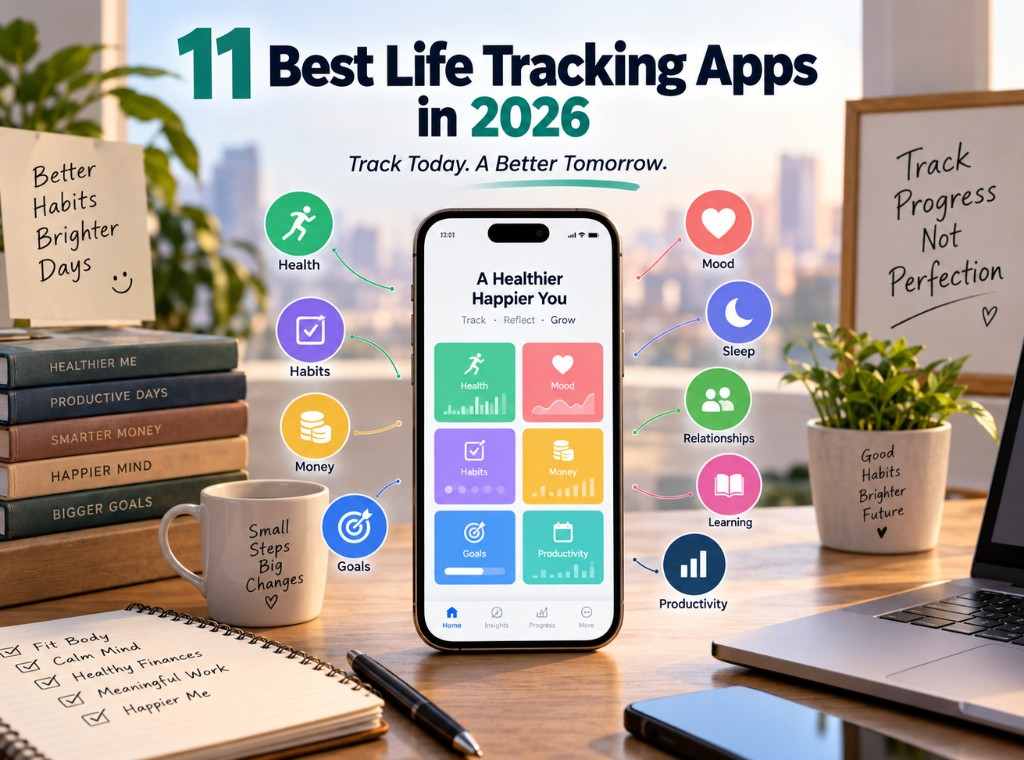
11 Best Life Tracking Apps in 2026
There is no single app that is ideal for everyone. Therefore, the right choice depends on what you actually want to understand or improve.
1. Exist – Best for Connecting Different Areas of Life
If you want to understand relationships between different behaviours, Exist is one of the more interesting options.
It combines automatically synced and manually entered information across areas such as activity, productivity, mood, sleep, workouts and other personal metrics. More importantly, it looks for correlations between the information you record.
For example, instead of simply knowing how much you slept, you may be able to investigate whether sleep appears related to mood, productivity or exercise.
Exist also supports custom tracking, allowing users to record quantities, durations, percentages, scales and other personally relevant measures.
Useful for: People who enjoy data and want a broader picture of their lifestyle.
2. Daylio – Best for Mood and Daily Activity Tracking
Not everyone wants to write a long journal entry after a tiring commute.
Daylio offers a simpler approach. Users can record moods and activities, while its statistics help reveal patterns over time. Daylio supports custom moods and provides charts that can show how particular activities may relate to mood.
Consequently, it can be useful when you want reflection without maintaining a detailed traditional diary.
Useful for: Mood tracking, quick daily reflection and recognising emotional patterns.
3. TickTick – Best for Tasks, Habits and Everyday Planning
A life tracker does not necessarily need dozens of health metrics.
Sometimes, knowing what needs to be done and whether you are actually doing it is more valuable.
TickTick combines task organisation with calendars, habits and focus-oriented features, making it particularly relevant for people trying to manage work alongside personal responsibilities. A recent 2026 comparison highlights its combination of tasks, habits and time management as its main strength.
Useful for: Daily planning, routines, task management and productivity.
4. Notion – Best for Building Your Own Life Dashboard
Some people want complete flexibility rather than a predefined tracking system.
That is where Notion becomes useful.
You can create pages and databases for goals, expenses, reading, workouts, projects, habits, learning and personal reviews. Therefore, instead of adapting your lifestyle to an app, you can design a system around your requirements.
However, flexibility comes with a disadvantage: building and maintaining an elaborate dashboard can itself become another task.
Useful for: People who want a highly customised life-management system.
5. Habitica – Best for Making Habits Feel Like a Game
If traditional habit trackers feel boring, Habitica takes a different approach.
It turns task completion into an RPG-style experience with avatars, rewards, equipment, pets, quests and social accountability. Users can organise tasks using tags and join parties with others.
As a result, ordinary activities such as exercising, reading or finishing personal tasks can feel more engaging.
Useful for: People who respond well to games, rewards and accountability.
6. YNAB – Best for Intentional Money Management
Life tracking is not only about fitness and productivity.
Your finances are also an important part of everyday wellbeing.
YNAB (You Need A Budget) uses a structured budgeting approach designed to help users decide how their available money should be allocated. Current 2026 coverage describes it as a zero-based budgeting option with educational support such as workshops.
For salaried households, tracking where income goes can make recurring subscriptions, lifestyle spending and irregular expenses much easier to notice.
Useful for: Budgeting, spending awareness and intentional money allocation.
7. Bearable – Best for Detailed Wellbeing Tracking
Bearable focuses more heavily on wellbeing, symptoms, mood and lifestyle factors.
It can be particularly useful for people who want to record how different factors relate to how they feel. However, detailed tracking also means the experience may feel more involved than a simple habit app.
The important principle here is moderation. Personal tracking can help you organise observations, but an app should not be treated as a substitute for appropriate medical advice or diagnosis.
Useful for: Detailed wellbeing and lifestyle observations.
8. Day One – Best for Journaling and Life Memories
Numbers cannot capture everything.
Sometimes the most meaningful record of your life is a photograph, a short paragraph, a memory or a thought you do not want to forget.
Day One takes this reflective approach. Rather than focusing mainly on quantitative measurements, it is built around journaling and preserving life experiences, including multimedia reflection.
Consequently, it suits people who want to understand their life through stories rather than dashboards alone.
Useful for: Journaling, reflection and preserving personal memories.
9. Finch – Best for Gentle Self-Care Motivation
Some tracking systems make every day feel like a performance review.
Finch approaches personal improvement more gently through virtual-pet-style motivation and self-care activities. Its emphasis is less on advanced productivity analytics and more on encouraging small actions.
Therefore, it may appeal to people who dislike strict streaks, complicated dashboards or highly competitive systems.
Useful for: Gentle routines, self-care and everyday motivation.
10. Gyroscope – Best for a Visual Health and Lifestyle Dashboard
If health and lifestyle information are your primary interests, Gyroscope offers a dashboard-oriented approach.
It is designed around bringing personal health and lifestyle information together so users can see a broader picture rather than checking isolated measurements. Current life-tracking comparisons particularly position it around unified health data and lifestyle tracking.
However, anyone mainly interested in budgeting or complex project management may need additional tools.
Useful for: Health-focused lifestyle tracking and visual dashboards.
11. Loop Habit Tracker – Best for Simple Habit Tracking
You do not need a complicated system to build better habits. Loop Habit Tracker, one of the Best Life Tracking Apps 2026, helps you monitor simple routines such as exercise, reading, spending control, learning, and evening habits.
Its straightforward approach makes it easier to focus on consistency and repeated behaviours without turning life tracking into another daily task.
Useful for: Habit consistency, daily routines, and personal goal tracking.
Which Life Tracking App Should You Choose?
Before downloading several apps, decide what problem you are actually trying to solve.
If your main concern is productivity, explore a task-and-habit system such as TickTick. If you want mood awareness, Daylio may be more appropriate. Meanwhile, people interested in personal-data relationships can explore Exist.
For budgeting, YNAB takes a finance-first approach. For journaling, Day One offers a different experience, while Habitica may appeal if gamification helps you stay motivated.
Most importantly, avoid installing five tracking apps simply because each one looks useful.
More tracking does not necessarily create more awareness.
A Better Way to Start Life Tracking
The easiest way to make tracking sustainable is to start small.
Track Only Three Things Initially
Instead of recording 20 metrics, choose three areas that currently matter most.
For example:
- Sleep duration
- Daily spending
- Exercise or walking
Alternatively, you could track mood, reading and focused work.
After several weeks, review whether the information is actually helping you make decisions.
Make Tracking Take Less Than Five Minutes
A complicated tracking routine is difficult to maintain after a long workday.
Therefore, wherever possible, automate information collection or use quick check-ins.
If entering information becomes another exhausting responsibility, simplify the system.
Turn Tracking Into Useful Insights
Collecting information is only the beginning. The real benefit comes from understanding what your records reveal about your everyday choices and routines.
Therefore, take a few minutes periodically to look for useful patterns. Consider questions such as:
- Look at the areas where you are making noticeable progress.
- Identify any challenges that have recently started appearing.
- Consider which routine has become easier to follow consistently.
- Review your spending to find expenses that could have been avoided.
- Notice when your energy levels tend to be at their best.
- Decide what small adjustment could improve your routine going forward.Regular reflection turns simple tracking into practical insights that can support better decisions.
Regular reflection turns simple tracking into practical insights that can support better decisions.
Don't Turn Your Life Into a Spreadsheet
There is another side to life tracking that deserves attention.
When every walk, meal, rupee, hour and emotion becomes a number, tracking can become excessive.
You may start worrying about breaking streaks instead of enjoying an evening with family. Likewise, you might judge a perfectly normal low-productivity period as a failure because your dashboard looks worse.
That defeats the purpose.
Your tracker should serve your life. Your life should not serve your tracker.
At The Life TrackR, this distinction matters. Tracking is useful when it increases awareness and helps you make practical adjustments—not when it creates another source of pressure.
A Simple Life Tracking System for Busy Working Indians
For someone balancing a job, commuting, household responsibilities, finances and family time, an uncomplicated system is usually easier to sustain.
Start with four areas: money, health, time and personal wellbeing.
Track one useful indicator from each area. For instance, record discretionary spending for money, walking or exercise for health, focused hours for time and a simple daily mood rating for wellbeing.
Then review the pattern periodically.
You may discover that one small adjustment influences several areas simultaneously. Better sleep, for example, might make morning exercise easier and improve concentration later.
That is when tracking becomes meaningful.
The Life TrackR Approach: Track Less, Understand More
You do not need to measure every minute of your existence.
Instead, identify what matters, track it consistently and use what you learn to make better everyday decisions.
The Life TrackR encourages a simple philosophy: technology should create clarity, not complexity. Pick the smallest tracking system that gives you useful information and build from there.
Conclusion
The Best Life Tracking Apps 2026 cover very different needs, from mood and habits to finances, productivity, health and reflection. Therefore, choosing an app should begin with your goal rather than its longest feature list.
Ultimately, the best tracker is the one you can use consistently without feeling controlled by it. Start with a few meaningful measurements, review what they reveal and gradually adjust your routine.
Your life does not need a perfect dashboard. It needs better awareness followed by better decisions.
#LifeTracking #LifeTracker #HabitTracking #Productivity #GoalTracking #SelfImprovement #PersonalGrowth #TimeManagement #HealthyHabits #TheLifeTrackR
Editor’s Note: This article was originally published here: https://thelifetrackr.com/11-best-life-tracking-apps-in-2026-track-habits-health-money-goals/ by @Kairav and @krutika