
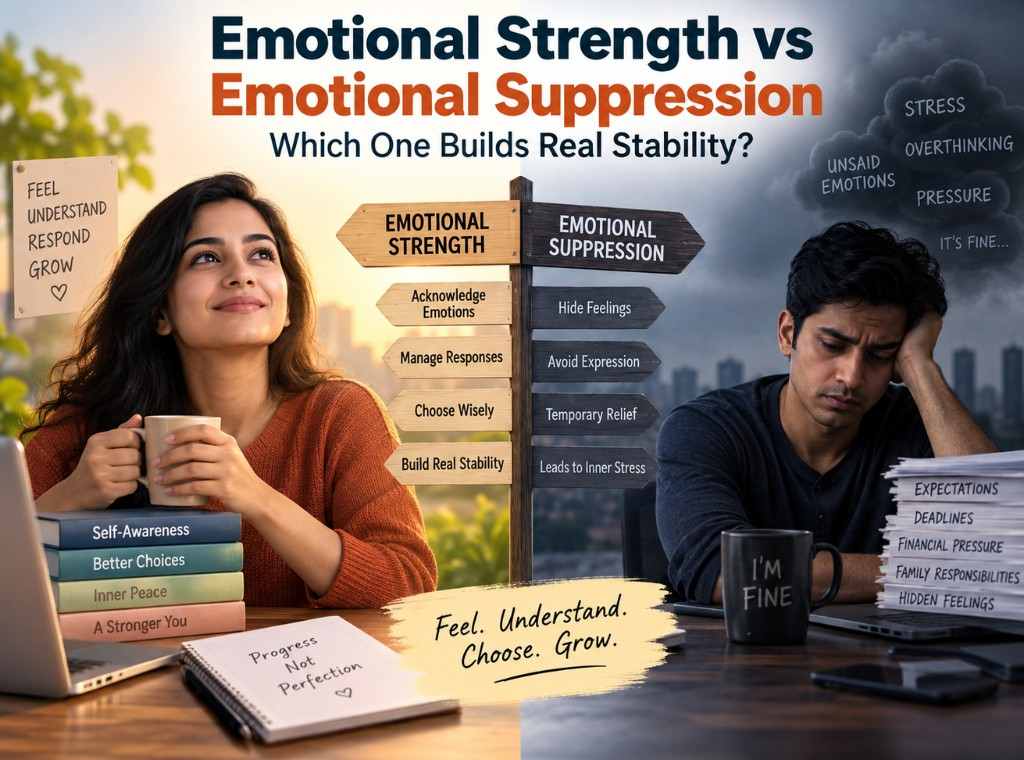
Introduction: Staying Silent Does Not Always Mean Staying Strong
Ever wondered why someone can appear completely calm at work, handle deadlines without complaining, support their family, manage monthly expenses and still feel emotionally exhausted inside?
This is where the focus keyphrase Emotional Strength vs Emotional Suppression becomes important. From the outside, both can look surprisingly similar. A person may remain quiet during an argument, continue working despite disappointment or avoid reacting when something hurts. However, what happens internally can be completely different.
Imagine coming home after a stressful commute and an exhausting workday. Something upsetting happened at the office, yet you say, “It’s fine.” Then another financial worry appears, but you tell yourself not to think about it. Later, a family disagreement adds another layer of frustration. Again, you stay silent.
Everything appears normal. But where did those emotions go?
Understanding that question can change the way you think about emotional stability.
Emotional Strength Is Not the Absence of Emotion
Many people associate emotional strength with being unaffected by difficult situations.
However, real emotional strength does not mean becoming emotionless. Instead, it means being able to recognise, understand and manage emotions without allowing every emotion to control your behaviour.
For example, emotionally strong behaviour may mean feeling angry but choosing not to send an aggressive message immediately. Similarly, it may mean feeling disappointed after missing an opportunity while still evaluating what can be improved.
You experience the emotion, but you do not automatically become controlled by it.
That difference matters.
What Is Emotional Suppression?
Emotional suppression happens when you repeatedly push emotions aside, hide them or prevent yourself from expressing them.
Sometimes this is necessary temporarily.
For instance, if you receive upsetting news just before an important meeting, you may need to manage your immediate reaction until you have privacy and time to process what happened.
However, temporary emotional regulation is different from repeatedly telling yourself:
“I shouldn’t feel this.”
“I can’t show weakness.”
“Just forget about it.”
“There is no point talking about it.”
When this becomes your default response, you may not actually be processing the emotion. Instead, you may simply be postponing it.
Emotional Strength vs Emotional Suppression: The Real Difference
The difference is not simply whether you cry, complain or stay quiet.
Emotional strength says: “I am upset, but I can decide how to respond.”
Emotional suppression says: “I am upset, but I shouldn’t acknowledge it.”
Consider receiving harsh criticism at work.
An emotionally strong response might involve noticing that you feel embarrassed or angry, giving yourself time to settle, separating useful feedback from unnecessary criticism and then deciding what action is appropriate.
Suppression may look different. You pretend the incident did not bother you, continue working and refuse to think about it. Nevertheless, the frustration may later appear as irritability, overthinking or emotional distance.
Therefore, stability comes from learning how to handle emotions, not pretending they do not exist.
Why Suppression Can Feel Like Strength
There is a reason these two behaviours are easily confused.
Suppressing emotions can provide immediate relief.
When you say, “I don’t want to think about this right now,” you avoid discomfort temporarily. Moreover, staying silent may prevent an argument or help you finish an urgent responsibility.
As a result, suppression can sometimes feel efficient.
However, emotional strength asks a different question:
What will help me deal with this emotion constructively?
That may mean waiting before responding, talking to someone you trust, writing down your thoughts, solving the underlying problem or simply admitting that something hurt.
Everyday Situations Where the Difference Becomes Clear
Workplace Stress
Suppression: “The workload is fine. I just need to work harder.”
Emotional strength: “The workload is becoming difficult. I need to prioritise tasks, improve boundaries or discuss realistic expectations.”
Financial Pressure
Suppression: “I shouldn’t worry about money.”
Emotional strength: “I am worried about money, so I need to review my spending and understand what I can control.”
Family Conflict
Suppression: “Keeping quiet is always better.”
Emotional strength: “I don’t want an unnecessary argument, but this issue needs a calm conversation.”
Career Disappointment
Suppression: “It doesn’t matter that I didn’t get the opportunity.”
Emotional strength: “I am disappointed because it mattered to me. Now, what can I learn or do next?”
Personal Exhaustion
Suppression: “Other people handle more than this. I shouldn’t complain.”
Emotional strength: “I am exhausted. Something in my routine may need to change.”
In each situation, emotional strength accepts reality before deciding what to do about it.
Why Emotional Stability Is Often Misunderstood
Stable people are sometimes imagined as people who rarely become upset.
Yet emotional stability is better understood as the ability to return to balance after emotional experiences.
Think about physical balance.
If somebody pushes you slightly, having good balance does not mean your body never moves. Instead, your body adjusts and regains stability.
Emotions can work similarly.
You may experience disappointment, anger, sadness, excitement, anxiety or frustration. The goal is not to eliminate these reactions. Rather, the goal is to develop healthier ways to understand them and regain perspective.
Therefore, emotional stability is less about never being shaken and more about learning how to recover.
How to Build Emotional Strength in Everyday Life
1. Name What You Are Feeling
Instead of automatically saying “I’m fine,” identify the actual emotion. Are you disappointed, worried, irritated, lonely, overwhelmed, or simply tired? Naming emotions can make them easier to understand.
2. Create a Gap Between Feeling and Reacting
Emotions do not require immediate action. When anger or criticism affects you, pause before responding. Take a short walk, drink water, breathe slowly or give yourself time to think.
Feelings provide information, but they do not always provide instructions.
3. Ask What the Emotion Is Telling You
Frustration may point to a boundary problem, while disappointment may show that something genuinely mattered. Instead of asking, “How do I stop feeling this?”, ask, “Why might I be feeling this?”
4. Express Emotions Constructively
Healthy expression does not mean saying everything immediately. Instead, talk calmly, journal, reflect privately or discuss recurring concerns respectfully. This allows the emotion to remain real while making your response more useful.
5. Separate the Feeling From the Story
After a work mistake, separate facts from assumptions.
Fact: I made an error.
Emotion: I feel embarrassed.
Next step: I can correct it and learn from it.
This approach can prevent unnecessary emotional escalation.
6. Build Small Recovery Habits
Regular movement, sufficient sleep, meaningful conversations, hobbies, quiet time and realistic boundaries can support emotional wellbeing. Even a short walk or phone-free meal can create valuable breathing room.
7. Know When You Need More Support
Emotional strength does not mean handling everything alone. If difficult emotions persist or significantly affect work, sleep, relationships or everyday life, consider speaking with a qualified mental-health practitioner or healthcare provider.
A Simple Emotional Check-In
When something strongly affects you, use four questions:
- What am I feeling right now?
- What triggered this feeling?
- What part of this situation can I control?
- What is the healthiest reasonable action I can take next?
For example, suppose you are overlooked for an expected opportunity at work.
First, acknowledge the disappointment. Next, identify why the opportunity mattered. Then, distinguish what you cannot control from what you can influence. Finally, decide whether you need feedback, skill development, a conversation or simply time to process the outcome.
That is emotional strength in practice.
Stop Treating Every Difficult Emotion as a Problem
One of the biggest changes you can make is to stop assuming that uncomfortable emotions are automatically bad.
Sadness is uncomfortable.
Disappointment is uncomfortable.
Frustration is uncomfortable.
However, discomfort is part of being human.
The real goal is not to create a life where you never experience difficult emotions. Instead, it is to develop enough self-awareness and emotional regulation to move through them without unnecessary damage to yourself or the people around you.
With practice, you can become more emotionally flexible rather than emotionally numb.
Small Changes Can Build Real Stability
You do not need to transform your emotional habits overnight.
Start with one moment.
The next time you automatically say, “I’m fine,” ask yourself whether that is actually true.
The next time anger appears, give yourself a little space before responding.
When disappointment arrives, acknowledge it before trying to solve it.
Most importantly, remember that emotional strength is not about proving how much discomfort you can silently tolerate.
It is about responding to difficult emotions with awareness, perspective and healthier choices.
At The Life TrackR, small improvements matter because everyday stability is built through what you repeatedly practise, not through pretending that difficult moments never affect you.
Conclusion
The debate around Emotional Strength vs Emotional Suppression becomes much clearer once we stop judging strength by how little emotion someone displays.
Suppressing an emotion may sometimes help you function temporarily. However, genuine emotional strength involves recognising what you feel, regulating your response, communicating appropriately and taking constructive action when necessary.
You do not have to react to every feeling. At the same time, you do not have to hide every feeling either. Real stability lies somewhere in between: feel, understand, choose and move forward.
The Life TrackR encourages you to start small. Notice one emotion today instead of immediately pushing it aside, and ask yourself what a healthier response could look like.
#EmotionalStrength #EmotionalSuppression #EmotionalStability #EmotionalWellbeing #SelfAwareness #PersonalGrowth #StressManagement #TheLifeTrackR
Editor’s Note: This article was originally published here: https://thelifetrackr.com/emotional-strength-vs-emotional-suppression-which-one-builds-real-stability/ by @Kairav and @krutika