
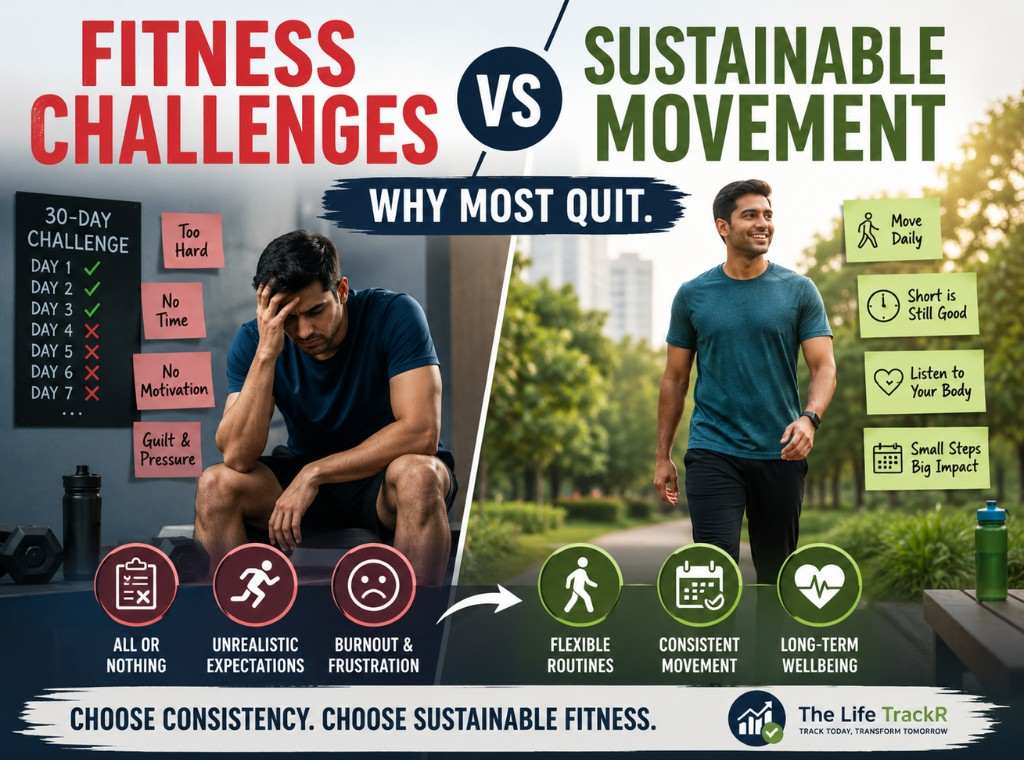
Fitness Challenges Feel Exciting—Until Real Life Shows Up
Ever wondered why a 30-day fitness challenge can feel exciting at the beginning, yet become exhausting before it ends?
You save the workout plan. You decide that this time will be different. Perhaps you buy new workout clothes, download an app, set an early alarm, and promise yourself that there will be no excuses.
For the first few sessions, everything feels surprisingly easy.
Then work gets hectic.
The commute becomes tiring. A late meeting changes your evening. Household responsibilities pile up. Your body feels sore, your motivation drops, and suddenly the workout that once felt exciting starts feeling like another unfinished task.
Eventually, one missed session becomes several.
This is exactly where Sustainable Fitness Habits matter. The problem is often not that people dislike movement. Instead, they build routines that only work when life is going perfectly.
And for most working Indians, life rarely stays perfectly predictable.
Why Do So Many Fitness Challenges End Early?
Fitness challenges are attractive because they provide a clear starting point and a visible finish line.
“Walk 10,000 steps every day.”
“Exercise every morning for 30 days.”
“Complete 100 squats daily.”
“Never miss a workout.”
These goals can create useful short-term momentum. However, they may also encourage an all-or-nothing approach.
When you successfully complete everything, you feel disciplined. However, when you miss one session because of work, travel, illness, family commitments, or simple tiredness, you may feel that the entire routine has failed.
That thinking creates the real problem.
Fitness becomes a test of perfection instead of a normal part of everyday life.
The Challenge Is Not Exercise—It Is Sustainability
Imagine someone with a full-time job and a long commute.
They decide to exercise for one hour every evening.
Initially, the plan looks reasonable. Nevertheless, the routine actually requires much more than one hour. There is travel to the gym, changing clothes, exercising, returning home, showering, eating dinner, and handling everything else waiting at home.
Soon, the “one-hour workout” consumes a significant part of the evening.
Then a busy workday arrives.
The person reaches home exhausted and skips the gym.
Immediately, guilt appears.
“I have already broken the routine.”
That sentence matters because once the routine feels broken, quitting becomes easier.
Now imagine a different approach.
Instead of demanding a perfect hour-long workout, the person creates several acceptable versions of movement:
- Ideal day: 45-minute structured workout.
- Busy day: 20-minute brisk walk.
- Very busy day: 10 minutes of mobility or bodyweight movement.
- Exhausting day: A short, comfortable walk after dinner.
The intensity changes, but movement remains part of life.
That is the difference between completing a challenge and building a lifestyle.
Stop Treating Fitness Like a Temporary Projectre
Many people approach fitness like an exam.
They become extremely disciplined for a limited period, expect noticeable results, and then gradually return to their previous routine.
However, your body does not know whether you completed a 21-day or 30-day challenge.
It responds to what you repeatedly do over months and years.
Therefore, instead of asking:
“How quickly can I transform myself?”
A more useful question is:
“What type of movement can realistically remain in my life?”
This small change in thinking can completely reshape your relationship with fitness.
A routine does not need to look impressive online. It needs to survive deadlines, commuting, family responsibilities, festivals, travel, low-energy evenings, and unpredictable schedules.
Fitness Challenge vs Sustainable Movement
A fitness challenge usually asks you to temporarily change your life around exercise.
Sustainable movement does the opposite.
It fits exercise around your real life.
Fitness Challenge Thinking
A challenge-based approach may sound like:
- “I must work out for one hour.”
- “I cannot miss a session.”
- “I need fast results.”
- “If I cannot do the full workout, there is no point.”
- “I will start again properly later.”
Sustainable Movement Thinking
A sustainable approach sounds different:
- “Some movement is better than none.”
- “My routine can change according to my schedule.”
- “Consistency matters more than one intense session.”
- “A short walk still counts.”
- “I can continue after a missed workout.”
The second approach may appear less dramatic. However, it is much easier to repeat.
And repetition is where meaningful progress is built.
Why Working People Often Struggle With Fitnessre
For many middle-class Indians doing a job, the difficulty is not understanding that exercise is beneficial.
The real challenge is fitting movement into a crowded schedule.
A typical day can involve commuting, office hours, family responsibilities, grocery shopping, household tasks, social commitments, and screen time.
Therefore, waiting for a completely free hour may keep exercise permanently on the “later” list.
Instead, movement can be distributed throughout the day.
For example, you might:
- Walk for 10 minutes after a meal.
- Take stairs when practical.
- Walk while making a phone call.
- Stretch briefly after long periods of sitting.
- Complete a short home workout before getting ready.
- Walk part of your commute when safe and practical.
- Take short movement breaks during extended desk work.
Individually, these actions may seem small. Collectively, however, they can make movement a normal part of your routine.
The Biggest Fitness Trap: Doing Too Much Too Soon
Motivation can make people overly ambitious.
Someone who has barely exercised for months suddenly decides to train intensely every day.
The first workout feels productive.
The next brings soreness.
After several sessions, fatigue starts building.
Soon, exercise becomes something the person dreads.
This is why starting smaller can actually be smarter.
If your current activity level is low, begin with something manageable. For example, start with a comfortable 10–20 minute walk rather than immediately attempting an exhausting routine.
Once that feels normal, gradually increase duration, frequency, or intensity according to your ability and health circumstances.
Progress does not have to be dramatic to be meaningful.
Build a Minimum Movement Rule
One of the simplest ways to create Sustainable Fitness Habits is to establish a minimum version of your routine.
Your minimum should be easy enough to complete even on a busy day.
For example:
Normal routine: 30-minute workout.
Minimum routine: 10 minutes of movement.
The minimum could include walking, mobility exercises, stretching, yoga, bodyweight movements, or another appropriate activity.
Importantly, the minimum routine is not failure.
It is your backup system.
When life becomes difficult, you reduce the routine rather than completely abandoning it.
Use the Green, Yellow and Red Day Method
Your energy and available time will not be identical every day.
Therefore, your movement plan should not expect them to be.
Green Day
You have enough time and energy.
Complete your normal workout, longer walk, cycling session, strength routine, yoga practice, or another planned activity.
Yellow Day
Your schedule is crowded or your energy is lower.
Reduce the duration. A 15–25 minute session may be enough to maintain continuity.
Red Day
You are extremely busy or exhausted.
Choose gentle, manageable movement instead of forcing an intense workout.
The objective is not to achieve maximum performance every day.
The objective is to maintain a healthy relationship with movement over time.
Make Movement Convenient
If exercising requires too many decisions, motivation has more opportunities to disappear.
Therefore, remove unnecessary friction.
Keep comfortable walking shoes easily accessible. Save a simple home routine. Decide in advance where you can walk. Choose activities that do not always require travel, expensive equipment, or complicated preparation.
Additionally, connect movement with routines that already happen.
For example:
Lunch → short walk
Work ends → 15 minutes of movement
Long sitting period → brief mobility break
Dinner → comfortable walk
Existing routines become natural reminders, which means you rely less on motivation.
Track Consistency, Not Perfection
Tracking can be useful when it encourages awareness rather than obsession.
Instead of measuring only calories burned, kilometres completed, workout duration, or body weight, track a simpler question:
“Did I intentionally move today?”
Your answer could be:
Full movement: Completed the planned routine.
Light movement: Completed a shorter version.
Recovery: Intentionally rested or performed gentle movement.
This approach helps you see patterns without turning every day into a pass-or-fail test.
The Life TrackR philosophy fits naturally here: what you consistently notice and track becomes easier to understand and improve.
Missing One Workout Is Not the Problem
People rarely lose their routine because of one missed workout.
The bigger problem is the story they tell themselves afterward.
“I missed yesterday, so this week is ruined.”
That belief can transform one skipped workout into several inactive weeks.
Instead, create a simple rule:
Never punish yourself for missing. Simply return at the next realistic opportunity.
You do not need to compensate with an extreme workout.
You simply continue.
That ability to restart quickly is one of the most valuable fitness skills you can develop.
Choose Movement You Actually Enjoy
There is no prize for choosing a physical activity you dislike. Staying active becomes much easier when exercise fits your interests, lifestyle, and daily routine. For example, if running makes you miserable, you do not necessarily need to run to maintain an active lifestyle. Depending on your health, ability, and preferences, activities such as walking, cycling, swimming, yoga, dancing, strength training, badminton, hiking, mobility exercises, or home workouts may be better choices.
Rather than selecting the activity that looks the hardest, focus on sustainable movement that you can perform safely, enjoy reasonably, and continue consistently. After all, a manageable fitness routine that lasts for months can be more valuable than an intense workout plan that you abandon after a few weeks.
Before building your routine, ask yourself:
Which type of movement do I actually enjoy?
How much can I realistically afford to spend on fitness?
Where can physical activity fit naturally into my schedule?
Which activities are easily accessible near my home or workplace?
During busy periods, which forms of exercise can I realistically continue?
By answering these questions, you can create sustainable fitness habits around your real life instead of trying to copy someone else’s lifestyle. Ultimately, the best fitness routine is one that works with your circumstances and makes regular movement easier to maintain.
Stop Measuring Fitness Only by Appearance
Another reason people quit is that they expect visible physical changes too quickly.
When those changes take longer than expected, motivation falls.
However, movement can offer reasons to continue beyond appearance.
Depending on the activity and individual, regular movement can support physical fitness, mobility, strength, endurance, energy management, and overall wellbeing.
Therefore, notice functional progress too.
Perhaps climbing stairs feels easier.
Maybe you can walk longer without feeling exhausted.
Perhaps your body feels less stiff after long desk hours.
These changes matter.
Your Sustainable Movement Formula
A practical routine does not need dozens of rules.
Start with four:
- Choose movement you can realistically repeat.
- Create a shorter backup version for busy days.
- Track whether you showed up, not whether you were perfect.
- Return quickly whenever your routine gets interrupted.
Then review your routine periodically.
If you repeatedly skip a particular workout, do not immediately assume you lack discipline.
Ask why.
Is the timing unrealistic?
Is the workout too long?
Does it require too much travel?
Are you starting too intensely?
Do you simply dislike the activity?
Once you identify the friction, adjust the system.
What Sustainable Fitness Actually Looks Like
Sustainable fitness is rarely about dramatic workouts or pushing your body to its limits every day. Instead, it is about making movement a realistic part of everyday life. Sometimes that means completing an excellent workout, while on other days, it may simply involve taking a 20-minute walk, choosing the stairs, or stretching after sitting for long hours. Moreover, sustainable movement also means recognising when your body needs proper rest and recovery. Most importantly, this approach makes it easier to return to physical activity consistently without feeling exhausted or discouraged. The goal is not to prove how hard you can exercise for a few weeks; rather, it is to build health
A Small Change Can Keep You Moving
You do not need another extreme fitness promise. Start with movement that fits your current life, track it simply, and gradually build from there.
The Life TrackR can help you focus on consistency and notice the small actions that eventually become meaningful routines.
Conclusion
Fitness challenges can create excitement, structure, and short-term motivation. However, they become difficult to maintain when they depend on perfect schedules, constant motivation, or unrealistic intensity.
Sustainable Fitness Habits take a different approach.
Instead of asking how much exercise you can force into your life temporarily, ask how movement can naturally become part of your everyday routine.
Walk when you can. Exercise according to your ability. Create shorter alternatives for difficult days. Track consistency without demanding perfection. Most importantly, return after interruptions instead of waiting for another “perfect” restart.
Because long-term fitness is not built by the hardest workout you complete once.
It is built by the movement you are willing and able to return to again and again.
#SustainableFitnessHabits #DailyMovement #FitnessJourney #HealthyLifestyle #StayActive #Consistency #FitnessMotivation #TheLifeTrackR
Editor’s Note: This article was originally published here: https://thelifetrackr.com/fitness-challenges-vs-sustainable-movement-why-most-quit/ by @Kairav and @krutika