
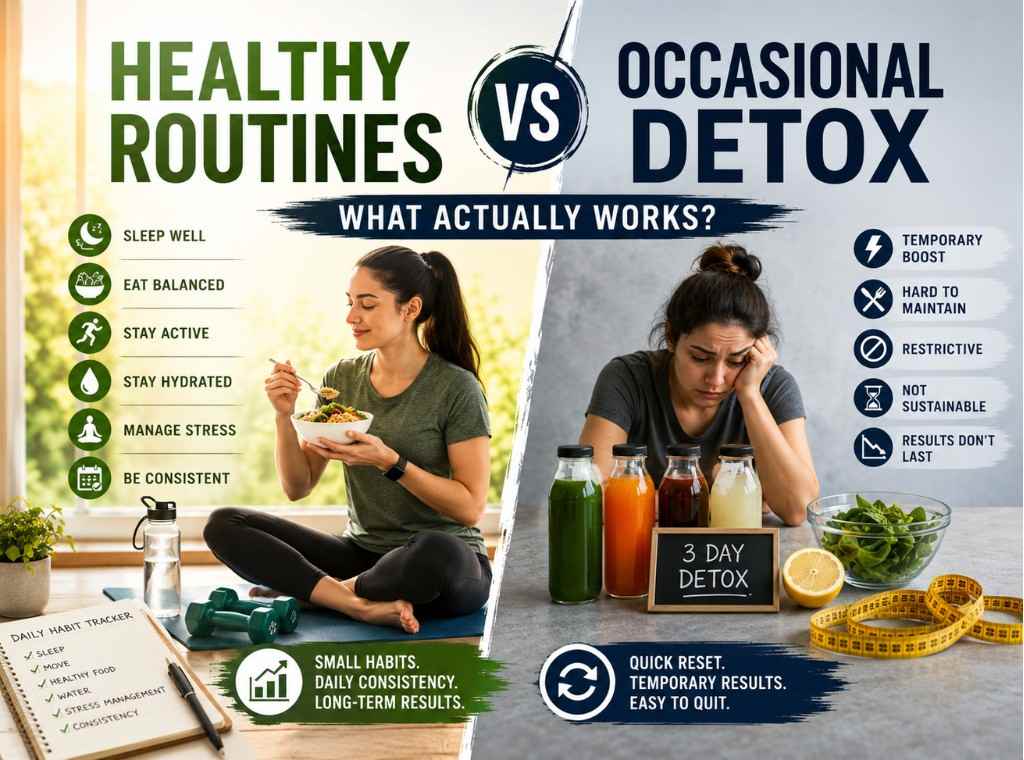
Did you know that many people spend days trying to “detox” after spending weeks following unhealthy routines?
After several days of late-night meals, poor sleep, little movement, excessive screen time, and irregular eating, it is tempting to believe that a short detox will somehow reset everything. Juice cleanses, restrictive diets, social media breaks, and intense workout challenges can all feel like a fresh start.
However, the focus keyphrase Healthy Routines vs Detox raises a much more useful question: Does your body and mind really need an occasional reset, or would small healthy actions repeated every day work better?
The answer may change the way you approach your health completely.
The Familiar Cycle: Unhealthy Routine, Guilt, Detox, Repeat
Imagine a typical working week.
You wake up later than planned and rush through breakfast—or skip it completely. You sit for long hours at work, drink several cups of tea or coffee, and barely remember to drink water.
By evening, you are mentally exhausted. Exercise feels difficult, so you order something convenient for dinner. Then, although you planned to sleep early, you spend another hour scrolling on your phone.
Eventually, you feel tired, heavy, distracted, or simply “off.”
So, you decide something needs to change.
Perhaps you plan a strict diet. Maybe you avoid certain foods completely, start exercising intensely, drink only juices for a short period, or temporarily delete social media apps.
Initially, the change feels refreshing.
But then normal life returns.
Work becomes busy again. The strict routine becomes difficult to maintain. Gradually, old habits return, and before long, another “detox” feels necessary.
The real problem may not be that you need another detox. It may be that your everyday routine needs attention.
What Does “Detox” Actually Mean?
The word detox is used very loosely in wellness conversations.
Medically, the human body already has systems involved in processing and eliminating waste products. The liver, kidneys, digestive system, lungs, and other organs continuously perform essential functions.
Therefore, a commercial “detox” should not automatically be assumed to remove mysterious toxins from your body.
At the same time, some activities commonly called a detox can still be useful when interpreted differently.
For example, taking a break from alcohol, reducing highly processed foods, spending less time on social media, improving sleep, or returning to balanced meals can certainly support healthier living.
However, these benefits usually come from changing the behaviour itself, rather than from a special detox effect.
Healthy Routines vs Detox: The Difference That Matters
Think about your health like maintaining your home.
Would you ignore cleaning, maintenance, and repairs for months because you plan to perform one massive cleaning session later?
Probably not.
Your health works similarly.
An occasional healthy weekend cannot fully compensate for weeks of insufficient sleep, inactivity, poor eating patterns, chronic stress, or excessive screen time.
Meanwhile, small daily behaviours may look unimpressive at first.
A 20-minute walk does not feel dramatic. Drinking enough water does not feel like a transformation. Going to bed at a reasonable time does not create an exciting before-and-after photo.
Yet, when repeated consistently, these behaviours can create meaningful long-term improvements.
That is why the Healthy Routines vs Detox conversation should focus less on dramatic resets and more on sustainable systems.
Why Occasional Detoxes Feel So Attractive
If daily routines are more sustainable, why are detoxes so appealing?
The answer is partly psychological.
They Give You a Clear Starting Point
Saying “I am starting a detox” feels decisive.
There is a beginning, a set of rules, and often an ending. Consequently, it can feel easier than making an open-ended commitment to healthier living.
They Promise Faster Results
People naturally prefer quick solutions.
However, health improvements usually develop gradually. Therefore, promises of dramatic transformation within a few days deserve careful scrutiny.
They Reduce Decision-Making
Strict plans tell you exactly what to eat, avoid, or do.
Although this can temporarily reduce decision fatigue, extremely restrictive plans may be difficult to maintain alongside commuting, family responsibilities, social events, and demanding jobs.
What Actually Works Better? Build a Routine You Can Repeat
Instead of asking, “How can I detox?”, try asking:
“What healthy actions can I realistically continue during a busy month?”
That question immediately changes your approach.
Rather than trying to become perfectly healthy overnight, you begin creating a lifestyle that works even when motivation is low.
1. Make Your Meals More Predictable
You do not necessarily need complicated meal plans.
Instead, aim for balanced meals built around appropriate portions of vegetables, whole grains or other suitable carbohydrate sources, protein-rich foods, and healthy fats.
For many Indian households, simple options such as dal, vegetables, roti, curd, sprouts, legumes, fruit, nuts, and other minimally processed foods can fit naturally into everyday eating patterns.
Most importantly, choose meals you can realistically continue.
2. Make Movement Part of Normal Life
Exercise does not always need to mean an intense gym session.
You could:
Walk after meals when practical.
Take stairs when appropriate.
Stretch after long sitting periods.
Walk during short breaks.
Include strength-based activity regularly.
Choose enjoyable physical activities.
A sustainable movement routine is generally more useful than exercising intensely for a short period and then stopping completely.
3. Protect Your Sleep Routine
Sleep is often sacrificed when life gets busy.
However, instead of attempting to “catch up” occasionally, try creating a reasonably consistent sleep schedule.
Start by reducing unnecessary late-night screen use, limiting stimulating activities close to bedtime, and creating a calmer sleeping environment.
Furthermore, avoid treating sleep as leftover time after everything else is finished.
Sleep is part of your health routine, not a reward for completing your work.
4. Use Water as a Daily Habit, Not a Detox Tool
You do not need expensive detox drinks simply because they contain attractive ingredients.
Plain water remains an effective way to support normal hydration.
Therefore, keep water accessible during working hours, drink according to your needs, and pay additional attention during hot weather or physical activity.
5. Create a Healthier Relationship With Screens
A digital detox can be helpful temporarily.
However, deleting every app for a short period and reinstalling everything later may simply restart the same cycle.
Instead, create boundaries you can maintain.
For example, keep phones away during meals, turn off unnecessary notifications, avoid endless scrolling before sleeping, and create short screen-free periods during the day.
The goal is not to escape technology. The goal is to use it intentionally.
6. Stop Using Guilt as Motivation
One unhealthy meal does not require punishment.
Likewise, missing one workout does not mean your routine has failed.
This all-or-nothing mindset often creates the exact cycle that makes extreme resets attractive.
Instead, return to your normal routine at the next reasonable opportunity.
Consistency does not mean never slipping. It means returning quickly without turning one imperfect choice into an entire unhealthy week.
Try the “Minimum Healthy Day” Approach
Busy working people need routines that survive difficult days.
Therefore, create a minimum version of your healthy routine.
For example:
- Movement: Take a short walk.
- Food: Include vegetables and a protein source in major meals.
- Hydration: Keep water nearby.
- Sleep: Maintain a sensible bedtime.
- Mental break: Spend a few minutes away from screens.
- Tracking: Record whether you completed your core habits.
On easier days, you can do more.
However, on demanding days, completing your minimum routine protects your consistency.
This approach removes the pressure to be perfect while keeping you moving in the right direction.
When Can a “Reset” Still Be Useful?
Occasional resets are not automatically bad.
In fact, they can be useful when they help you restart sustainable habits rather than replace them.
For example, after a period of disrupted routines, you might spend a short period reorganising your meals, resetting your sleep schedule, reducing unnecessary screen time, planning physical activity, and preparing healthier food options.
In this context, the reset becomes a bridge back to your routine, rather than an attempt to erase previous choices.
That distinction matters.
Track Patterns Instead of Chasing Perfection
Sometimes you do not realise how inconsistent a routine has become until you start tracking it.
You might believe you exercise regularly, for example, but tracking reveals that several days frequently pass without meaningful movement.
Similarly, you might underestimate late-night screen time or forget how often you skip a healthy meal.
Therefore, track a few simple behaviours such as:
- Sleep routine
- Daily movement
- Water intake
- Balanced meals
- Screen-free time
- Personal wellbeing habits
You do not need to track everything.
Instead, choose the behaviours that genuinely influence your lifestyle.
This is where The Life TrackR approach becomes useful: progress becomes easier to understand when you can actually see your patterns.
Sustainable Health Is Usually Less Dramatic Than Social Media Suggests
Healthy living can look surprisingly ordinary.
There may be no dramatic detox drink.
No extreme challenge.
No perfect morning routine.
Instead, sustainable health often looks like eating reasonably well most of the time, moving regularly, sleeping adequately, managing stress, staying hydrated, and returning to your routine when life interrupts it.
These actions may not feel exciting individually.
Together, however, they create a foundation that occasional extreme efforts rarely provide.
A Simple Rule to Remember
Before starting any new health routine, ask yourself:
“Could I realistically continue some version of this for the next six months?”
If the answer is no, consider simplifying it.
A slightly imperfect routine you can maintain is often more valuable than an extreme plan you abandon quickly.
Moreover, if a detox programme involves severe calorie restriction, prolonged fasting, supplements, laxatives, or claims to treat medical conditions, speak with an appropriately qualified healthcare provider before trying it.
How The Life TrackR Can Help
Instead of waiting until you feel unhealthy enough to need another reset, start noticing the small habits shaping your everyday life.
The Life TrackR encourages you to focus on consistent progress, track meaningful routines, and build habits that fit real life rather than chasing temporary perfection.
Conclusion
When comparing Healthy Routines vs Detox, sustainable daily habits generally offer the more practical long-term approach.
An occasional reset can help you refocus, but it should support your healthy routine rather than substitute for one. Small improvements in food choices, movement, hydration, sleep, screen habits, and stress management can become powerful when repeated consistently.
You do not need to rebuild your entire lifestyle tomorrow.
Choose one healthy action. Track it. Repeat it. Then build from there with The Life TrackR.
#HealthyRoutines #HealthyHabits #HealthyLifestyle #DailyHabits #HabitTracking #SustainableWellness #BetterLiving #SelfImprovement #WellnessTips #TheLifeTrackR
Editor’s Note: This article was originally published here:https://thelifetrackr.com/healthy-routines-vs-occasional-detox-what-actually-works/ by @Kairav and @krutika