
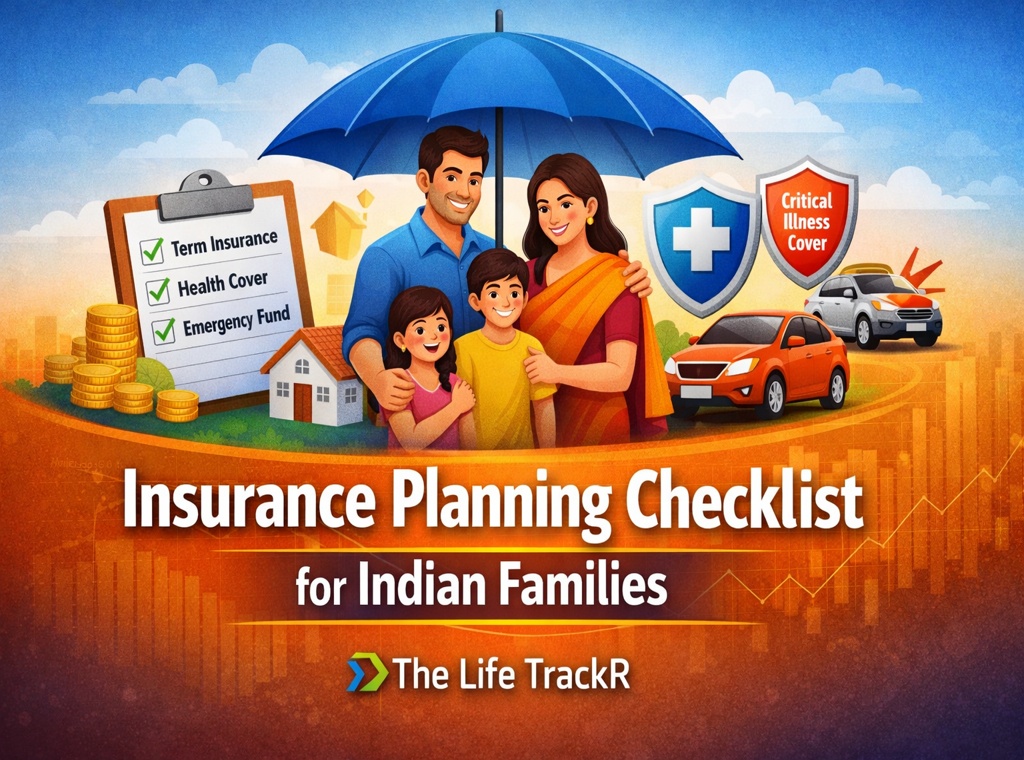
Did you know that most people overlook this one thing while planning their finances? They invest in SIPs. They track expenses. They dream about buying a home. However, they quietly ignore protection.
Rohit, a 35-year-old salaried employee from Jaipur, believed insurance was just another expense. He delayed buying proper coverage for years. Then suddenly, a medical emergency in the family forced him to borrow money at high interest. That moment changed everything for him.
If this sounds familiar, you’re not the only one.
The truth is simple. Without protection, wealth creation is incomplete. Therefore, understanding the focus keyphrase – Insurance Planning Checklist India can completely change how you look at financial security. Moreover, when you follow a structured checklist, you reduce risk, stress, and uncertainty.
This is where The Life TrackR becomes important, because tracking your financial protection is as crucial as tracking your income.
Let us walk through a practical and easy-to-follow insurance planning checklist designed especially for middle class Indian families who are doing a job.
Why Insurance Planning Is Not Optional Anymore
Life in India is becoming expensive. Medical costs are rising every year. Education expenses are increasing rapidly. Meanwhile, job stability is no longer guaranteed.
In today’s scenario, insurance is no longer a luxury; instead, it has become a basic necessity.
Many families assume nothing will go wrong. Financial planning is not about expecting the worst; rather, it focuses on being prepared for uncertainty.
Once you understand this, you never see insurance as a burden again.
Step 1: Calculate Your Life Insurance Requirement
The first item in your Insurance Planning Checklist India is life insurance.
However, the question is — how much is enough?
A simple method is:
- Multiply your annual income by 15 to 20 times to estimate a strong financial cover.
- Consider all your outstanding loans so your family isn’t burdened later.
- Include your children’s future education expenses for long-term security.
- Then, subtract your existing investments to arrive at the actual insurance requirement.
For example, if your annual income is ₹10 lakh, your life cover should ideally be between ₹1.5 to ₹2 crore.
Choose Term Insurance, Not Traditional Plans
Term insurance provides high coverage at a low premium. On the other hand, traditional policies mix insurance with savings but offer lower coverage.
For this reason, it is always better to keep insurance and investment separate.
This one decision can protect your family’s lifestyle even if you are not around.
Step 2: Health Insurance for the Entire Family
Many salaried employees depend completely on company health insurance. But what happens if you switch jobs or lose employer coverage?
That is where personal health insurance becomes critical.
What You Should Do
- Take a family floater plan of at least ₹10–20 lakh
- Consider a super top-up plan for extra protection
- Check waiting periods and exclusions carefully
- Ensure cashless hospital network availability
Medical inflation in India is around 10–15% annually. Therefore, small coverage today may not be enough tomorrow.
With The Life TrackR, you can track policy renewal dates and coverage amounts so that nothing slips through the cracks.
Step 3: Emergency Fund Comes Before Insurance Riders
Many people add unnecessary riders to policies. At the same time, many of them fail to maintain an emergency fund.
This is a mistake.
Before increasing riders, ensure you have:
- 6 months of expenses saved
- Liquid and easily accessible funds
- Separate account for emergencies
Insurance supports large unexpected events. Meanwhile, an emergency fund supports short-term financial shocks.
Both are important.
Step 4: Critical Illness Cover
Diseases like cancer, heart problems, or kidney failure can impact income drastically. Even with health insurance, additional expenses can arise.
Therefore, a critical illness cover provides a lump sum payout.
This payout can:
- Replace lost income
- Cover advanced treatments
- Support lifestyle adjustments
If you are the primary earning member, this coverage becomes even more important.
Step 5: Personal Accident Insurance
Most families ignore accident insurance. However, accidents can lead to disability.
Unlike life insurance, disability may not end life but can end earning capacity.
Personal accident policies are affordable. Yet, they provide:
- Accidental death cover
- Permanent disability benefit
- Partial disability support
This small premium can make a massive difference.
Step 6: Protect Your Assets
If you own a house or vehicle, protection is necessary.
1. Home Insurance
- Covers damage due to fire, flood, or earthquake
- Protects household contents
2. Motor Insurance
- Always renew on time
- Consider comprehensive coverage instead of third-party only
Ignoring these can lead to heavy repair costs.
Step 7: Nominee Details and Documentation
Many families purchase insurance. However, they forget documentation clarity.
Ensure that:
- Nominee details are updated
- Family members know policy location
- Digital copies are stored safely
- Premium payment reminders are active
Using The Life TrackR, you can maintain a structured record of all policies in one place. As a result, your family will not struggle during emergencies.
Common Mistakes Indian Families Make
Let’s be real about this.
- Buying insurance late
- Underinsuring due to low premium preference
- Mixing investment and insurance
- Ignoring inflation
- Not reviewing policies regularly
So, avoiding these mistakes is essential if you want long-term financial stability.
How Often Should You Review Your Insurance Plan?
As life evolves, your insurance coverage should evolve as well.
Review your insurance when:
- After getting married, your financial responsibilities naturally increase.
- When you welcome a child, your need for protection becomes even more important.
- If you take a home loan, ensuring coverage for liabilities is essential.
- As your income grows significantly, your insurance should also be upgraded accordingly.
Ideally, review once every year.
Tracking this annually through The Life TrackR ensures that your financial safety net grows with your responsibilities.
A Simple Insurance Planning Framework
You can remember insurance planning in this order:
- Term Insurance
- Health Insurance
- Emergency Fund
- Critical Illness Cover
- Accident Insurance
- Asset Protection
- Annual Review
Follow this sequence. Do not complicate it.
Financial clarity reduces stress.
Small Changes, Big Peace of Mind
At one point, many salaried individuals feel overwhelmed by financial responsibilities. However, protection planning brings confidence.
Once your insurance foundation is strong, investing becomes stress-free. Saving becomes purposeful. Future planning becomes realistic.
The focus keyphrase – Insurance Planning Checklist India is not just a checklist. Instead, it is a structured approach to protect everything you are building.
The Life TrackR helps you organize, track, and review your financial protection easily. You do not need complicated spreadsheets. You only need awareness and action.
Take one step today. Your future self will thank you
Conclusion
Financial growth without protection is risky. Hence, insurance planning should always come before aggressive investing. The Insurance Planning Checklist India ensures that your family remains secure regardless of what life brings.
When you track your coverage regularly using The Life TrackR, you stay prepared, confident, and financially stable. Protection is not an expense. It is peace of mind.
#InsurancePlanningIndia #FamilyFinancialSecurity #LifeInsuranceIndia #HealthInsuranceIndia #MoneyManagementIndia #FinancialPlanning #SecureFuture #TheLifeTrackR #PersonalFinanceIndia #RiskManagement
Editor’s Note: This article was originally published here https://thelifetrackr.com/insurance-planning-checklist-for-indian-families/ by @Kairav and @krutika