
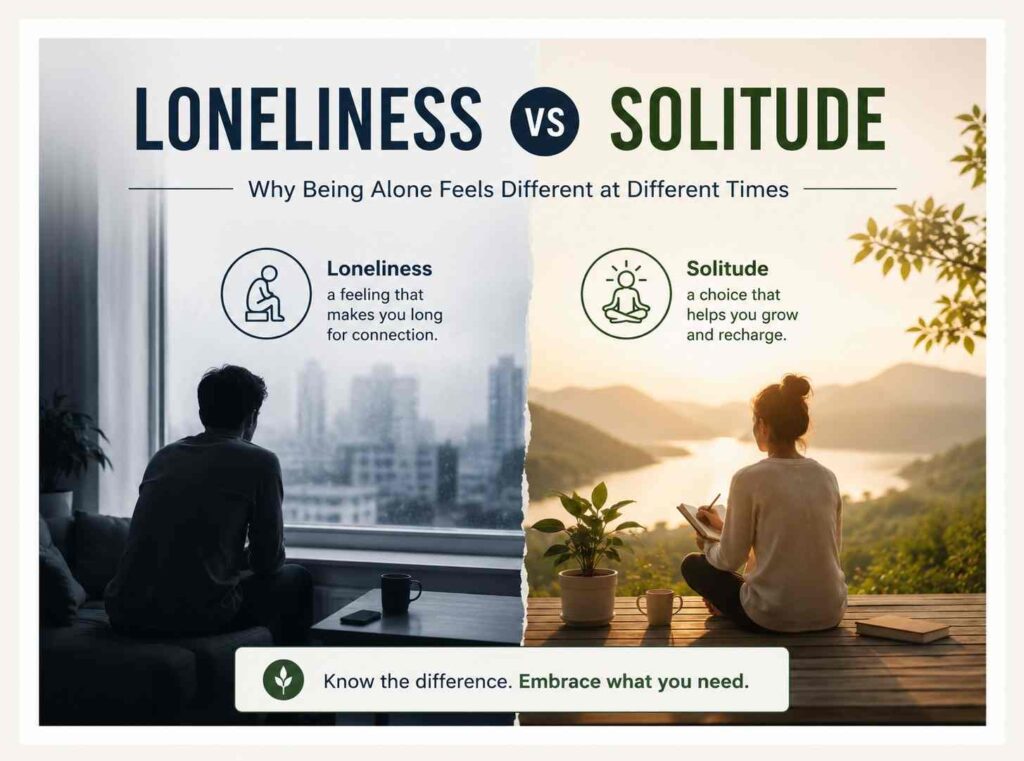
Ever wondered why spending an evening alone can sometimes feel peaceful, while on another occasion the same quiet room can feel strangely empty?
Nothing obvious has changed. The room is the same. Your phone is nearby. Your routine may even be similar. Yet emotionally, the experience can be completely different.
Understanding the Loneliness vs Solitude Difference can help explain why this happens. The focus keyphrase is not simply about whether other people are physically present. Instead, it is about whether your time alone feels chosen, meaningful and emotionally comfortable—or unwanted and disconnected.
For many middle-class Indians balancing jobs, commuting, family responsibilities, finances and endless notifications, genuine quiet time can be rare. However, when that quiet finally arrives, it does not always feel relaxing.
Sometimes you need space. Sometimes you need connection. The real skill is learning to recognise which one you need right now.
Picture Two Evenings That Look Almost Identical
Imagine returning home after a packed work schedule.
The commute was tiring. Messages kept arriving throughout the day. Several tasks required your attention, and conversations seemed endless.
You finally sit down alone with a cup of tea.
There is no conversation, no meeting and no immediate demand on your attention. Surprisingly, the silence feels wonderful. You put your phone aside, enjoy your tea and feel your mind gradually becoming quieter.
That is solitude.
Now imagine another evening.
You return home after a difficult day. You wanted someone to ask how things went. You open your phone, scroll through social media and see people meeting friends, celebrating milestones or simply enjoying themselves together.
Suddenly, the same silence feels heavier.
That may be loneliness.
Therefore, being alone is not automatically the problem. What the aloneness means to you can make all the difference.
What Is the Difference Between Loneliness and Solitude?
Loneliness and solitude can look almost identical from the outside because both may involve spending time without other people.
Internally, however, they can feel very different.
Solitude is often chosen. Loneliness is often experienced as unwanted disconnection.
You might intentionally spend an hour alone because you want to read, think, walk, exercise, plan your finances or simply recover after a demanding day. In this situation, being alone serves a purpose.
Loneliness, meanwhile, can appear even when other people are physically nearby. You could sit inside a crowded office, travel in a packed local train or attend a family gathering and still feel emotionally disconnected.
That is an important part of the Loneliness vs Solitude Difference: physical company and emotional connection are not necessarily the same thing.
Solitude Can Feel Like Charging Your Internal Battery
Think about your phone.
When its battery becomes low, you do not blame the device for needing electricity. You simply recharge it.
Your attention also needs recovery.
Work conversations, traffic, household responsibilities, social media, calls, notifications and constant decision-making can keep your brain occupied for hours. Consequently, a small period without stimulation may feel refreshing.
Healthy solitude can provide space to:
- Process your thoughts without interruption.
- Reflect on decisions more calmly.
- Read or enjoy a hobby.
- Take a quiet walk.
- Plan upcoming responsibilities.
- Rest without needing to entertain anyone.
- Reconnect with personal goals.
Therefore, wanting occasional time alone does not necessarily mean something is wrong. Sometimes your mind simply needs fewer inputs.
Loneliness Is Different Because Something Feels Missing
Loneliness is usually less about physical isolation and more about the quality of connection you feel you have.
For example, you may regularly speak with colleagues about deadlines, tasks and meetings. You might exchange messages with family members about bills, groceries and responsibilities.
Yet you may still feel that nobody really knows what is happening inside your head.
In that situation, the problem is not necessarily a lack of conversations. Instead, it may be a lack of meaningful connection.
You might notice thoughts such as:
- “I wish I had someone to talk to.”
- “Nobody really understands what I’m going through.”
- “Everyone seems busy with their own lives.”
- “I don’t feel connected even when I’m around people.”
- “I want company, but I don’t know whom to contact.”
These feelings can be signals that your emotional needs deserve attention rather than something to simply push aside.
Why Being Alone Feels Different at Different Times
Here is where things become interesting.
The same person can enjoy solitude at one moment and dislike being alone at another.
Why?
Because your emotional needs are constantly changing.
1. Your Social Battery Changes
After hours of meetings, conversations, phone calls and commuting, being alone may feel refreshing.
However, after spending a long period without meaningful interaction, another quiet evening might feel isolating.
Therefore, ask yourself:
“Have I had too much interaction—or too little meaningful connection?”
That simple question can reveal a lot.
2. Choice Changes the Experience
Choosing to spend an evening alone can feel completely different from being alone because your plans were cancelled.
In the first situation, you have control.
In the second, the experience may feel imposed on you.
Consequently, chosen solitude often feels restorative, while unwanted isolation can feel uncomfortable.
3. Your Mood Changes Your Interpretation
When you feel confident and emotionally settled, spending time alone may feel peaceful.
However, after a stressful day, disappointment or disagreement, silence can create more space for difficult thoughts.
The environment has not necessarily changed.
Your emotional state has.
4. Social Media Can Make Quiet Time Feel Louder
You sit alone and open Instagram for “just five minutes.”
Suddenly, you see holidays, restaurants, weddings, promotions, fitness achievements and groups of friends smiling together.
Your peaceful evening begins to look boring by comparison.
However, social media usually shows selected moments rather than complete lives. Therefore, comparing your ordinary evening with somebody else’s highlight can unnecessarily transform solitude into dissatisfaction.
5. Life Circumstances Change
Being alone can feel different during periods of transition.
A job change, relocation, changing friendships, increased responsibilities or shifts in family routines can temporarily reduce familiar social contact.
Therefore, loneliness may sometimes reflect a transition rather than a permanent reality.
The Question That Changes Everything
Instead of immediately asking:
“Why am I alone?”
Try asking:
“What do I need right now—connection or recovery?”
That small change moves your attention from judgement to action.
If you need recovery, protect your solitude.
If you need connection, create an opportunity for meaningful interaction.
The goal is not to eliminate alone time. Instead, it is to become better at understanding what your emotional state is communicating.
How to Turn Alone Time Into Healthy Solitude
Solitude becomes more valuable when it has intention behind it.
1. Give Your Alone Time a Purpose
Do not automatically fill every quiet moment with scrolling.
Instead, decide what your alone time is for.
For example:
- Take a 15-minute walk without constantly checking your phone.
- Read a few pages of a book.
- Prepare tomorrow’s priorities.
- Listen to music without multitasking.
- Organise your room.
- Write down your thoughts.
- Sit quietly with tea or coffee.
- Work on a personal interest.
The activity does not need to be productive. Rest itself can be useful.
2. Create Small Screen-Free Windows
Constant digital stimulation can prevent solitude from actually feeling quiet.
Try keeping your phone away for 10–20 minutes while eating, walking or relaxing.
Initially, the silence may feel unfamiliar. However, over time, these small pauses can help you become more comfortable with your own thoughts.
3. Track How Alone Time Makes You Feel
This is where The Life TrackR approach can become useful.
Instead of assuming that alone time is either “good” or “bad,” observe patterns.
You could track simple notes such as:
Time alone: 30 minutes
Activity: Evening walk
Before: Mentally tired
After: Calm and refreshed
Another entry might look completely different:
Time alone: 2 hours
Activity: Social media scrolling
Before: Slightly low
After: More disconnected
After several entries, patterns may become easier to recognise.
Perhaps walking helps while scrolling makes things worse. Perhaps you enjoy solitude after busy work hours but need social connection after spending too much time at home.
Awareness makes better choices easier.
When You Need Connection, Make It Meaningful
The opposite of loneliness is not necessarily having hundreds of contacts.
Often, one genuine conversation is more valuable than dozens of shallow interactions.
Therefore, when you notice that you need connection, consider taking one small action.
You could call someone you trust, have tea with a family member without phones, meet a friend, join a hobby group, exercise with someone or simply start a genuine conversation instead of sending another forwarded message.
Most importantly, do not wait for connection to appear automatically.
Sometimes creating connection requires initiative.
Try the 3-Question Check-In
Whenever being alone begins to feel uncomfortable, ask yourself three questions.
Question 1: Do I Need Rest?
If you feel mentally overloaded, irritable or exhausted, you may need quiet rather than more stimulation.
In that case, protect your solitude.
Question 2: Do I Need Connection?
If you feel disconnected, overlooked or strongly wish you had someone to speak with, reaching out may be more helpful than distracting yourself.
Send a message. Make a call. Plan a conversation.
Question 3: Am I Simply Bored?
Boredom is not always loneliness.
Sometimes you simply need engagement.
Cook something, exercise, organise your space, learn something new or work on a hobby before deciding that your discomfort means you are lonely.
This three-question check-in helps you respond to the actual need instead of automatically reaching for your phone.
Stop Treating Every Quiet Moment as a Problem
Modern life encourages constant stimulation.
Waiting for a lift? Check your phone.
Standing in a queue? Scroll.
Eating alone? Watch a video.
Travelling? Open another app.
As a result, even a few minutes without stimulation can begin to feel uncomfortable.
However, quiet moments do not always need fixing.
Sometimes they allow your mind to process experiences that constant digital input keeps pushing aside.
Therefore, building comfort with short periods of intentional solitude can become a valuable daily habit.
A Simple Weekly Experiment
For one week, intentionally create 15 minutes of quiet alone time.
No scrolling. No work email. No pressure to “achieve” anything.
Walk, sit quietly, journal, stretch or simply enjoy a drink.
Afterward, record three things:
- What did I do?
- How did I feel before?
- How did I feel afterward?
At the same time, notice moments when being alone feels emotionally heavy.
This contrast can help you understand your personal Loneliness vs Solitude Difference instead of relying on generic advice.
When Loneliness Deserves More Attention
Occasional loneliness is a common human experience. However, persistent loneliness that significantly affects your daily life deserves attention.
If feelings of isolation continue for a long period, begin affecting sleep or everyday functioning, or make it difficult to enjoy activities you normally value, consider speaking with someone you trust or seeking support from a qualified mental-health practitioner.
Asking for meaningful connection is not the opposite of independence.
Strong independence includes knowing when connection is necessary.
A Better Relationship With Being Alone
The goal is not to become someone who always loves being alone.
Neither is the goal to stay constantly surrounded by people.
A healthier goal is flexibility.
Enjoy connection when you need connection.
Protect solitude when you need recovery.
And learn to recognise the difference.
With The Life TrackR, you can begin noticing these patterns instead of judging individual moments. A simple record of your mood, habits and alone time can gradually show you what genuinely helps you recharge.
Conclusion
Understanding the Loneliness vs Solitude Difference changes the question from “Is being alone good or bad?” to “What does being alone feel like for me right now?”
Sometimes silence means your mind finally has room to recover. At other times, the same silence signals that you need meaningful human connection. Therefore, instead of escaping every quiet moment, pay attention to what it is telling you.
With small check-ins, intentional solitude, genuine conversations and simple tracking through The Life TrackR, being alone can become something you understand rather than something you automatically fear.
Your quiet moments are giving you information.
The next time the room becomes silent, notice what you hear inside.
#LonelinessVsSolitude #BeingAlone #Solitude #EmotionalWellbeing #SelfAwareness #PersonalGrowth #HealthyHabits #Mindfulness #TheLifeTrackR
Editor’s Note: This article was originally published here: https://thelifetrackr.com/loneliness-vs-solitude-why-being-alone-feels-different-at-different-times/ by @Kairav and @krutika