
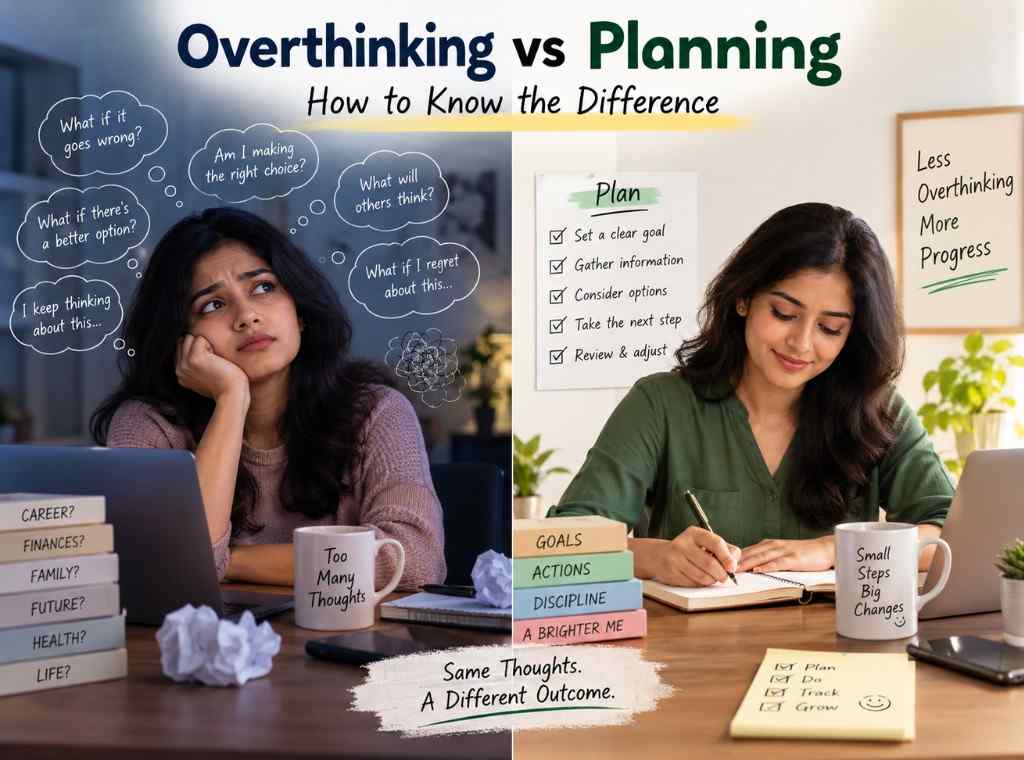
Have you ever spent an entire evening thinking about a decision, only to realise that you are no closer to making it?
Perhaps you were considering whether to change jobs, start investing, speak to your manager, reduce an expense, begin exercising, or make an important family decision. You considered one possibility, then another. Soon, you started imagining everything that could go wrong.
It felt productive because your mind was busy. However, thinking more does not always mean planning better.
Understanding the focus keyphrase, Overthinking vs Planning Difference, can help you recognise when useful preparation has quietly turned into repetitive thinking. More importantly, learning this difference can help you make clearer decisions without waiting until every uncertainty disappears.
What Is the Difference Between Overthinking and Planning?
At first, planning and overthinking can look surprisingly similar.
Both involve considering the future. Both may include evaluating risks, comparing choices and imagining possible outcomes. However, there is one important distinction:
Planning moves you towards action. Overthinking repeatedly moves you through the same thoughts.
A useful plan usually produces something concrete: a decision, deadline, checklist, budget, next step or alternative approach.
Overthinking, meanwhile, often produces more questions without meaningful progress.
For example, suppose you are considering changing your job.
Planning might involve updating your resume, researching suitable roles, improving a skill, calculating how much emergency savings you need and applying to selected opportunities.
Overthinking might sound different:
“What if the new company is worse?”
“What if I regret leaving?”
“What if I cannot adjust?”
“What if I wait and something better comes later?”
These concerns are understandable. Nevertheless, repeatedly asking them without gathering new information rarely improves the decision.
Why Overthinking Can Feel Like Responsible Planning
This is where the distinction becomes difficult.
When you care about your career, money, health, family or future, thinking carefully feels responsible. Therefore, spending more time analysing a decision can create the impression that you are protecting yourself from mistakes.
Yet there is a hidden problem.
No amount of thinking can remove every uncertainty from life.
You cannot completely predict whether a new job will be perfect, whether an investment will perform exactly as expected, whether a new routine will work immediately or whether every decision will produce the result you imagined.
Planning prepares you for uncertainty.
Overthinking tries to eliminate uncertainty.
That difference matters.
Signs You Are Planning Rather Than Overthinking
Healthy planning usually has boundaries. You know what you are trying to achieve, what information you need, and what you will do next.
1. You Have a Clear Problem to Solve
Instead of thinking vaguely about everything that might happen, you define the actual issue. For instance, rather than thinking, “My finances are a mess,” you identify a specific concern, such as reducing unnecessary monthly expenses or building an emergency fund. Once the problem becomes specific, possible solutions become easier to identify.
2. You Are Gathering Useful Information
Planning involves collecting information that can genuinely influence your decision. Before buying an expensive item, for example, you might compare prices, review your monthly budget, and decide whether the purchase is necessary. However, repeatedly searching for more opinions after you already have enough information can turn useful planning into unnecessary overthinking.
3. Your Thinking Produces a Next Step
Productive planning should eventually answer one important question: “What am I going to do next?” Your next step does not need to solve the entire problem. It might mean updating your resume, saving ₹5,000 this month, scheduling an appointment, walking for 20 minutes, discussing an issue with family, or cancelling an unused subscription. The important part is moving from thinking to action.
4. You Can Accept That the Plan May Change
Good planning is flexible. You make the best decision possible with the information currently available and adjust when circumstances change. In contrast, overthinking often keeps you waiting for complete certainty before taking even the first step.
Signs Planning Has Turned Into Overthinking
Sometimes useful thinking slowly becomes mental repetition without us noticing.
Here are some common warning signs.
You Keep Revisiting a Decision Without New Information
You already considered the advantages, disadvantages and risks. Yet you continue mentally reopening the same decision.
Nothing new has been discovered, but the thinking continues.
That is a strong indication that analysis is no longer helping.
You Spend More Time Imagining Problems Than Solving Them
Planning asks:
“If this problem happens, what can I do?”
Overthinking asks:
“What if something goes wrong?”
The first question encourages preparation. The second can continue indefinitely.
Small Decisions Begin Feeling Unnecessarily Heavy
Choosing what to buy, what message to send, whether to attend something or when to start a routine should not always require hours of analysis.
If relatively small choices regularly become exhausting, you may be giving them more mental attention than their consequences justify.
You Are Waiting for the Perfect Decision
Many decisions do not have one perfect answer.
Sometimes there are simply several reasonable options with different advantages and disadvantages.
Therefore, searching endlessly for a completely risk-free choice can delay progress.
Thinking Leaves You More Confused
Planning generally creates greater clarity.
Overthinking often does the opposite.
After repeatedly analysing the same situation, you may feel mentally tired, anxious and less certain than when you started.
A Simple Test: Ask Yourself These 5 Questions
When you are unsure whether you are planning or overthinking, stop and ask:
- Have I learned anything new from the last few minutes of thinking?
- Is there additional information I genuinely need before deciding?
- Can I identify one practical next step?
- Am I solving a realistic problem or imagining endless possibilities?
- What would I do if I had to make the decision with the information I already have?
Your answers can quickly reveal whether additional thinking is useful.
How to Stop Overthinking and Start Planning
The goal is not to stop thinking carefully. Instead, you want to give your thoughts direction.
1. Define the Actual Decision
Write the decision in one clear sentence.
For example:
“I need to decide whether I can afford this purchase.”
That is much easier to address than thinking vaguely about money, future expenses and everything that might possibly happen.
2. Separate Facts From Possibilities
Create two mental categories: what you know and what you are imagining.
Suppose you are worried about an upcoming workplace presentation.
A fact might be:
“I have 15 minutes to present.”
An imagined possibility might be:
“Everyone will think my presentation is terrible.”
Once you separate facts from assumptions, the situation often becomes easier to manage.
3. Give Decisions a Time Limit
Not every decision deserves unlimited thinking time.
A small decision might deserve a few minutes, while an important financial or career decision could require considerably more research.
However, establish a reasonable point at which thinking must become action.
Without a boundary, analysis can continue simply because more thinking is always possible.
4. Focus on the Next Controllable Step
Large decisions feel overwhelming when you try to solve the entire future at once.
Instead, ask:
“What can I control right now?”
If you want a better job, you cannot control when an employer will offer you one. However, you can improve your resume, strengthen relevant skills and begin applying.
If you want greater financial stability, you cannot predict every future expense. However, you can review spending and start building savings.
Action reduces uncertainty more effectively than endless thinking.
5. Create a Backup Plan
Sometimes overthinking comes from fear that one wrong decision will ruin everything.
A backup plan can reduce that pressure.
If Plan A does not work, decide what Plan B might look like.
Knowing that you can adapt makes it easier to move forward without demanding certainty.
Apply the 70% Clarity Rule
Waiting for 100% certainty can keep you waiting indefinitely.
Instead, when you have enough reliable information to understand the main benefits, risks and consequences, consider whether you have sufficient clarity to move forward.
This does not mean making reckless decisions.
Major financial, medical, legal or career choices may require appropriate research or qualified advice. However, everyday decisions rarely need perfect information.
Sometimes good enough information combined with thoughtful action is more valuable than perfect information that arrives too late.
Create a Personal Decision Routine
The Life TrackR encourages tracking not simply what you accomplish, but also how you make everyday choices.
When facing an important decision, try this short process:
Step 1: Define the decision clearly.
Step 2: Write down the facts you currently know.
Step 3: Identify information that is genuinely missing.
Step 4: Consider the most realistic risks.
Step 5: Decide how you would respond if those risks occurred.
Step 6: Choose one next action.
Step 7: Set a point to review the result.
This approach transforms vague worry into a structured process.
Planning Gives Direction; Action Gives Feedback
One of the biggest limitations of overthinking is that your mind is working with predictions.
Real action provides information that imagination cannot.
You can spend weeks wondering whether you will enjoy exercising in the morning, for example. Alternatively, you can try the routine several times and observe what happens.
Similarly, you can spend months wondering whether a new skill will help your career. Or you can complete an introductory course, build a small project and evaluate your interest.
Small experiments create real feedback.
Consequently, you do not always need to make a huge permanent decision. Sometimes you simply need to test the next sensible step.
Give Yourself Permission to Adjust
Changing your plan does not automatically mean the original decision was wrong.
Circumstances change. New information appears. Priorities evolve.
Therefore, a healthy planning process includes reviewing and adjusting your approach.
Instead of asking:
“What if I make the wrong decision?”
Try asking:
“If the situation changes, how will I respond?”
That question replaces the demand for certainty with confidence in your ability to adapt.
How The Life TrackR Can Help
The Life TrackR can encourage a simple habit: track decisions, actions and outcomes instead of repeatedly replaying possibilities in your mind.
When you record what you planned, what you actually did and what happened afterward, patterns become easier to recognise. Over time, you may discover which decisions genuinely require more preparation and which ones simply require action.
The goal is not to think less. It is to think with purpose and act with greater clarity.
Conclusion
The Overthinking vs Planning Difference is not determined by how long you spend thinking. It is determined by whether your thinking creates clarity, preparation and meaningful action.
Planning asks, “What information do I need, and what should I do next?” Overthinking repeatedly asks, “But what if…?”
Therefore, the next time you notice yourself mentally circling the same decision, stop searching for complete certainty. Identify what you know, prepare for realistic risks and choose one controllable next step.
With The Life TrackR, small decisions, regular reflection and consistent action can gradually turn uncertainty into forward movement.
#Overthinking #Planning #DecisionMaking #MentalClarity #Productivity #PersonalGrowth #SelfImprovement #TheLifeTrackR
Editor’s Note: This article was originally published here: https://thelifetrackr.com/overthinking-vs-planning-how-to-know-the-difference/ by @Kairav and @krutika