
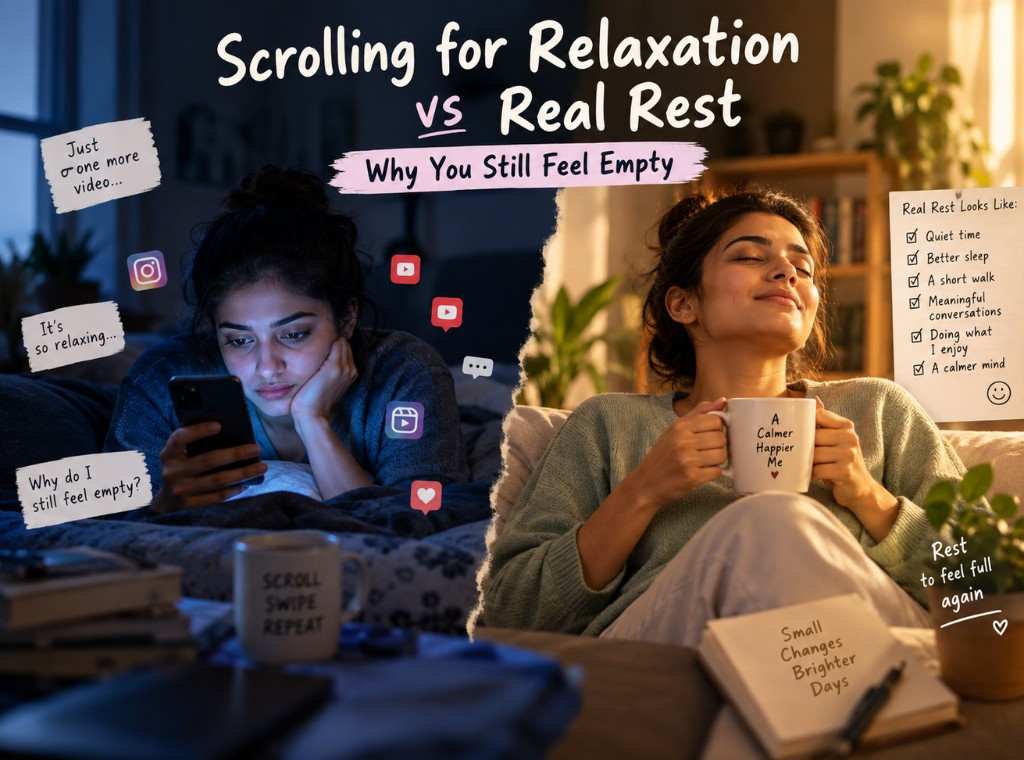
You finally finish a long working day. Dinner is done, responsibilities are temporarily out of the way, and you sit down with your phone thinking, “I’ll scroll for just a few minutes.”
A few reels become twenty. One video leads to another. Messages, memes, news, shopping suggestions and random posts keep appearing. Before you realise it, a large part of your free time has disappeared.
Yet something strange happens when you finally put the phone down.
You do not feel rested. You feel empty, distracted or even more tired.
Ever wondered why something that feels so relaxing in the moment does not always leave you refreshed afterwards?
Understanding scrolling vs real rest can completely change how you use your limited free time. The problem is not necessarily your phone. Instead, the real issue may be confusing distraction with recovery.
Why Scrolling Feels Like Rest
After spending hours meeting deadlines, travelling, managing household responsibilities or dealing with workplace pressure, your mind naturally wants relief.
Scrolling provides it instantly.
There is no planning involved. You do not need much physical effort. Furthermore, endless content gives your brain something new every few seconds.
That makes scrolling extremely convenient when you are mentally exhausted.
For example, imagine reaching home after a packed commute. You may not have enough energy to read a book, exercise or have a long conversation. Opening Instagram, YouTube or another app feels much easier.
For a while, you stop thinking about responsibilities.
However, escaping from effort and recovering from effort are not always the same thing.
That difference matters.
Scrolling vs Real Rest: What Is the Difference?
Scrolling generally keeps your mind occupied.
Real rest gives your mind an opportunity to recover.
While scrolling through short-form content, your attention repeatedly shifts from one piece of information to another. You may see humour, bad news, travel content, financial advice, advertisements and someone’s personal update within a few minutes.
Therefore, although your body may be sitting comfortably, your attention is still busy processing information.
Real rest can look completely different.
It might involve sitting quietly with tea, taking a slow walk, listening to calming music, spending relaxed time with family, stretching, sleeping properly or simply allowing yourself to do nothing for a while.
The important difference is not whether an activity involves technology.
The real question is: How do you feel afterwards?
Why You Can Feel Empty After Long Scrolling Sessions
1. You Consumed but Did Not Recover
Scrolling gives you content continuously.
However, consuming information is still mental activity.
When your brain has already spent hours handling meetings, messages, decisions and responsibilities, adding another stream of information may not provide the recovery you actually need.
Consequently, you may finish scrolling entertained but not restored.
2. Your Free Time Disappears Quietly
Most people do not intentionally decide to spend an hour scrolling.
It usually happens gradually.
You watch one reel, check another post, open a recommended video and then look at the comments. Suddenly, much more time has passed than expected.
This can create another uncomfortable feeling: “I finally had some time for myself, and I wasted it.”
Therefore, the emptiness may partly come from losing time you genuinely needed.
3. Comparison Can Enter Without Permission
Social media often presents selected moments.
Someone is travelling. Another person received a promotion. Someone bought a home. Another person appears extremely fit, productive or financially successful.
Meanwhile, you may be sitting exhausted after an ordinary working day.
Even when you understand that online content is selective, repeated exposure can still influence how you view your own life.
As a result, something you opened for relaxation may quietly leave you dissatisfied.
4. Your Body Is Still Asking for What It Actually Needs
Sometimes you do not need entertainment.
You need sleep.
At other times, you may need movement, silence, food, emotional connection or simply freedom from stimulation.
However, scrolling can temporarily cover those signals.
The underlying need remains.
That is why putting the phone away can suddenly make the tiredness return.
Not All Screen Time Is Bad
It would be unrealistic to suggest completely avoiding phones.
Technology is part of modern life. Moreover, scrolling can genuinely be enjoyable.
A funny video can improve your mood. Talking with a friend can make you feel connected. Watching useful content can teach you something valuable. Similarly, entertainment can provide a healthy break.
Therefore, scrolling vs real rest does not have to become a battle between “good” and “bad” habits.
The better goal is awareness.
Instead of asking, “How do I stop using my phone?”, ask:
“What kind of rest do I actually need right now?”
That small question changes the entire approach.
Different Types of Tiredness Need Different Types of Rest
We often treat every form of tiredness the same way.
However, exhaustion can have different causes.
1. Mental Tiredness
If your mind has been making decisions all day, more information may not help.
Try reducing stimulation instead. Sit quietly, take a shower, listen to soft music or go for a short walk without constantly checking notifications.
2. Physical Tiredness
A demanding commute, long hours of sitting or physical work can leave your body uncomfortable.
In that situation, gentle stretching, proper food, hydration and sufficient sleep may provide more recovery than another hour online.
3. Emotional Tiredness
Workplace tension, financial concerns, family responsibilities and personal worries can create emotional fatigue.
Sometimes genuine conversation with someone you trust can feel more restorative than consuming random content.
4. Social Tiredness
There are also moments when you have simply interacted with too many people.
You may need quiet time without conversations, calls or notifications.
Recognising the type of tiredness helps you choose the right response.
Try the 10-Minute Rest Test
Here is a simple experiment.
Before automatically opening a social media app after a tiring period, give yourself 10 minutes of intentional rest.
During those ten minutes, you could:
- Sit somewhere quietly without your phone.
- Take a short walk around your building or neighbourhood.
- Stretch your shoulders, neck and back.
- Drink water or tea without watching anything.
- Close your eyes and breathe slowly.
- Talk casually with a family member.
- Listen to one relaxing song without multitasking.
Afterwards, ask yourself:
“Do I still want to scroll, or was I actually looking for rest?”
You may still choose to use your phone.
That is completely fine.
However, now scrolling becomes a conscious choice rather than an automatic reaction to exhaustion.
Create a Small Gap Between Work and Screens
For many working Indians, the phone becomes the immediate transition between work and personal life.
Office finishes.
The commute begins.
The phone appears.
You reach home.
The phone appears again.
Therefore, your brain rarely receives a genuine transition period.
Try creating a small screen-light buffer after work. Even 15–20 minutes can help you shift mentally from work responsibilities to personal time.
For example, change clothes, wash your face, have water, stretch or sit quietly before opening entertainment apps.
Small boundaries are usually easier to maintain than extreme digital rules.
Make Rest Easy to Access
One reason scrolling wins is convenience.
Your phone is already in your hand.
Meanwhile, healthier forms of rest sometimes feel like another task.
Therefore, make recovery easier.
Keep a book near your sofa. Create a relaxing playlist. Leave walking shoes somewhere visible. Keep notifications away from the dining table. Charge your phone slightly away from your bed.
The easier an alternative becomes, the less willpower you need.
Stop Measuring Rest by Productivity
There is another trap worth noticing.
Sometimes people turn rest itself into a performance target.
They feel they must meditate perfectly, read something educational, complete a workout or use every free minute productively.
But genuine rest does not always need to achieve something.
You are allowed to have periods where nothing measurable happens.
Sitting quietly for fifteen minutes is not necessarily wasted time.
A relaxed conversation is not unproductive.
Taking a slow walk without counting steps can still be valuable.
Rest does not need to earn its place in your schedule.
A Simple Evening Reset
Instead of completely banning scrolling, create a healthier sequence.
Step 1: Finish your immediate responsibilities.
Step 2: Take 10–20 minutes away from unnecessary screens.
Step 3: Check what you actually need—food, movement, conversation, silence or sleep.
Step 4: Give yourself that form of recovery first.
Step 5: If you still want entertainment afterwards, enjoy it intentionally.
This approach removes unnecessary guilt while protecting genuine recovery.
Use The Life TrackR Approach: Observe Before You Change
You do not need a complicated digital detox.
For one week, simply notice three things: when you start scrolling, why you started and how you feel afterwards.
For example:
Before: Mentally exhausted
Activity: Scrolled reels for 50 minutes
After: Distracted and still tired
Another entry might look different:
Before: Slightly bored
Activity: Watched funny videos for 20 minutes
After: Relaxed and cheerful
Both observations are useful.
The Life TrackR encourages awareness because patterns become easier to change once you can actually see them.
What Real Rest Might Look Like for You
There is no universal formula.
For one person, rest might be sitting quietly on the balcony. For another, it could be playing with children, listening to music, taking a short walk, cooking slowly or simply sleeping earlier.
Instead of copying somebody else’s perfect evening routine, discover what leaves you feeling genuinely restored.
That is the difference worth tracking.
A Small Change Can Feel Surprisingly Different
You do not need to delete every app or throw your phone into a drawer.
Start smaller.
Before your next long scrolling session, give yourself ten minutes of actual recovery first.
Then notice what happens.
You may discover that what you were searching for on your screen was not entertainment at all. You were simply tired and needed permission to rest.
The Life TrackR is about recognising patterns like these and making small, realistic improvements without turning everyday life into another stressful project.
Conclusion
The debate around scrolling vs real rest is not really about whether phones are good or bad. It is about understanding the difference between temporarily distracting yourself from tiredness and genuinely recovering from it.
Scrolling can entertain you, connect you and sometimes help you relax. However, when you consistently finish your free time feeling empty, your mind may be asking for a different kind of break.
So, the next time your thumb automatically reaches for another reel, ask one simple question:
“Am I looking for entertainment—or do I actually need rest?”
That answer might completely change how you spend the next hour.
#ScrollingVsRealRest #TheLifeTrackR #DigitalWellness #MentalRest #ScreenTime #MindfulLiving #HealthyHabits #WorkLifeBalance #SocialMediaHabits #DigitalHabits
Editor’s Note: This article was originally published here: https://thelifetrackr.com/scrolling-for-relaxation-vs-real-rest-why-you-still-feel-empty/ by @Kairav and @krutika