
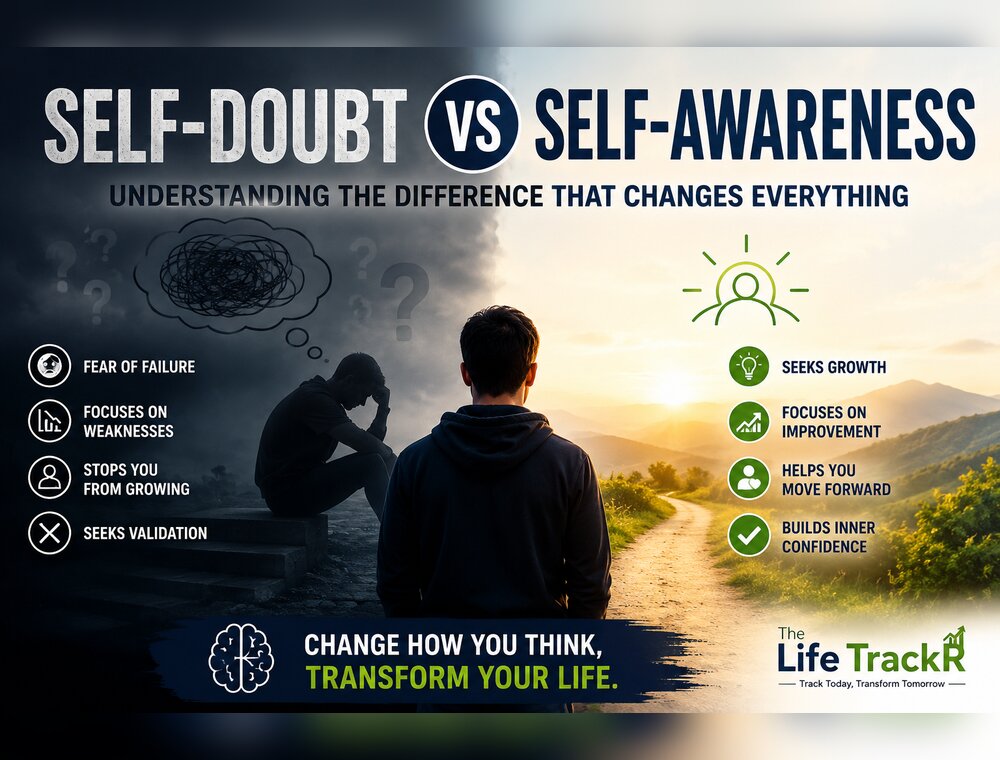
Ever wondered why some people constantly question themselves while others calmly improve without feeling broken inside? The answer often lies in understanding the difference between self-doubt vs self-awareness.
At first, both can feel similar. After all, both involve thinking deeply about yourself. However, one quietly drains your confidence while the other helps you grow stronger. One keeps you stuck, whereas the other pushes you forward with clarity.
Most people confuse the two without even realizing it.
That confusion affects careers, relationships, financial decisions, and even daily happiness. In fact, many hardworking people spend years believing they are “being realistic” when they are actually trapped in self-doubt.
The truth is surprising.
Once you understand the difference between self-doubt vs self-awareness, the way you see your life begins to change completely. Moreover, you stop fighting yourself and start understanding yourself better.
This shift can transform everything.
Why Most People Misunderstand Themselves
There comes a point in life when you start questioning your choices. You wonder whether you are good enough, smart enough, capable enough, or successful enough.
At first, it seems harmless.
You think you are simply analyzing your mistakes. Yet slowly, that analysis turns into criticism. Then criticism turns into fear. Eventually, fear becomes hesitation.
This is where self-doubt quietly takes control.
On the other hand, self-awareness works differently. Instead of attacking your identity, it helps you observe your behavior. It does not say, “You are a failure.” Instead, it asks, “What can be improved here?”
That single difference changes everything.
What Is Self-Doubt?
Self-doubt is the constant feeling that you are not capable, worthy, or good enough. It creates fear before action even begins.
It often sounds like this:
- “What if I fail?”
- “Others are better than me.”
- “Maybe I should not even try.”
- “I always mess things up.”
Over time, self-doubt creates mental exhaustion. Furthermore, it makes even simple decisions feel heavy.
Many people assume self-doubt keeps them humble. However, excessive self-doubt actually prevents growth because it focuses on fear instead of learning.
Common Signs of Self-Doubt
1. Constant Overthinking
You replay conversations, decisions, and mistakes repeatedly in your mind.
2. Fear of Taking Opportunities
Even when opportunities appear, you hesitate because you assume failure before starting.
3. Comparing Yourself to Everyone
Social media, office achievements, and even small successes of others begin affecting your confidence.
4. Seeking Endless Validation
You constantly need reassurance before making decisions.
5. Difficulty Celebrating Wins
Even after achieving something meaningful, you feel it was luck instead of capability.
What Is Self-Awareness?
Self-awareness is the ability to understand your emotions, strengths, weaknesses, patterns, and behaviors without judging yourself harshly.
It is honest, but it is not cruel.
Instead of pulling you down, self-awareness helps you improve with clarity and maturity. Moreover, it allows you to respond thoughtfully instead of reacting emotionally.
A self-aware person might think:
- “I handled that situation poorly. I can improve next time.”
- “I feel stressed today, so I need rest.”
- “This skill needs work, and that is okay.”
- “I need better boundaries.”
Notice the difference?
Self-awareness focuses on solutions. Self-doubt focuses on limitations.
The Small Difference That Creates Massive Impact
At first glance, both self-doubt and self-awareness involve reflection. Yet emotionally, they move in opposite directions.
| Self-Doubt | Self-Awareness |
|---|---|
| Creates fear | Creates clarity |
| Focuses on weakness | Focuses on improvement |
| Stops action | Encourages better action |
| Feels emotionally heavy | Feels emotionally balanced |
| Seeks perfection | Accepts progress |
| Damages confidence | Builds confidence |
This difference affects every area of life.
How Self-Doubt Affects Daily Life
Many middle-class Indians working long hours silently struggle with self-doubt. Yet because it feels normal, they rarely notice its impact.
At Work
Self-doubt can stop you from:
- Asking for better opportunities
- Sharing ideas in meetings
- Switching careers
- Starting side income plans
- Negotiating salary
As a result, talented people often stay invisible despite hard work.
In Relationships
Self-doubt creates insecurity. Therefore, people may:
- Overthink conversations
- Fear rejection
- Avoid honest communication
- Depend too much on approval
Eventually, emotional exhaustion grows on both sides.
In Personal Growth
People with self-doubt delay action endlessly. They wait to feel “fully ready.”
Unfortunately, that perfect moment rarely comes.
How Self-Awareness Improves Life
Self-awareness changes the quality of decisions.
Instead of reacting emotionally, you begin understanding why certain situations affect you. Moreover, you start identifying patterns that hold you back.
1. Better Emotional Control
Self-aware people notice stress early. Therefore, they respond calmly instead of exploding emotionally.
2. Better Career Decisions
They understand their strengths clearly. As a result, they choose opportunities more wisely.
3. Better Confidence
True confidence does not come from pretending to be perfect. Instead, it comes from knowing yourself honestly.
That is what self-awareness builds.
4. Better Boundaries
Self-aware individuals understand their limits. Therefore, they avoid burnout more effectively.
Why Self-Doubt Feels So Real
One reason self-doubt becomes powerful is because the brain treats fear like protection.
Your mind believes:
- Avoiding risk prevents pain
- Avoiding failure keeps you safe
- Staying small avoids embarrassment
However, this “safety” slowly limits your life.
Interestingly, self-awareness does not remove fear completely. Instead, it helps you move forward despite fear.
That is real growth.
The Shift That Changes Everything
The biggest transformation happens when you stop asking:
“Am I good enough?”
And start asking:
“What can I learn here?”
That small shift moves your mind from self-doubt into self-awareness.
Suddenly:
- Mistakes become lessons
- Feedback becomes useful
- Failure becomes temporary
- Growth becomes possible
This mindset creates emotional freedom.
Practical Ways to Build Self-Awareness Without Falling Into Self-Doubt
Observe Your Thoughts Without Believing Everything
Not every negative thought is true.
Whenever your mind says:
“I cannot do this,”
Pause and ask:
“Is this fact or fear?”
This simple habit creates mental clarity.
Stop Attacking Yourself for Mistakes
Instead of saying:
“I am terrible at this,”
Try:
“I need more practice here.”
Your brain responds differently to constructive thinking.
Journal Your Emotional Patterns
Spend 10 minutes daily writing:
- What triggered stress
- What made you happy
- What drained your energy
- What improved your mood
Over time, patterns become visible.
Reduce Constant Comparison
Comparison fuels self-doubt faster than almost anything else.
Remember:
People usually show highlights, not struggles.
Therefore, comparing your full life to someone’s edited moments is unfair to yourself.
Ask for Feedback Without Fear
Self-aware people are open to improvement.
Feedback is not an attack. Instead, it is information that helps growth.
Celebrate Small Progress
Growth is rarely dramatic.
Sometimes real progress looks like:
- Speaking confidently once
- Saying no when needed
- Managing emotions calmly
- Trying again after failure
These moments matter deeply.
The Role of The Life TrackR in Personal Growth
At The Life TrackR, growth is not about becoming perfect overnight. Instead, it is about understanding yourself better every day.
When people learn the difference between self-doubt vs self-awareness, they stop fighting internally and begin growing intentionally.
That shift improves:
- Mental clarity
- Confidence
- Productivity
- Relationships
- Financial decisions
- Emotional balance
Most importantly, it creates peace within yourself.
What Happens When You Finally Understand the Difference
Something powerful changes.
You stop seeing yourself as the problem.
Instead, you begin seeing yourself as a work in progress.
That realization reduces emotional pressure. Moreover, it creates space for learning, confidence, and healthier decisions.
Life becomes lighter.
Not because problems disappear, but because your relationship with yourself improves.
And honestly, that changes everything.
Conclusion
Understanding Self Doubt vs Self Awareness can completely transform the way you think, work, and grow. While self-doubt keeps you trapped in fear and hesitation, self-awareness helps you improve with honesty and balance.
The goal is not to become perfect. Instead, the goal is to understand yourself better without constantly tearing yourself down.
At The Life TrackR, meaningful growth begins when you stop questioning your worth and start understanding your potential. Once that happens, confidence no longer feels forced — it becomes natural.
#SelfDoubt #SelfAwareness #MentalClarity #PersonalGrowth #ConfidenceBuilding #MindsetMatters #TheLifeTrackR #EmotionalHealth #SelfImprovement #WorkLifeBalance
Editor’s Note: This article was originally published here: https://thelifetrackr.com/self-doubt-vs-self-awareness-understanding-the-difference-that-changes-everything/ by @Kairav and @krutika