
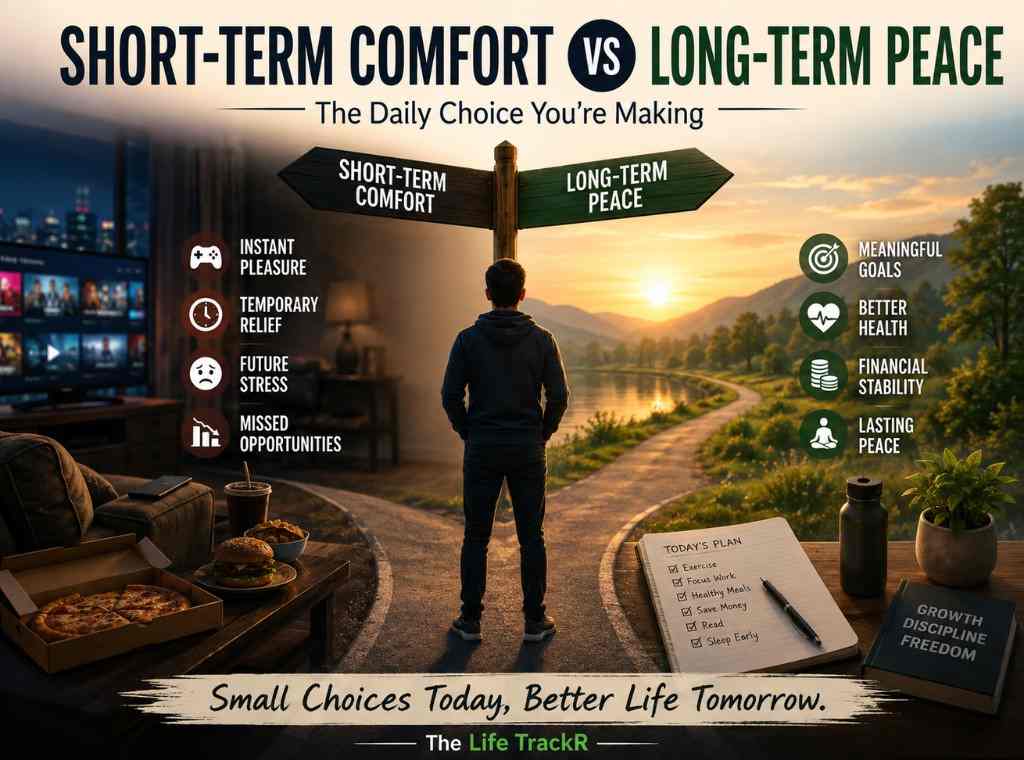
Introduction: The Choice That Rarely Feels Like a Choice
You finish a tiring day at work, reach home, eat dinner and finally get a few minutes for yourself. You planned to sleep early. However, your phone is right beside you.
Watching one more video feels like harmless short-term comfort.
Choosing another episode can delay the long-term peace you actually need.
Scrolling for a few more minutes can quietly turn short-term comfort into a daily habit.
Suddenly, much more time has passed than you intended. Sleeping late felt comfortable in the moment, but the next morning brings tiredness, rushing and regret.
Did you know that many of the decisions shaping your future can feel completely harmless while you are making them?
This is where the Short-Term Comfort Long-Term Peace focus keyphrase becomes relevant. Every day, we repeatedly choose between what feels easier right now and what may make life easier later.
The difference may seem small today. However, repeated over weeks, months and years, these choices can influence your health, finances, relationships, career, routines and overall peace of mind.
Why Short-Term Comfort Is So Attractive
Short-term comfort is not automatically bad.
After a demanding day, watching a movie can help you relax. Ordering food occasionally can save time. Buying something you enjoy can be rewarding. Taking a break can also be exactly what your body and mind need.
The problem begins when temporary relief becomes your automatic response to discomfort.
Consider some familiar situations:
- You feel tired, so you skip exercise.
- You feel stressed, so you keep scrolling.
- You want something expensive, so you buy it without considering your budget.
- You dislike an uncomfortable conversation, so you avoid it.
- You have an important task, but you postpone it because entertainment feels easier.
- You know you should sleep, yet another episode seems more appealing.
Each decision provides immediate relief.
However, tomorrow often receives the bill.
Comfort Today Can Quietly Become Stress Tomorrow
Imagine you have an important presentation to complete.
You still have enough time. Therefore, instead of beginning immediately, you tell yourself:
“I’ll start later.”
Initially, that decision feels wonderful. There is no pressure, no difficult thinking and no uncomfortable work.
But later arrives.
Now the deadline is closer.
You begin rushing. Your stress increases. Sleep gets delayed. Moreover, the quality of your work may suffer.
The interesting part is that procrastination did not remove discomfort. It simply transferred discomfort from the present to the future—with interest.
That same pattern can appear in many parts of everyday life.
| Short-Term Comfort | Possible Long-Term Cost |
|---|---|
| Skipping exercise repeatedly | Lower fitness and energy |
| Impulsive spending | Financial pressure |
| Avoiding difficult conversations | Relationship tension |
| Constant scrolling | Lost time and reduced focus |
| Delaying important work | Deadline stress |
| Sleeping very late | Poor next-day energy |
| Ignoring small problems | Bigger problems later |
Therefore, the real question isn’t always, “What feels good now?”
Sometimes a better question is:
“What choice will make tomorrow easier?”
Long-Term Peace Often Looks Uncomfortable at First
This is where many people misunderstand discipline.
Long-term peace does not always feel peaceful while you are building it.
Saving money means saying no to certain purchases.
Exercising means getting started when sitting down feels easier.
Finishing work early means choosing concentration over entertainment.
Setting boundaries can mean having uncomfortable conversations.
Sleeping on time may mean putting your phone away while something interesting is happening online.
In other words, peace often requires accepting a little discomfort today so that you carry less stress tomorrow.
That changes the way we can think about discipline.
Discipline isn’t simply punishment or restriction.
It can be a form of future comfort.
Think of Your Future Self as Someone You Are Helping
Suppose you wake up and discover that your clothes are ready, lunch is prepared, your bag is packed and your most important tasks are already organised.
Your morning becomes easier.
Who created that convenience?
You did—the previous evening.
This simple idea can completely change daily decision-making.
Instead of thinking:
“Why should I do this now?”
Try thinking:
“How can I make life easier for myself later?”
Suddenly, preparing tomorrow’s clothes isn’t another chore. It is reducing morning stress.
Saving part of your salary isn’t simply giving up spending. It is creating financial breathing room.
Walking regularly isn’t just exercise. It is investing in future energy.
Completing an important task isn’t only work. It is protecting your evening from unnecessary worry.
Where This Daily Choice Appears Most
1. Your Money
For many middle-class Indian households, financial peace is built through hundreds of ordinary decisions rather than one dramatic financial move.
A food delivery, unnecessary subscription or impulse purchase may seem insignificant individually. However, repeated spending can gradually reduce savings.
Instead, you can create simple rules:
Wait before making non-essential purchases.
Automate savings soon after receiving your salary.
Review recurring subscriptions periodically.
Keep an emergency fund goal.
Separate “want” spending from essential expenses.
Importantly, the objective isn’t to stop enjoying your money.
The goal is to enjoy today without repeatedly stealing security from tomorrow.
2. Your Health
Health decisions often have delayed consequences.
Skipping one walk probably changes very little. Similarly, eating one indulgent meal isn’t the issue.
The pattern matters more.
A manageable approach could include:
Walking after meals when practical.
Keeping regular sleeping and waking routines.
Drinking enough water.
Choosing balanced meals more often.
Taking movement breaks during long sitting periods.
Small actions are easier to repeat. Consequently, they are often more useful than extreme routines that disappear quickly.
3. Your Work
Sometimes the easiest part of a workday is answering simple messages, attending routine meetings and completing minor tasks.
Meanwhile, the task requiring deeper thinking keeps getting pushed aside.
Try identifying your one high-impact task before becoming occupied with everything else.
Complete meaningful work when your concentration is stronger. Then handle lower-priority activities afterward whenever possible.
As a result, you may experience less unfinished-work anxiety later.
4. Your Relationships
Avoiding difficult conversations feels comfortable.
Unfortunately, unresolved issues rarely disappear simply because nobody discusses them.
A calm conversation today may prevent weeks of misunderstanding.
Similarly, putting your phone away during dinner might feel inconvenient initially. However, being genuinely present can strengthen relationships over time.
Long-term peace isn’t only personal.
It is also created through trust, communication and presence.
The 10-Minute Rule for Difficult Choices
Not every positive habit needs enormous motivation.
When something feels difficult, commit to just 10 minutes.
Walk for 10 minutes.
Work on the delayed task for 10 minutes.
Organise your finances for 10 minutes.
Clean one area for 10 minutes.
Put your phone away for 10 minutes.
Often, starting is harder than continuing.
Therefore, instead of demanding a complete transformation from yourself, simply reduce the size of the first step.
Ask Yourself These Three Questions
Before choosing the easiest option, create a small pause.
Ask:
- Will this make my life easier only now or later too?
- What will this choice cost me tomorrow?
- What would my future self prefer I do?
You don’t need to ask these questions before every tiny decision.
Instead, use them when you notice yourself repeatedly avoiding something important.
That small pause creates space between impulse and intention.
Don't Turn Long-Term Thinking Into Perfectionism
There is another side to this conversation.
Choosing long-term peace does not mean always choosing the hardest possible option.
Rest matters.
Entertainment matters.
Celebrations matter.
Enjoying food matters.
Buying something you genuinely want can be perfectly reasonable.
Moreover, occasionally doing nothing productive can be valuable.
The goal is not to eliminate comfort.
The goal is to recognize when comfort is helping you recover and when it is helping you avoid.
There is a significant difference.
Healthy comfort restores you.
Avoidance temporarily distracts you while the original problem continues growing.
Build Systems That Make Better Choices Easier
Willpower becomes unreliable when you are tired, busy or stressed. Therefore, instead of depending entirely on motivation, change your environment.
For example:
- Keep your phone away from your bed.
- Automate monthly savings.
- Prepare workout clothes beforehand.
- Keep healthier food easily available.
- Block distracting apps during focused work.
- Write tomorrow’s priorities before finishing your workday.
- Schedule important tasks instead of hoping you remember them.
Good systems reduce the number of decisions you need to make.
Consequently, choosing what benefits you later becomes easier.
Track Direction, Not Perfection
One poor decision does not destroy your progress.
A late night doesn’t mean your sleep routine has failed. An unnecessary purchase doesn’t ruin your financial plan. Missing exercise doesn’t erase previous effort.
Instead of asking:
“Did I do everything perfectly?”
ask:
“Am I generally moving toward the life I want?”
That question creates room for flexibility without losing direction.
This is also where The Life TrackR can support a more intentional approach to everyday life. Tracking simple habits and patterns can help you notice whether your repeated choices are moving you toward greater balance or greater stress.
Conclusion: Which Version of Comfort Are You Choosing?
Short-Term Comfort Long-Term Peace isn’t really about choosing between enjoying life and becoming disciplined.
It is about understanding that comfort has two versions.
One says:
“Make me feel better right now.”
The other says:
“Make my life easier later.”
Sometimes both choices will be the same. Other times, they will compete.
You don’t need to make the perfect decision every time. Instead, begin noticing the pattern.
Save a little.
Move a little.
Sleep a little earlier.
Finish one important task.
Have the conversation you’ve been avoiding.
Put your phone down when you intended to.
Small choices rarely look life-changing while you’re making them. However, repeated consistently, they can create something much more valuable than temporary comfort:
a life with fewer avoidable problems and more genuine peace.
The Life TrackR encourages you to notice these everyday patterns, track what matters and make small choices that your future self will appreciate.
#TheLifeTrackR #LongTermPeace #DailyChoices #PersonalGrowth #SelfDiscipline #HealthyHabits #LifeBalance #BetterDecisions
Editor’s Note: This article was originally published here: https://thelifetrackr.com/short-term-comfort-vs-long-term-peace-the-daily-choice-youre-making/ by @Kairav and @krutika