
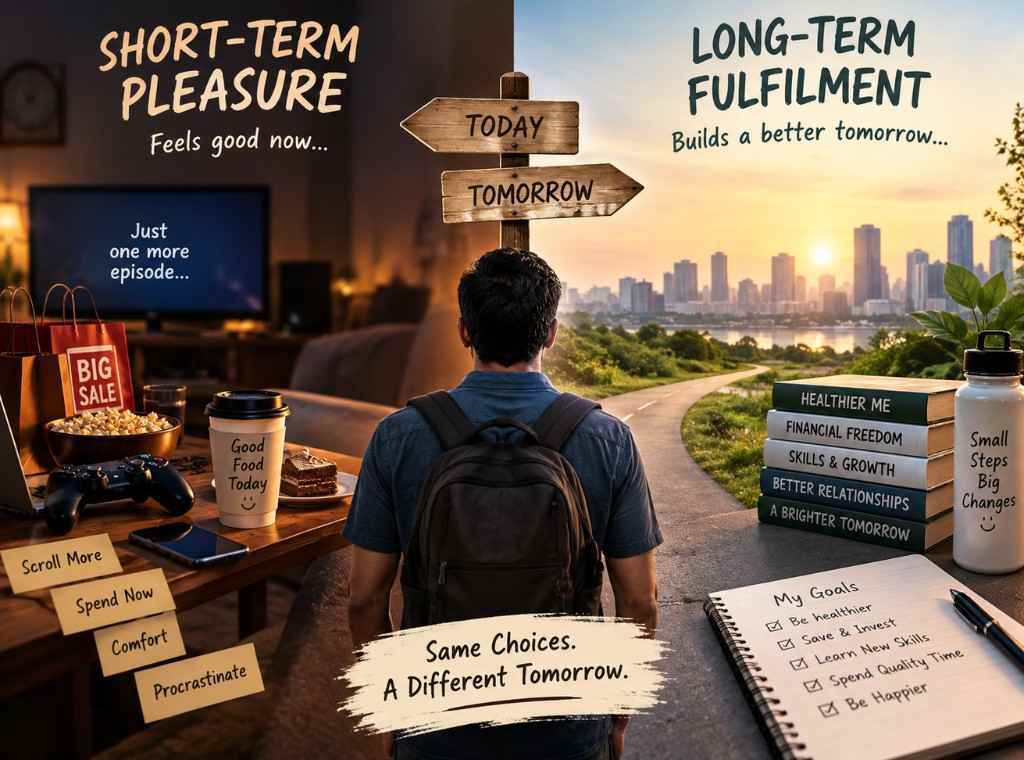
Did you know that many of the choices shaping your future do not feel important when you make them?
You finish a tiring workday. You know you should take a short walk, but scrolling on your phone feels easier. You planned to save part of your salary, yet an online sale suddenly looks irresistible. You want to sleep on time, but one more episode seems harmless. You have been thinking about learning a useful skill, although entertainment feels much more appealing right now.
None of these decisions looks life-changing on its own. However, when repeated, they slowly create a direction.
Understanding Short-Term Pleasure vs Long-Term Fulfilment can therefore help us recognise an important truth: a satisfying life is rarely built through one dramatic decision. Instead, it develops through hundreds of ordinary choices involving money, health, relationships, work, time, and personal growth.
At The Life TrackR, the goal is not to eliminate enjoyment. Rather, it is to build a life where today’s comfort does not repeatedly come at tomorrow’s expense.
Why Short-Term Pleasure Feels So Powerful
Short-term pleasure offers an immediate reward. It asks very little from us right now.
Ordering food instead of preparing a simple meal feels convenient. Buying something impulsively creates excitement. Watching videos provides effortless entertainment. Avoiding an uncomfortable conversation gives temporary relief. Skipping exercise saves energy in the moment.
Meanwhile, long-term fulfilment usually works differently.
Saving money does not instantly make you financially secure. Exercising once does not transform your fitness. Learning for thirty minutes does not immediately change your career. Spending meaningful time with family may require putting your phone away. Furthermore, developing emotional stability often means facing uncomfortable feelings instead of escaping them.
Therefore, the challenge is understandable: pleasure often rewards us now, while fulfilment rewards consistency later.
Short-Term Pleasure Is Not the Enemy
There is an important distinction to make.
Enjoying a movie, eating your favourite food, taking a holiday, buying something you genuinely like, relaxing after work, or spending money on entertainment is not automatically irresponsible.
In fact, enjoyment is an important part of life.
The problem begins when temporary pleasure repeatedly overrides priorities that matter more to us.
For example, occasional online shopping may fit comfortably within your budget. However, frequent impulse purchases could interfere with savings. Similarly, relaxing after work can help you recover, whereas spending every free hour scrolling may leave little room for movement, relationships, learning, or proper sleep.
So, instead of asking, “Is pleasure bad?”, ask a better question:
“Is this choice adding enjoyment to my life, or is it quietly replacing something more important?”
That question changes everything.
Where We Make This Choice Every Day
The conflict between immediate comfort and long-term fulfilment appears in everyday choices involving money, health, work, and personal growth.
1. Money: Spending Now vs Financial Freedom Later
A new gadget, restaurant meal, fashion purchase, or online deal may seem affordable after payday. However, repeated unplanned spending can reduce money available for savings, investments, debt repayment, and important goals.
Long-term fulfilment does not mean avoiding every enjoyable purchase. Instead, protect your financial priorities first. For example, automatically transfer savings after receiving your salary, then enjoy guilt-free spending from what remains.
2. Health: Comfort Today vs Energy Tomorrow
After a long workday and commute, exercise may feel exhausting. Nevertheless, small healthy habits can make a difference over time.
Regular walking, sufficient sleep, balanced meals, hydration, and physical activity can support your overall well-being. Therefore, choose manageable habits you can repeat consistently rather than unrealistic routines you quickly abandon.
3. Work: Easy Tasks vs Meaningful Progress
Being busy does not always mean being productive. Checking notifications, answering unnecessary messages, and completing easy tasks can create instant satisfaction while important work remains unfinished.
Instead, identify one meaningful task and give it your strongest attention before smaller activities consume your time.
4. Learning: Entertainment vs Personal Growth
Given one free hour, entertainment often feels easier than learning a new skill. However, you do not need to eliminate enjoyment.
Divide your time intentionally. Spend part of the hour learning and the rest relaxing. This creates a healthier balance between short-term pleasure and long-term fulfilment without making personal growth feel like punishment.
The Hidden Cost of “Just This Once”
One skipped workout rarely affects your fitness goals, while one unnecessary purchase usually does not ruin your monthly budget. Similarly, one late night may not completely disrupt your healthy daily routine.
However, the phrase “just this once” can become a problem when occasional choices slowly turn into repeated habits. Because daily habits are built through repetition, every small decision can influence what you choose the next time a similar situation appears.
Fortunately, the same principle works in a positive direction.
Saving ₹500 regularly can strengthen your financial habits over time. Reading ten pages a day can gradually expand your knowledge, while walking for twenty minutes can support a more active lifestyle. Likewise, putting your phone away during dinner can help you become more present with your family.
Individually, these actions may seem small. However, when repeated consistently, small daily habits can create meaningful long-term change. The Life TrackR encourages focusing on steady progress because consistency often matters more than one perfect decision.
A Simple Framework for Better Daily Choices
You do not need perfect discipline. Instead, create a small pause between wanting something and acting on it.
When you feel pulled toward immediate gratification, try asking yourself these questions:
- Will I still be happy with this decision tomorrow?
- Does this support or interfere with something important to me?
- Am I choosing this consciously, or simply because it is easy?
- What happens if I repeat this choice 100 times?
- Can I enjoy this without abandoning my bigger priority?
These questions are not designed to create guilt. Rather, they help bring the future into a decision that otherwise feels entirely about the present.
Use the 10-Minute Delay
Impulse thrives on speed.
Therefore, when the urge involves unnecessary shopping, unhealthy snacking, skipping an important task, or endless scrolling, delay the decision for ten minutes.
During that period, move away from the trigger.
Sometimes you will still decide to continue, and that is fine. However, the decision becomes more intentional instead of automatic
Make Long-Term Choices Easier
Willpower is useful, but your environment can be even more powerful.
If you want to save money, automate the transfer. If you want to exercise, prepare what you need beforehand. If you want better sleep, keep your phone away from the bed. If you want to read, leave the book somewhere visible. Likewise, if you want fewer impulse purchases, remove shopping notifications.
In other words, do not rely entirely on motivation when you can redesign the environment around the behaviour you want.
Track What Actually Makes You Feel Good
Interestingly, what feels pleasurable immediately is not always what leaves us feeling satisfied afterwards.
Scrolling for an hour may feel effortless but leave you mentally drained. In contrast, completing a walk, organising your finances, finishing meaningful work, or having a good conversation may require more effort initially but create greater satisfaction later.
For a short period, notice what happens after different activities.
Ask yourself: Did this leave me refreshed, neutral, regretful, proud, calmer, or more stressed?
Over time, you may discover that some activities you consider “relaxing” are not actually restoring you.
Build a “Both” Life
Short-Term Pleasure vs Long-Term Fulfilment does not have to become an endless battle between enjoying today and preparing for tomorrow.
You can enjoy restaurant meals while maintaining savings. You can watch entertainment while protecting your sleep. You can buy things you love while avoiding unnecessary debt. You can relax after work while still making time for movement. Similarly, you can pursue ambitious goals without making every moment productive.
The objective is balance.
A sustainable life has space for enjoyment today and security, health, relationships, growth, and meaning tomorrow.
A Small Challenge for Your Next Decision
The next time you face a choice between what feels easiest now and what matters later, do not automatically reject the enjoyable option.
Simply pause.
Ask yourself:
“Which choice will I be happier to have made?”
Then decide consciously.
That small pause may seem insignificant. However, repeated hundreds of times across your finances, health, relationships, and personal growth, it can gradually change the direction of your life.
At The Life TrackR, tracking your life is not about measuring every minute or eliminating enjoyment. It is about noticing patterns, making better choices, and ensuring your everyday actions gradually move you toward the life you want.
Conclusion
The difference between Short-Term Pleasure vs Long-Term Fulfilment is rarely found in one huge decision. More often, it appears in ordinary moments: save or spend, scroll or sleep, postpone or begin, avoid or communicate, stay still or move.
You do not need to choose perfectly every time. Instead, aim to choose intentionally more often. Enjoy the present, but keep your future in the conversation.
Because ultimately, fulfilment is not created by avoiding pleasure. It comes from enjoying today without repeatedly sacrificing what matters tomorrow.
#TheLifeTrackR #ShortTermPleasure #LongTermFulfilment #DailyChoices #PersonalGrowth #LifeBalance #BetterHabits #SelfImprovement #FinancialWellness #Productivity
Editor’s Note: This article was originally published here: https://thelifetrackr.com/short-term-pleasure-vs-long-term-fulfilment-a-choice-we-make-daily/ by @Kairav and @krutika