
Have you ever finished an entire day feeling exhausted, yet wondered where all your time actually went? You answered emails, attended meetings, replied to messages, and completed dozens of small tasks. Still, your biggest priorities remained untouched.
This is where the focus keyphrase, Busy vs Mental Overload, becomes important. Many people assume that feeling busy means they are being productive. However, there is a significant difference between having a full schedule and carrying a mind that has reached its mental limit.
Understanding this difference can completely change how you approach work, manage your energy, and protect your well-being. More importantly, it can help you stop confusing constant activity with meaningful progress.
Being Busy Is About Time. Mental Overload Is About Capacity.
Being busy simply means your calendar contains many activities. You have appointments, deadlines, conversations, and responsibilities filling your day.
Mental overload, however, is very different.
It happens when your brain is processing more information than it can comfortably handle. Although you may not be physically working harder, your mind is constantly switching between thoughts, remembering unfinished tasks, making decisions, and responding to interruptions.
As a result, even simple activities begin to feel surprisingly difficult.
Therefore, two people can have identical workloads while experiencing completely different levels of mental strain
Why We Often Confuse the Why We Often Confuse the Two
Modern work encourages visible activity.
Quick replies, constant availability, and multitasking often appear productive from the outside. Consequently, many people believe staying busy automatically means they are succeeding.
Unfortunately, your brain measures something entirely different.
It responds to:
- Constant notifications
- Frequent context switching
- Endless decision-making
- Information overload
- Unfinished tasks
- Emotional stress
Because of these hidden mental demands, your brain becomes exhausted long before your calendar becomes empty.
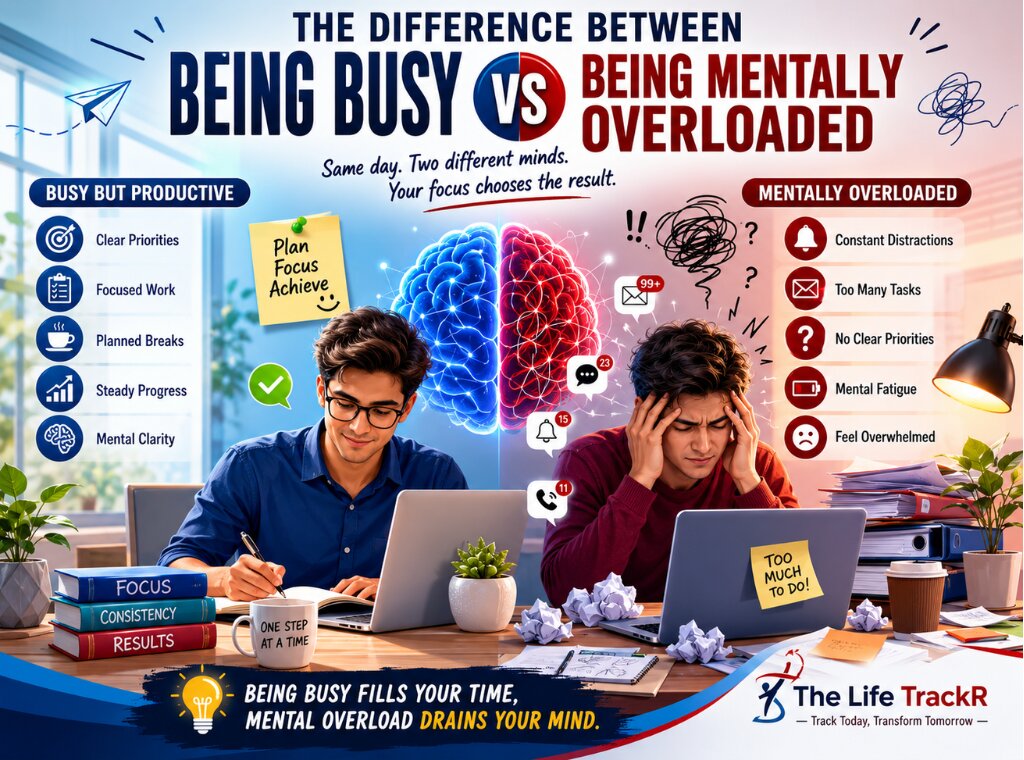
Signs You're Simply Busy
Being busy does not automatically harm your mental health.
In many situations, a busy period can feel energizing because your work remains organized and manageable.
Common signs include:
- You know exactly what needs to be done.
- You can prioritize tasks easily.
- Your concentration stays relatively stable.
- Breaks help you recover quickly.
- You finish important work despite having a full schedule.
- You still have mental energy after completing your day.
Although your schedule may be packed, your mind still feels in control.
Signs You're Mentally Overloaded
Mental overload creates a completely different experience.
Instead of feeling motivated, you begin feeling mentally heavy. Even routine decisions require more effort than usual.
Some common warning signs include:
- You forget simple things regularly.
- Reading the same paragraph multiple times becomes common.
- Small decisions suddenly feel overwhelming.
- You constantly switch between unfinished tasks.
- Minor interruptions cause major frustration.
- You struggle to relax even after work ends.
- Sleep no longer refreshes your mind.
- You feel busy all day but accomplish very little.
These symptoms usually develop gradually, making them easy to ignore until productivity begins to decline.
The Hidden Cost of Mental Overload
Many people believe working longer hours will solve their workload.
Unfortunately, an overloaded brain rarely becomes more productive by simply spending additional time working.
Instead, mental overload often leads to:
1. Reduced Focus
Your attention becomes scattered, making deep work almost impossible.
2. More Mistakes
Memory weakens while concentration drops, increasing small but costly errors.
3. Slower Decisions
Choosing between simple options suddenly takes much longer than before.
4. Lower Creativity
Your brain focuses on survival rather than generating fresh ideas.
5. Emotional Exhaustion
Patience decreases while stress continues increasing throughout the day.
Over time, these effects reduce both performance and overall well-being.
Why Your Brain Reaches Its Limit
Your brain processes thousands of pieces of information every day.
Although many of these seem insignificant individually, together they create substantial cognitive pressure.
Some common contributors include:
- Continuous phone notifications
- Email overload
- Frequent meetings
- Open browser tabs
- Social media interruptions
- Family responsibilities
- Financial concerns
- Constant decision-making
Each demand uses a small amount of mental energy. Eventually, these small drains combine into overwhelming mental fatigue.
How to Reduce Mental Overload
Fortunately, reducing mental overload does not always require working less.
Instead, it often requires helping your brain work more efficiently.
1. Reduce Daily Decisions
Create simple routines for recurring tasks.
For example, planning meals, setting work priorities, or preparing clothes the night before reduces unnecessary mental effort.
2. Finish Small Tasks Completely
Unfinished work occupies valuable mental space.
Whenever possible, complete small tasks instead of leaving dozens partially finished.
This creates a greater sense of clarity.
3. Work on One Priority at a Time
Although multitasking feels efficient, it usually increases cognitive strain.
Instead, focus on one meaningful task before moving to the next.
Your brain performs far better when attention remains steady.
4. Schedule Recovery Time
Mental recovery is just as important as productive work.
Short breaks, stretching, walking, or sitting quietly for a few minutes help restore concentration throughout the day.
5. Capture Everything Outside Your Mind
Instead of remembering every responsibility, write it down.
Using a planner, notebook, or productivity system reduces the pressure on your working memory.
This is one of the simplest habits recommended by The Life TrackR for improving mental clarity.
6. Protect Deep Work Sessions
Turn off unnecessary notifications while working on important tasks.
Even brief interruptions can significantly reduce concentration and increase the time needed to regain focus.
A Different Way to Measure Productivity
Instead of asking:
“How busy was I today?”
Try asking:
- Did I complete my most important task?
- Did I stay focused?
- Did I protect my mental energy?
- Did I create progress instead of simply reacting?
These questions provide a far more meaningful measure of productivity than simply counting hours worked.
A Small Change That Makes a Big Difference
Many people spend years trying to become more productive by working harder.
However, lasting improvement often comes from managing mental capacity rather than adding more effort.
Once you recognize the difference between Busy vs Mental Overload, you begin making smarter choices about your attention instead of simply filling every available minute.
Gradually, work feels more manageable, decisions become easier, and your mind regains the space needed for meaningful progress.
Conclusion
Understanding the focus keyphrase, Busy vs Mental Overload, can completely change the way you approach productivity. A full schedule is not always the problem. Instead, an overloaded mind is often the real reason behind poor focus, constant fatigue, and unfinished work.
By reducing unnecessary mental demands, protecting your attention, and building simple daily systems, you can work more effectively without feeling constantly exhausted. The Life TrackR believes that true productivity is not about doing more—it is about creating enough mental space to focus on what truly matters.
#BusyVsMentalOverload #MentalWellness #Productivity #Focus #StressManagement #TimeManagement #Mindfulness #WorkLifeBalance #MentalClarity #TheLifeTrackR
Editor’s Note: This article was originally published here: https://thelifetrackr.com/the-difference-between-being-busy-and-being-mentally-overloaded/ by @Kairav and @krutika