
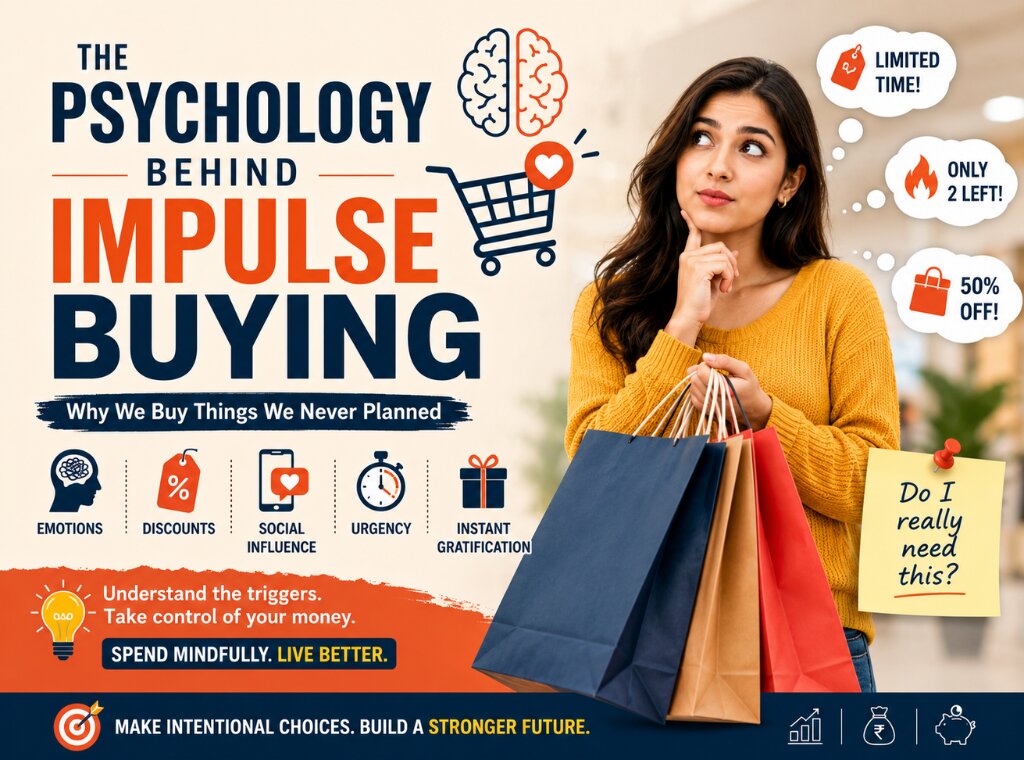
Have you ever opened a shopping app just to “look around” and ended up buying something you never planned to purchase? If this sounds familiar, you’re certainly not alone. The focus keyphrase Psychology Behind Impulse Buying explains why our brains often make emotional purchasing decisions long before logic gets involved.
Many working people in India experience this regularly. After a busy day, online shopping feels like a quick reward. Flash sales, limited-time offers, and attractive discounts create excitement, making it difficult to resist. However, what feels like a small purchase today can quietly affect monthly savings and long-term financial goals.
Understanding why impulse buying happens is the first step toward taking control of your money rather than letting your emotions control your wallet.
What Is Impulse Buying?
Lorem ipsum dolor sit amet, consectetur adipiscing eli
Impulse buying refers to making an unplanned purchase without careful thought or prior intention. Instead of evaluating whether an item is necessary, buyers often react to emotions, attractive offers, or external triggers.
While occasional impulse purchases may seem harmless, repeated spontaneous spending can lead to:
- Reduced monthly savings
- Increased credit card bills
- Financial stress
- Buyer’s remorse
- Clutter at home
Therefore, understanding the psychology behind these decisions becomes extremely valuable.
t. Ut elit tellus, luctus nec ullamcorper mattis, pulvinar dapibus leo.
Why Does Our Brain Love Impulse Purchases?
Our brain is naturally designed to seek pleasure and avoid discomfort. Shopping activates the brain’s reward system by releasing dopamine—a chemical associated with happiness and excitement.
Although the feeling is temporary, the brain remembers it. As a result, it starts associating shopping with emotional relief, making future impulse purchases even more likely.
This explains why many people shop when they feel:
- Stressed
- Bored
- Lonely
- Tired
- Overworked
- Celebrating success
In reality, they are often buying emotions rather than products.
Emotional Triggers That Lead to Impulse Buying
1. Stress Shopping
After handling deadlines, meetings, or daily responsibilities, many people look for quick emotional rewards.
Shopping provides temporary comfort, even though the underlying stress remains unchanged.
2. Fear of Missing Out (FOMO)
Messages like:
“Only 2 items left!”
“Sale ends in 30 minutes!”
“Limited Stock”
create urgency.
Consequently, people purchase quickly without evaluating whether they truly need the item.
3. Social Media Influence
Social media constantly exposes us to influencers, product reviews, luxury lifestyles, and advertisements.
Eventually, comparison creates desire.
Instead of asking:
“Do I need this?”
our brain asks:
“Why don’t I have this?”
4. Instant Gratification
Humans naturally prefer immediate rewards over future benefits.
Buying something now feels more satisfying than saving money for months.
Although the purchase creates temporary happiness, the satisfaction often disappears quickly.
5. Discounts Feel Like Winning
Interestingly, our brain often focuses more on the discount than the actual price.
For example:
Instead of spending ₹2,500 wisely, many people think:
“I saved ₹1,000!”
However, if the product wasn’t needed, no money was actually saved.
The Marketing Tricks That Encourage Impulse Buying
Retailers understand consumer psychology exceptionally well.
Therefore, they intentionally design shopping experiences that increase spontaneous purchases.
Some common strategies include:
Flash Sales
Countdown timers increase urgency.
Free Shipping Thresholds
People add unnecessary products simply to qualify for free delivery.
Product Recommendations
“Customers also bought…”
creates curiosity and additional spending.
Easy EMI Options
Smaller monthly payments make expensive products appear affordable.
Attractive Product Placement
Whether online or in physical stores, high-demand products receive maximum visibility.
Signs You May Be an Impulse Buyer
You may be buying impulsively if you:
- Frequently shop to improve your mood.
- Purchase items without comparing alternatives.
- Feel guilty after shopping.
- Forget what you recently purchased.
- Own products that remain unused.
- Spend more during sales than on regular days.
- Regularly exceed your monthly budget.
Recognizing these habits is an important step toward changing them.
How Impulse Buying Affects Financial Wellness
Impulse purchases rarely damage finances overnight.
Instead, they quietly accumulate over months and years.
Imagine spending just ₹500 three times every week on unnecessary purchases.
That becomes:
- ₹1,500 every week
- ₹6,000 every month
- ₹72,000 every year
Now imagine investing that amount instead.
Small spending decisions create surprisingly large long-term outcomes.
Practical Ways to Control Impulse Buying
Fortunately, overcoming the Psychology Behind Impulse Buying doesn’t require extreme discipline. Instead, small daily habits make the biggest difference.
1. Follow the 24-Hour Rule
Before buying anything non-essential, wait for one full day.
Often, the excitement fades naturally.
2. Shop with a List
Whether shopping online or offline, prepare a list beforehand.
Then purchase only what’s on that list.
3. Remove Saved Payment Methods
Entering payment details manually creates a small pause.
That pause often gives your logical brain enough time to reconsider.
4. Unsubscribe from Promotional Emails
Fewer promotional notifications mean fewer purchasing temptations.
Out of sight often becomes out of mind.
Set Monthly Spending Limits
Allocate a specific amount for personal shopping.
Once the limit is reached, postpone additional purchases until next month.
Identify Your Emotional Triggers
Ask yourself:
Am I stressed?
Am I bored?
Am I trying to reward myself?
Do I actually need this?
Simple self-awareness reduces emotional spending.
Focus on Financial Goals
When you clearly remember your goals—whether it’s buying a house, planning a vacation, creating an emergency fund, or investing for the future—small impulse purchases become easier to resist.
Shift Your Mindset from Spending to Purpose
Money is not simply meant to be spent—it is meant to support the life you truly want.
Every purchase is a decision between immediate satisfaction and future freedom.
Instead of asking:
“Can I afford this?”
Start asking:
“Is this helping me reach my goals?”
That single question changes purchasing behaviour dramatically.
How The Life TrackR Can Help
Building better financial habits starts with understanding your daily choices. The Life TrackR encourages mindful decision-making by helping you stay focused on your goals, build positive routines, and improve financial awareness one habit at a time.
Progress doesn’t come from avoiding every purchase. Instead, it comes from making intentional decisions that align with the future you want to create.
Conclusion
The focus keyphrase Psychology Behind Impulse Buying reminds us that most unplanned purchases are driven more by emotions than actual needs. Once you understand the psychological triggers behind impulsive spending, you gain the power to pause, reflect, and make better financial decisions.
Small changes today can protect your savings, reduce financial stress, and help you build a more secure future. With consistent awareness and mindful habits, every purchase becomes an opportunity to move closer to your goals instead of further away from them. That’s exactly the kind of positive lifestyle The Life TrackR encourages every day.
#PsychologyBehindImpulseBuying #ImpulseBuying #PersonalFinance #MoneyManagement #SmartSpending #FinancialWellness #MindfulSpending #SavingsGoals #FinancialHabits #TheLifeTrackR #Productivity #SelfImprovement #Budgeting #HealthyHabits #Lifestyle
Editor’s Note: This article was originally published here:https://thelifetrackr.com/the-psychology-behind-impulse-buying-why-we-buy-things-we-never-planned/ by @Kairav and @krutika