
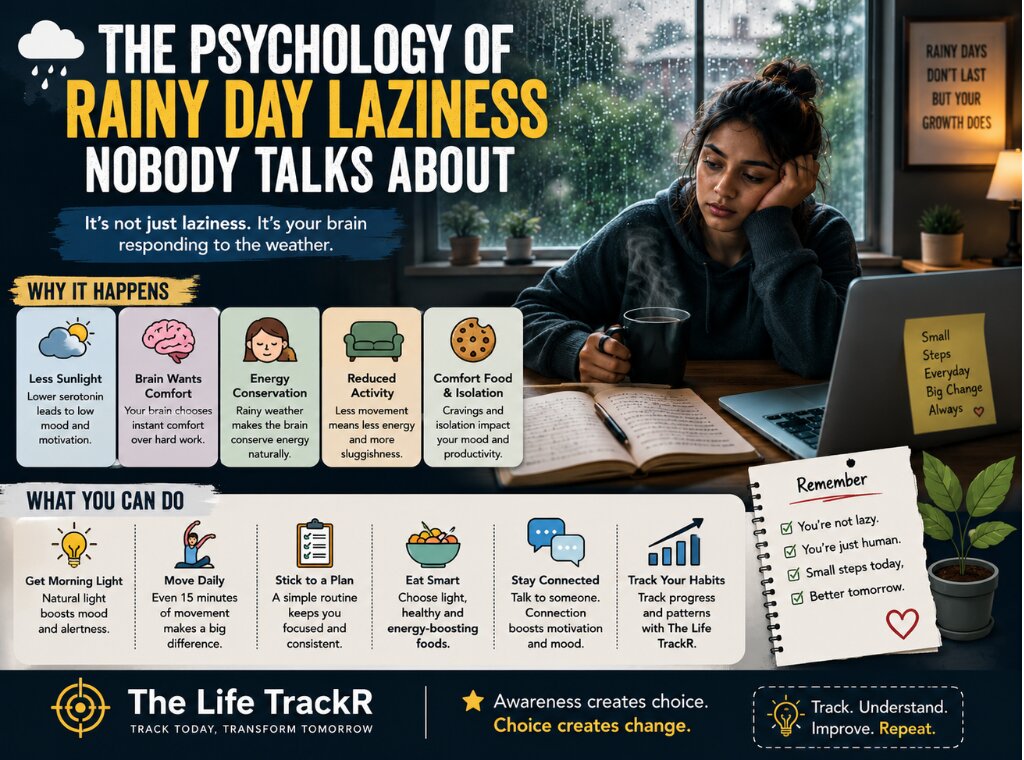
Ever wondered why your motivation suddenly disappears when the rain starts pouring outside?
You wake up with plans. There are tasks to complete, goals to chase, and responsibilities waiting. However, the moment you hear raindrops hitting the window, everything changes. The bed feels warmer. The blanket feels heavier. Even simple tasks seem harder than usual.
Most people assume they are simply being lazy. Yet the truth behind Rainy Day Laziness Psychology is far more interesting.
What if your brain is actually responding to environmental signals that influence your energy, mood, focus, and motivation?
The surprising part is that rainy-day laziness is not always about poor discipline. Instead, it often involves a combination of biology, psychology, weather conditions, and daily habits that quietly affect your behavior.
Understanding this hidden connection can help you regain control of your routine instead of blaming yourself every monsoon season.
Let’s uncover what nobody talks about.
Why Rainy Days Feel Different Mentally
Rainy weather creates a unique atmosphere that affects both the mind and body.
Unlike bright sunny days, monsoon weather often brings:
- Reduced sunlight
- Cooler temperatures
- Higher humidity
- More indoor time
- Less physical movement
- Quieter surroundings
As a result, the brain receives different environmental signals.
Consequently, your body may naturally shift into a slower state. This response is not imaginary. In fact, researchers have found that weather conditions can directly influence mood, alertness, and energy levels.
Therefore, what feels like laziness may actually be your brain adapting to seasonal changes.
The Hidden Role of Sunlight in Motivation
One of the biggest reasons behind rainy-day sluggishness is reduced sunlight exposure.
Sunlight helps regulate important chemicals such as:
- Serotonin
- Melatonin
- Dopamine
These chemicals influence:
- Mood
- Energy
- Focus
- Sleep quality
- Motivation
During rainy periods, cloud cover reduces natural light exposure significantly.
As a result, serotonin production may decrease. Since serotonin contributes to feelings of well-being and motivation, lower levels can make people feel less energetic and less enthusiastic about daily tasks.
Meanwhile, melatonin production may increase, making the body feel sleepier even during daytime hours.
Therefore, many people experience an unexplained desire to rest, nap, or postpone responsibilities.
Why Comfort Becomes More Attractive During Rainy Weather
There is another psychological factor at work.
The human brain naturally seeks comfort when environmental conditions become less stimulating.
Rainy weather often creates:
- Cozy indoor environments
- Warm blankets
- Hot beverages
- Relaxing sounds
- Reduced social activity
While these experiences feel pleasant, they also encourage the brain to prioritize comfort over action.
Consequently, productivity becomes less appealing compared to rest and relaxation.
This is why many people suddenly feel motivated to watch movies, scroll social media, or spend extra time in bed during monsoon season.
The brain simply chooses immediate comfort over long-term goals.
The Connection Between Rain and Reduced Physical Activity
Movement plays a major role in maintaining energy levels.
Unfortunately, rainy weather often disrupts daily movement patterns.
For example:
- Morning walks get skipped.
- Outdoor exercise becomes difficult.
- Commutes involve more sitting.
- Weekend activities get cancelled.
As physical activity decreases, energy production also drops.
Furthermore, exercise naturally boosts mood-enhancing chemicals within the brain.
Without regular movement, people often experience:
- Mental fog
- Lower motivation
- Reduced concentration
- Increased tiredness
Therefore, rainy-day laziness may actually be linked to reduced physical activity rather than a lack of ambition.
The Emotional Effect of Grey Skies
Most people underestimate how much visual surroundings influence emotions.
Bright environments stimulate alertness.
Grey environments often encourage introspection and slower thinking.
During extended rainy periods, the world outside appears:
- Darker
- Quieter
- Less active
- More isolated
As a result, people naturally spend more time reflecting on problems, worries, and unfinished tasks.
Consequently, many individuals report:
- Overthinking
- Mood swings
- Reduced enthusiasm
- Lack of excitement
This emotional heaviness can easily be mistaken for laziness.
However, the root cause may actually be environmental mood influence.
Why Your Brain Wants to Conserve Energy
From an evolutionary perspective, conserving energy was once a survival advantage.
When conditions became unfavorable, humans naturally reduced unnecessary activity.
Although modern life is different, parts of the brain still respond to environmental cues.
Rainy weather can subconsciously signal:
- Stay indoors
- Preserve energy
- Avoid unnecessary effort
As a result, your brain may encourage low-effort activities such as:
- Sleeping
- Watching content
- Eating comfort foods
- Avoiding demanding work
While this response made sense historically, it can interfere with modern productivity goals.
The Comfort Food Trap
Have you noticed stronger cravings during rainy weather?
This is extremely common.
Many people crave:
- Fried snacks
- Sweet foods
- Hot comfort meals
- Sugary drinks
These foods provide temporary emotional satisfaction.
However, they can also create energy crashes later.
As a result, people often experience:
- Sluggishness
- Reduced concentration
- Afternoon fatigue
- Lack of motivation
Therefore, rainy-day laziness is sometimes fueled by food choices rather than weather alone.
The Social Isolation Factor
Another overlooked aspect of Rainy Day Laziness Psychology is reduced social interaction.
Rain often causes people to:
- Stay indoors
- Cancel plans
- Avoid gatherings
- Work remotely more often
While occasional solitude is healthy, extended isolation can affect motivation.
Humans naturally gain energy from social engagement.
Without enough interaction, many people experience:
- Lower enthusiasm
- Reduced accountability
- Increased procrastination
Consequently, maintaining social connections becomes even more important during monsoon months.
Signs That Rainy-Day Laziness Is Affecting You
You may be experiencing rainy-weather motivation loss if you frequently notice:
- Delaying simple tasks
- Sleeping longer than usual
- Feeling tired despite adequate sleep
- Increased screen time
- Lack of exercise
- Frequent snacking
- Reduced focus
- Less enthusiasm toward goals
Recognizing these signs early helps prevent small disruptions from becoming long-term habits.
How to Stay Productive Despite Rainy-Day Laziness
The good news is that you do not need extreme discipline to overcome rainy-day sluggishness.
Small adjustments often create significant improvements.
1. Increase Morning Light Exposure
Open curtains immediately after waking up.
Natural light helps regulate energy-related hormones.
Even limited sunlight exposure can improve alertness.
2. Move Within the First Hour
Simple activities work well:
- Stretching
- Indoor walking
- Yoga
- Light exercise
Movement signals the brain that the day has started.
3. Follow a Simple Daily Structure
Rainy days become harder when routines disappear.
Create a daily plan that includes:
- Top priorities
- Break times
- Exercise
- Sleep schedule
Structure reduces decision fatigue.
4. Avoid Excessive Comfort
Comfort is helpful in moderation.
However, spending entire days under blankets can reinforce inactivity.
Instead, create designated relaxation periods.
5. Track Your Daily Habits
Awareness changes behavior.
Track:
- Sleep
- Water intake
- Exercise
- Mood
- Screen time
- Productivity
When habits become visible, improvement becomes easier.
This is where consistent tracking through The Life TrackR can help individuals identify patterns that often go unnoticed during monsoon months.
6. Maintain Social Interaction
Regular conversations improve motivation.
Even brief interactions can create a sense of connection and accountability.
7. Eat Energy-Supporting Foods
Focus on:
- Fruits
- Protein-rich meals
- Warm healthy snacks
- Adequate hydration
Better nutrition supports better mental performance.
A Different Way to Think About Rainy-Day Laziness
Instead of asking:
“Why am I so lazy?”
Try asking:
“What environmental factors are influencing my energy today?”
This simple shift changes everything.
Rather than blaming yourself, you begin identifying triggers and creating solutions.
As a result, rainy days become easier to manage.
Furthermore, self-awareness helps prevent guilt, frustration, and unnecessary self-criticism.
Conclusion
The truth about Rainy Day Laziness Psychology is that it involves much more than a lack of willpower.
Reduced sunlight, lower physical activity, comfort-seeking behavior, emotional changes, social isolation, and altered routines all contribute to the sluggish feeling many people experience during monsoon season.
Fortunately, once you understand these influences, you can take practical steps to stay energized and focused.
Small daily actions often outperform motivation itself. By tracking habits, maintaining structure, and staying aware of environmental triggers, you can enjoy the rainy season without letting it derail your goals.
At The Life TrackR, the goal is not perfection. Instead, it is helping you understand your daily patterns so that even during challenging seasons, progress continues one small step at a time.
#RainyDayLaziness #MonsoonMindset #ProductivityTips #MentalWellbeing #DailyHabits #SelfImprovement #LifeTracking #TheLifeTrackR #MonsoonLifestyle #HealthyRoutine
Editor’s Note: This article was originally published here: https://thelifetrackr.com/the-psychology-of-rainy-day-laziness-nobody-talks-about/ by @Kairav and @krutika