
Did you know that most people don’t procrastinate because they’re lazy? They procrastinate because getting started feels harder than doing the task itself.
You sit down with the intention of being productive. Your laptop is open. Your notebook is ready. Your to-do list looks manageable.
Yet somehow, you check your phone “just for a minute.” Then another notification appears. Suddenly, an hour has disappeared, and the important task still hasn’t begun.
If this sounds familiar, you’re not alone.
This is where the focus keyphrase, Two Minute Rule for Procrastination, can completely change how you approach work, personal goals, and daily responsibilities.
Rather than forcing yourself to complete an entire project, this simple technique focuses on one thing—starting. Surprisingly, that small beginning often becomes the hardest part, and once you overcome it, continuing becomes much easier.
Let’s explore why this powerful rule works and how you can use it every day with The Life TrackR to build lasting consistency.
Why Do We Procrastinate in the First Place?
Many people believe procrastination comes from poor discipline. However, psychology suggests something different.
Most procrastination happens because our brain sees a task as large, uncertain, or mentally exhausting. As a result, it naturally searches for something easier and more rewarding.
Common reasons include:
- Fear of making mistakes
- Feeling overwhelmed
- Lack of clarity
- Perfectionism
- Low motivation
- Decision fatigue
Consequently, even simple tasks begin to feel much bigger than they really are.
The problem isn’t always the workload.
Instead, it’s the resistance we feel before taking the first step.
What Is the Two-Minute Rule?
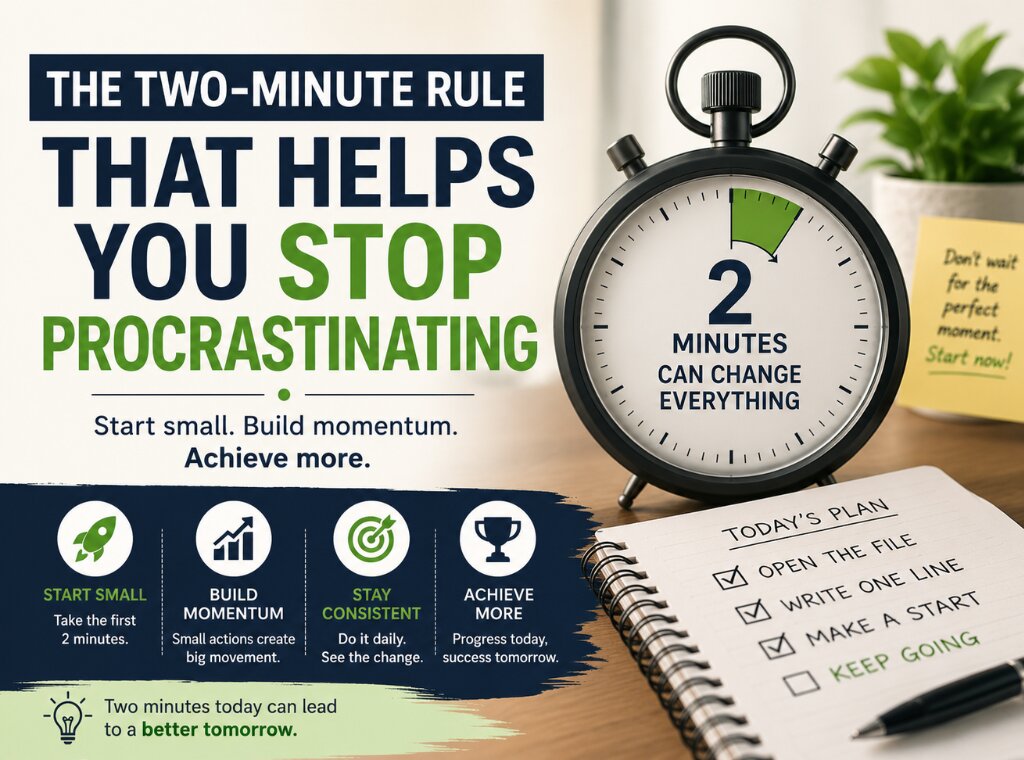
The Two Minute Rule for Procrastination is wonderfully simple.
If a task takes less than two minutes, do it immediately.
If the task is much larger, spend only the first two minutes getting started.
For example:
- Open the document.
- Write one sentence.
- Read one page.
- Put on your walking shoes.
- Organize your desk.
- Open your budgeting spreadsheet.
After two minutes, you have permission to stop.
Ironically, most people don’t.
Once momentum begins, continuing feels much easier than quitting.
That is why such a tiny commitment often produces surprisingly big results.
A Simple Story That Feels Familiar
Imagine reaching home after a busy workday with the intention of updating your monthly budget. At first, you tell yourself that you will relax for just five minutes before getting started. However, those few minutes quickly turn into scrolling through social media, watching online videos, and browsing random content. Before you realize it, the entire evening has slipped away, and your budget remains untouched. Unfortunately, the same pattern repeats itself the following day.
Now imagine taking a different approach. Instead of putting pressure on yourself to complete the entire budget, you make a much smaller commitment. You simply decide to open your spreadsheet and work on it for just two minutes. You enter one expense, then another, and before long, you find yourself fully engaged. Within fifteen minutes, most of your budget is complete without feeling overwhelmed. Your ability did not suddenly improve; rather, the way you chose to begin made the difference. Sometimes, a small and manageable first step is all it takes to overcome procrastination and build momentum.
Why the Rule Works So Well
The biggest obstacle is rarely the work itself.
Rather, it’s the mental barrier before beginning.
The Two-Minute Rule reduces that barrier because your brain no longer sees the task as stressful or overwhelming.
Instead, it becomes small, safe, and manageable.
It also helps because:
- Small actions reduce anxiety.
- Starting builds momentum naturally.
- Progress increases confidence.
- Repetition strengthens habits.
- Tiny wins improve motivation.
Eventually, beginning becomes automatic instead of something you constantly negotiate with yourself.
How to Apply the Two-Minute Rule Every Day
The beauty of this method is its flexibility.
It works for almost every area of life.
1. Work
Instead of writing an entire report:
- Open the file.
- Create the heading.
- Write the introduction.
Very often, you’ll continue naturally.
2. Health
Instead of forcing yourself through a one-hour workout:
- Wear your exercise clothes.
- Stretch for two minutes.
- Walk outside briefly.
Movement usually creates more movement.
3. Personal Finance
Instead of avoiding money management:
- Check your account balance.
- Record one expense.
- Review one transaction.
Small financial awareness creates better financial habits.
4. Learning
Instead of studying for hours:
- Read one paragraph.
- Watch two minutes of a lesson.
- Solve one question.
Learning becomes far less intimidating.
The Hidden Benefit Nobody Talks About
The Two Minute Rule for Procrastination offers more than just a way to start tasks—it changes how your brain approaches work. Instead of relying on willpower, it reduces the mental resistance that often leads to procrastination. Here’s how:
1. It Reduces Mental Friction
Every decision you make throughout the day uses mental energy. By committing to just two minutes, you eliminate the pressure of deciding whether you’re ready to tackle a large task.
2. It Removes the Pressure of Perfection
Rather than expecting yourself to complete everything perfectly, the rule encourages you to simply begin. This makes even difficult tasks feel much more approachable.
3. It Changes Your Inner Conversation
Instead of asking, “Can I finish this today?”, ask yourself, “Can I start this for just two minutes?” This small shift in thinking makes taking action feel easier and less intimidating.
4. It Builds Momentum Naturally
Once you begin, your brain often wants to continue. As a result, two minutes frequently turns into ten, twenty, or even a completed task without feeling forced.
5. It Creates Long-Term Consistency
Repeating small actions every day builds habits that are easier to maintain. Over time, these tiny efforts lead to greater productivity, increased confidence, and lasting personal growth.
This format is more scannable for readers, aligns well with SEO best practices, and keeps each point concise while adding value.
Mistakes People Make While Using the Rule
Although the method is simple, people sometimes misuse it.
Avoid these common mistakes:
- Waiting until you feel motivated.
- Trying to complete everything at once.
- Skipping several days.
- Expecting instant transformation.
- Choosing tasks that are still too large.
Remember, consistency matters far more than intensity.
Even two minutes every day eventually creates remarkable progress.
Combine the Rule with Habit Tracking
One completed action may seem insignificant.
However, dozens of small actions create lasting habits.
This is why tracking matters.
When you record each small success, your progress becomes visible.
Instead of wondering whether you’re improving, you can actually see your consistency growing over time.
The Life TrackR makes this process easier by helping you monitor daily habits, productivity, finances, wellness, and personal goals in one place.
Rather than relying on memory, you build a system that supports continuous improvement.
Practical Ways to Start Today
You don’t need a new planner or expensive productivity tools.
Simply choose one task you’ve been delaying.
Then follow this process:
- Decide your task.
- Reduce it to a two-minute action.
- Start immediately.
- Stop if you truly want to.
- Track the completion.
- Repeat tomorrow.
Eventually, your brain begins expecting action instead of delay.
That simple habit compounds over weeks and months.
Small Actions Create Big Results
Many people wait for the perfect mood before taking action.
Unfortunately, that moment rarely arrives.
Successful people often reverse the process.
They act first.
Motivation follows later.
The Two Minute Rule for Procrastination reminds us that progress doesn’t require huge bursts of effort. Instead, it grows through small, repeatable actions performed consistently.
When combined with habit tracking, these tiny beginnings become powerful long-term routines that improve productivity, confidence, and personal growth.
Conclusion
If you’ve been waiting for motivation to overcome procrastination, it may be time to change your approach.
The focus keyphrase, Two Minute Rule for Procrastination, proves that lasting change often begins with the smallest possible action. Rather than focusing on finishing everything, focus on starting. Over time, those tiny beginnings create meaningful progress.
With The Life TrackR, you can track each small victory, stay consistent, and gradually turn productive actions into lifelong habits. Remember, success is rarely built in one giant leap—it grows through countless two-minute decisions made every single day.
#TheLifeTrackR #TwoMinuteRule #StopProcrastinating #ProductivityTips #HabitBuilding #PersonalGrowth #DailyHabits #Self-Improvement #TimeManagement #GoalSetting #Consistency #Mindset #WorkSmarter #LifeManagement #SuccessHabits
Editor’s Note: This article was originally published here: https://thelifetrackr.com/the-two-minute-rule-that-helps-you-stop-procrastinating/ by @Kairav and @krutika