
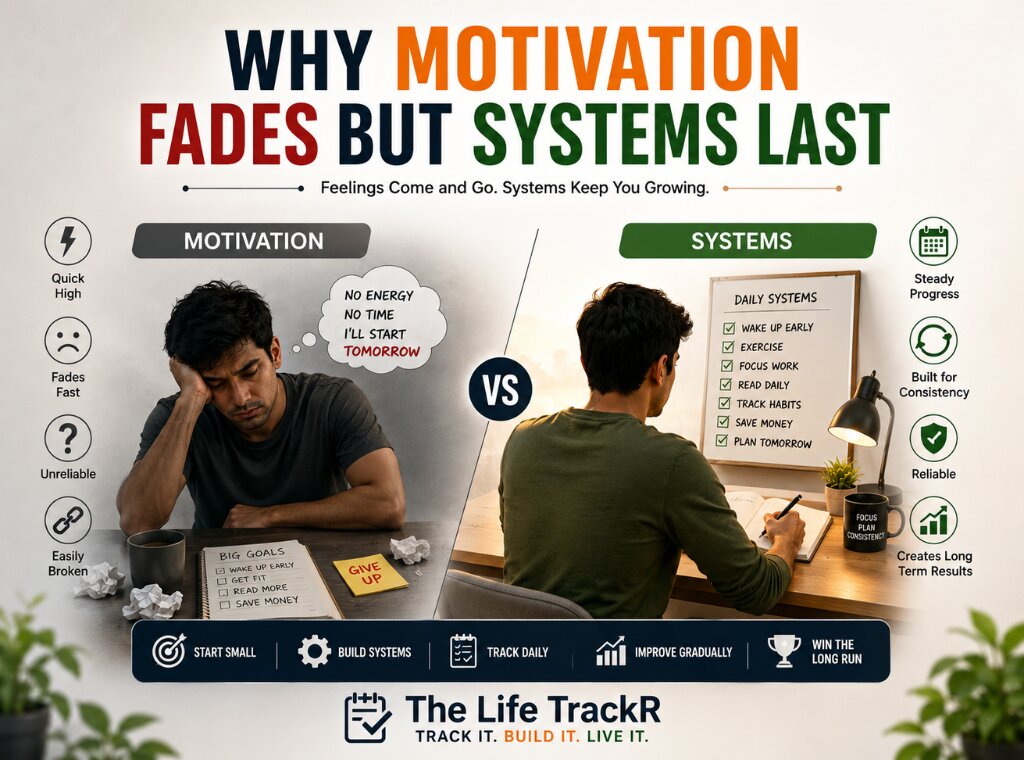
Did you know that most people overlook one simple reason behind failed goals? Every year, countless people begin with excitement. They buy planners, create vision boards, and promise themselves that this time will be different. For a few days, everything feels easy. However, after the initial excitement fades, those plans slowly disappear.
The truth is that motivation was never meant to carry you forever. Instead, long-term success comes from building reliable systems that continue working even when you do not feel inspired. That is why the focus keyphrase, Motivation vs Lasting Systems, has become one of the most important ideas in personal development.
At The Life TrackR, we believe that success is not created by occasional bursts of enthusiasm. Rather, it is created through simple systems repeated consistently over time.
Why Motivation Feels Powerful at First
Motivation creates emotional energy.
Whenever you start something new, your brain releases dopamine because the goal feels exciting. Consequently, waking up early, exercising, reading, or saving money seems effortless during the first few days.
Unfortunately, motivation depends heavily on emotions.
Life becomes busy. Work deadlines increase. Family responsibilities demand attention. Stress appears unexpectedly. As a result, motivation naturally begins to disappear.
This is completely normal.
Even highly successful people experience days when they feel unmotivated. The difference is that they continue because they rely on systems instead of emotions.
The Hidden Problem with Depending on Motivation
Many people unknowingly create a dangerous cycle.
It usually looks like this:
- Feel motivated
- Start a new habit
- Miss one day
- Feel guilty
- Lose confidence
- Quit completely
Although this pattern is common, it has very little to do with willpower.
Instead, it happens because there is no dependable system supporting the habit.
Without structure, every decision requires fresh motivation. Eventually, mental energy runs out.
A Small Story That Explains Everything
Imagine two people deciding to improve their health.
The first person promises to exercise whenever they feel motivated.
The second person schedules a 20-minute walk immediately after dinner every day. They also place their walking shoes near the door before leaving for work.
After several weeks, the first person has exercised only occasionally.
Meanwhile, the second person has completed dozens of walks.
Interestingly, the difference was not motivation.
The difference was the system.
What Exactly Is a System?
A system is a repeatable process that reduces decision-making.
Instead of asking yourself whether you should complete a task, your routine already answers that question.
Examples include:
- Writing tomorrow’s task list before leaving work.
- Reading five pages before sleeping.
- Drinking water immediately after waking up.
- Reviewing expenses every evening.
- Walking after dinner.
- Tracking habits before going to bed.
Each action may appear small. Nevertheless, together they create powerful long-term
Why Systems Continue Working
1. Systems Remove Daily Decisions
Every decision consumes mental energy.
When your habits become automatic, you no longer waste energy deciding what to do next.
Instead, you simply follow your routine.
2. Systems Reduce Dependence on Mood
Some mornings feel productive.
Others do not.
However, a well-designed system works regardless of your mood.
That consistency produces lasting progress.
3. Systems Build Identity
Instead of saying:
“I want to become healthy.”
Your system allows you to say:
“I am someone who walks every day.”
Likewise:
“I am someone who tracks expenses.”
“I am someone who reads daily.”
Small repeated actions gradually become part of who you are.
4. Systems Create Momentum
One completed habit encourages another.
For example:
Wake up on time.
Make the bed.
Drink water.
Exercise.
Eat breakfast.
Reach work feeling prepared.
One successful action often creates several more.
5. Systems Make Recovery Easier
Everyone misses days.
However, people with systems rarely quit.
Instead, they simply continue the following day because their routine already exists.
That ability to recover quickly matters far more than being perfect.
Why High Performers Love Systems
Successful people rarely depend on feeling inspired.
Instead, they create environments that encourage consistent behaviour.
They:
- Prepare tomorrow today.
- Automate repetitive decisions.
- Use reminders.
- Follow routines.
- Measure progress regularly.
- Review weekly improvements.
Because of these systems, they continue moving forward even during difficult weeks.
The Biggest Mindset Change
Many people ask:
“How do I stay motivated?”
A better question is:
“What system helps me succeed even without motivation?”
That single change completely transforms long-term progress.
Instead of chasing inspiration, you begin improving your daily environment.
Eventually, success becomes predictable rather than accidental.
Simple Systems You Can Start Today
You do not need complicated productivity methods.
Begin with one small system.
1. Morning System
- Wake up at the same time.
- Drink one glass of water.
- Avoid checking social media immediately.
- Write your top three priorities.
2. Work System
- Start with the most important task.
- Use focused work sessions.
- Take short movement breaks.
- Review unfinished tasks before leaving.
3. Financial System
- Record daily expenses.
- Save automatically every month.
- Review spending weekly.
4. Health System
- Walk after meals.
- Prepare healthy snacks.
- Sleep at a consistent time.
- Stretch before bed.
5. Personal Growth System
- Read ten pages daily.
- Write one lesson learned.
- Reflect for five minutes every evening.
Even one consistent system can change your entire year.
How Habit Tracking Makes Systems Stronger
A system becomes even more effective when it is visible.
Tracking your habits provides proof that you are improving.
Instead of wondering whether you are making progress, you can actually see it.
Habit tracking also increases accountability.
Missing one day becomes obvious.
Likewise, completing seven days in a row becomes motivating in a healthier way.
At The Life TrackR, we encourage people to focus on consistency rather than perfection because small improvements repeated daily create remarkable long-term success.
Common Mistakes That Break Good Systems
Avoid these common problems:
- Creating too many habits at once.
- Expecting immediate results.
- Skipping planning.
- Making routines too complicated.
- Depending only on motivation.
- Quitting after one missed day.
- Comparing your progress with others.
Instead, improve one system at a time.
Small wins grow into lasting change.
Why The Life TrackR Focuses on Systems
Real transformation rarely happens overnight.
Instead, it develops through daily actions that become automatic.
The Life TrackR helps individuals build practical systems that fit real life rather than unrealistic expectations.
Whether your goal is improving health, productivity, finances, or personal growth, consistent systems make success easier to maintain.
Over time, those systems become habits.
Eventually, those habits shape the life you want.
Conclusion
The biggest difference between temporary success and lasting success is rarely motivation.
Instead, it is having reliable systems that continue working every single day.
The focus keyphrase, Motivation vs Lasting Systems, reminds us that motivation may start the journey, but systems finish it.
At The Life TrackR, we believe that your future is built through simple actions repeated consistently. Begin with one small system today, stay consistent tomorrow, and allow those daily improvements to create extraordinary results over time.
#TheLifeTrackR #HabitBuilding #MotivationVsLastingSystems #Productivity #DailyHabits #SelfImprovement #Consistency #GoalSetting #PersonalGrowth #SuccessHabitsa
Editor’s Note: This article was originally published here: https://thelifetrackr.com/why-motivation-fades-but-systems-last/ by @Kairav and @krutika