
Introduction: Where Does Your Salary Disappear Every Month?
Have you ever checked your bank balance halfway through the month and wondered where all your money went?
Your salary arrived on time. Your rent, electricity bill, groceries, and EMIs were already planned. You even promised yourself that you would save more money this month.
Yet, somehow, your account balance looks surprisingly low.
The surprising reason may not be your biggest expenses. Instead, Small Unplanned Monthly Expenses could be quietly damaging your financial stability without attracting your attention.
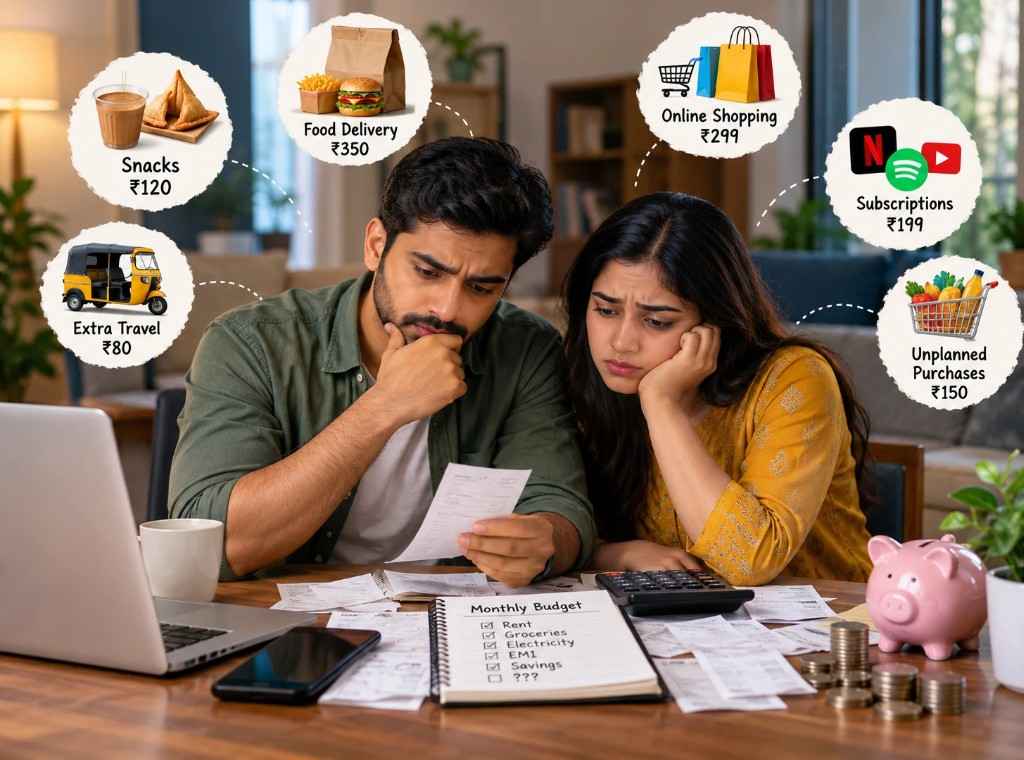
Imagine spending ₹120 on snacks, ₹199 on an unnecessary online purchase, ₹150 on a quick food delivery, and ₹80 on an extra auto ride. Individually, these amounts seem harmless. However, when similar expenses repeat throughout the month, they can consume thousands of rupees.
For middle-class salaried families in India, this spending pattern can create serious financial pressure. Moreover, it often leads to reduced savings, credit card dependence, and anxiety before the next salary arrives.
The good news? You do not need to stop enjoying life or follow an extremely strict budget.
Instead, understanding these nine hidden money traps can help you control unnecessary spending, protect your monthly salary, and build healthier financial habits.
Why Small Expenses Are More Dangerous Than Big Purchases
Large purchases usually demand attention. Before buying a smartphone, refrigerator, or expensive appliance, most people compare prices, review their savings, and consider affordability.
Small purchases, however, rarely receive the same attention.
A ₹100 expense may feel insignificant because it does not immediately affect your financial position. Nevertheless, repeating that expense frequently changes the situation.
Consequently, the real problem is not necessarily the price of an individual purchase. It is the frequency of unplanned spending and the absence of financial awareness.
9 Hidden Ways Small Unplanned Expenses Destroy Your Monthly Budget
1. Daily Convenience Spending Becomes an Expensive Habit
Buying tea, snacks, bottled drinks, or quick meals during office breaks may seem completely normal.
However, convenience spending becomes financially damaging when purchases happen automatically rather than intentionally.
For example, spending ₹150 on additional refreshments across 22 working days costs ₹3,300 monthly.
Therefore, carrying homemade snacks, planning refreshments, or limiting outside purchases can make a meaningful difference without eliminating small pleasures.
2. Digital Payments Make Spending Feel Less Noticeable
UPI payments have made everyday transactions remarkably convenient across India.
However, paying ₹49, ₹89, or ₹149 through a smartphone may feel less significant than physically handing over cash.
As a result, people sometimes make multiple small purchases without remembering the total amount spent.
To overcome this problem, review your UPI transaction history regularly. Additionally, set a weekly spending limit for optional digital purchases.
Remember: Convenient payments should simplify your life, not weaken your financial discipline.
3. Food Delivery and Impulse Orders Increase Monthly Expenses
After a tiring office commute, ordering food may seem like the easiest solution.
Although occasional food delivery is perfectly reasonable, repeated orders can increase monthly spending through delivery fees, packaging charges, and additional items.
For instance, four unplanned orders costing ₹350 each create an additional ₹1,400 expense.
Instead, keep simple meal ingredients available at home. Furthermore, decide in advance how much you can comfortably spend on outside food.
4. Small Online Shopping Discounts Encourage Unnecessary Purchases
An online product priced at ₹299 may appear affordable, especially when advertised with a limited-time discount.
Nevertheless, buying something simply because it is discounted does not automatically mean you are saving money.
Frequent impulse purchases can gradually consume funds reserved for important household needs.
Before placing an order, ask yourself whether you genuinely need the item. Alternatively, wait 24 hours before buying non-essential products.
This short delay can help separate actual requirements from temporary excitement.
5. Forgotten Subscriptions Quietly Reduce Your Savings
Streaming platforms, mobile applications, cloud storage, and premium memberships often involve recurring payments.
Individually, these charges may appear manageable. However, unused subscriptions can become a hidden financial burden.
For example, three unnecessary subscriptions costing ₹149, ₹199, and ₹299 add up to ₹647 monthly.
Therefore, review recurring payments and cancel services that no longer provide meaningful value.
6. Unplanned Travel Costs Disrupt Your Budget
Daily commuting is already a major expense for many salaried Indians.
However, additional auto rides, last-minute cab bookings, parking charges, and unnecessary fuel consumption can increase transportation costs.
Consequently, a carefully planned travel budget may become insufficient before the month ends.
Where practical and safe, combine errands, use suitable public transport, and plan travel more efficiently.
7. Social Spending Creates Pressure to Spend More
Office celebrations, group lunches, birthday contributions, and casual outings can strengthen relationships.
However, repeatedly agreeing to expenses beyond your budget may create unnecessary financial stress.
You do not need to reject every invitation. Instead, establish a realistic monthly social spending allowance.
Moreover, suggesting affordable alternatives can help you maintain relationships while respecting your financial limits.
8. Ignoring Small Household Purchases Creates Budget Gaps
Household spending does not end with monthly groceries.
Additional cleaning supplies, replacement items, minor repairs, and unexpected household requirements can appear throughout the month.
Although many of these expenses are necessary, failing to include them in your budget can cause financial confusion.
Therefore, create a separate category for irregular household purchases. This helps distinguish unavoidable expenses from spending that can be postponed.
9. Small Credit Card Purchases Can Turn Into Larger Financial Problems
Credit cards can be useful when managed carefully.
However, repeatedly using them for unplanned purchases may hide how much you have already spent.
Furthermore, paying only the minimum amount due can lead to interest charges on outstanding balances, depending on the card terms.
As a result, purchases that initially seemed affordable may become significantly more expensive.
Whenever possible, plan card spending within your available budget and pay the full statement balance by the due date.
How Much Are Your Small Expenses Really Costing You?
Consider a salaried employee earning ₹45,000 per month. After paying essential bills and household expenses, the remaining money must cover savings and personal spending.
The following example shows how easily unplanned expenses can accumulate.
| Time | Activity |
|---|---|
| 9:00–10:30 | Deep work |
| 10:30–10:45 | Short break |
| 10:45–12:00 | Meetings |
| 12:00–1:00 | Emails |
| 2:00–4:00 | Project work |
| 4:00–4:15 | Break |
| 4:15–5:30 | Planning & follow-up |
Interestingly, even reducing this unplanned spending by 40% could free up ₹2,400 monthly, or ₹28,800 annually.
The goal is not to eliminate every enjoyable purchase. Rather, it is to ensure that everyday spending does not prevent you from achieving more important financial goals.
7 Practical Ways to Stop Small Expenses From Destroying Your Budget
1. Track Every Expense for One Month
Record your daily spending using a notebook, spreadsheet, or budgeting application.
Even a ₹20 purchase deserves attention because the purpose is to understand your spending patterns.
2. Create a Separate Budget for Small Purchases
Instead of trying to avoid every unnecessary expense, allocate a fixed amount for snacks, entertainment, and personal shopping.
This approach allows flexibility while maintaining financial boundaries.
3. Follow the 24-Hour Rule
Before purchasing a non-essential item, wait for 24 hours.
Often, the desire to buy disappears once the initial excitement fades.
4. Review Your Spending Every Week
A short financial review can reveal overspending before it becomes a serious problem.
Compare actual spending against your planned budget and make adjustments where necessary.
5. Automate Savings After Receiving Your Salary
Consider transferring a realistic amount into a separate savings account after essential obligations are accounted for.
Consequently, saving becomes a planned activity rather than something dependent on leftover money.
6. Build a Small Buffer for Unexpected Expenses
Not every unplanned expense is unnecessary.
Medicines, urgent repairs, and essential travel may require immediate attention. Therefore, gradually create an emergency fund that can cover genuine unexpected needs.
7. Practise Intentional Spending Instead of Extreme Budgeting
Financial discipline does not mean denying yourself everything enjoyable.
Instead, spend consciously on things that genuinely improve your life while reducing purchases that provide little lasting value.
A Simple 30-Day Plan to Control Unplanned Expenses
Managing small expenses does not require major lifestyle changes. Instead, follow this simple 30-day plan to improve your spending habits and protect your monthly budget.
Your 30-Day Money-Saving Action Plan
Days 1–5: Track Your Spending
Record every expense, including small UPI payments, snacks, and daily purchases.
Days 6–10: Find Unnecessary Expenses
Identify impulse purchases, unused subscriptions, and spending habits that waste money.
Days 11–15: Set Spending Limits
Create a realistic daily budget for optional purchases and personal expenses.
Days 16–20: Choose Affordable Alternatives
Reduce frequent convenience purchases by planning meals, snacks, and travel.
Days 21–25: Review and Save
Check your spending progress and transfer any affordable savings into a separate account.
Days 26–30: Plan Your Next Month
Compare your expenses, identify improvements, and prepare a smarter monthly budget.
By following these simple steps, you can gradually reduce unnecessary spending, improve financial discipline, and build better money habits without sacrificing your everyday comfort.
Why Financial Awareness Matters More Than a High Salary
Many people believe that earning more money will automatically solve their budgeting problems.
However, increasing income without improving spending habits may simply lead to higher expenses.
For example, someone earning ₹70,000 can still struggle financially if spending consistently exceeds available income. Meanwhile, a person earning less may build savings through careful planning, provided essential living costs leave sufficient room.
Therefore, financial stability depends not only on how much you earn but also on how effectively you manage what remains after necessary expenses.
At The Life TrackR, we believe that small, consistent improvements can help you build stronger money habits without sacrificing everyday happiness.
Conclusion: Small Expenses Should Not Control Your Financial Future
Small Unplanned Monthly Expenses may seem harmless, but their combined effect can quietly weaken your savings and disturb your monthly budget.
Fortunately, tracking spending, reviewing digital payments, planning purchases, and setting realistic limits can help you regain financial control.
You do not need a perfect budget to make meaningful progress. Instead, start by identifying one unnecessary spending habit and gradually replace it with a smarter choice.
Remember: Every rupee you manage intentionally brings you one step closer to greater financial peace of mind.
Explore more practical money-management ideas with The Life TrackR and take small steps towards a more secure financial future.
#MonthlyBudget #SmallExpenses #MoneySavingTips #PersonalFinanceIndia #BudgetPlanning #FinancialDiscipline #SalaryManagement #MiddleClassFinance #SmartSpending #TheLifeTrackR
Editor’s Note: This article was originally published here: https://thelifetrackr.com/why-small-unplanned-expenses-destroy-your-monthly-budget-9-hidden-money-traps/ by @Kairav and @krutika