
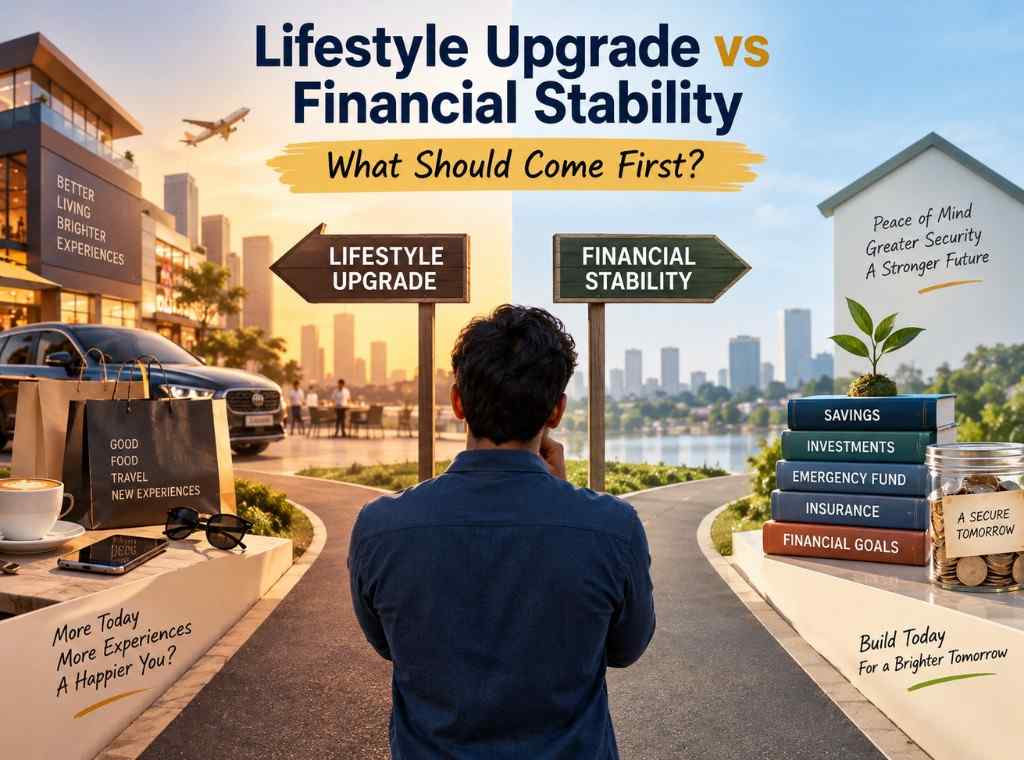
You receive a salary increase. Suddenly, a better phone seems reasonable. A car upgrade feels affordable. Dining out more frequently does not appear excessive anymore. Perhaps moving to a better apartment also starts looking like the natural next step.
However, a few months later, something unexpected happens. Your income has increased, yet the feeling of financial freedom has not.
Ever wondered why earning more does not always make you feel financially secure?
The answer may lie in the difference between improving your lifestyle and strengthening your financial foundation. The focus keyphrase Lifestyle Upgrade vs Financial Stability highlights a choice many working Indians face as their income gradually increases.
Lifestyle improvements are not automatically wasteful. Nevertheless, when expenses rise as quickly as income, financial stability can remain frustratingly distant.
So, what should come first?
Understanding Lifestyle Upgrade vs Financial Stability
A lifestyle upgrade happens when increasing income leads to higher spending on comfort, convenience, experiences or status.
For example, you may shift from public transport to frequent cabs, replace a functioning phone with a premium model, choose a more expensive apartment, increase food deliveries or start taking costlier holidays.
Individually, these choices may fit comfortably into your salary.
The problem begins when several upgrades happen together.
Financial stability, on the other hand, means creating enough financial resilience to manage regular expenses, unexpected costs and future goals without constantly depending on the next salary.
Therefore, the real question is not whether you should enjoy your money.
It is whether your lifestyle is growing after your financial foundation or ahead of it.
The Salary Increase That Disappears
Imagine a household earning ₹60,000 per month.
After a salary increase, monthly income becomes ₹70,000.
At first, that additional ₹10,000 feels significant.
However, the family gradually increases spending.
The internet plan gets upgraded. Weekend dining becomes more frequent. Online shopping increases. A new EMI is added. Cab rides replace cheaper commuting options.
Before long, monthly expenses have increased by almost ₹10,000.
Income improved.
Lifestyle improved.
Yet savings barely changed.
Then an unexpected ₹35,000 expense arrives.
Suddenly, the family needs a credit card or has to withdraw money reserved for another goal.
This is the hidden problem with lifestyle inflation: higher income can create the appearance of progress without creating greater financial resilience.
Why Lifestyle Upgrades Feel So Natural
Most people do not deliberately decide to become financially vulnerable.
Instead, lifestyle inflation often develops through dozens of reasonable-looking decisions.
1. You Feel You Have Earned It
After working hard for a promotion or salary increase, wanting to reward yourself is completely understandable.
A better meal, short holiday or useful purchase can make the achievement feel meaningful.
However, problems can arise when a one-time reward quietly becomes a permanent monthly expense.
2. Your Social Environment Changes
Colleagues may upgrade their phones.
Friends may buy cars.
Social media may constantly display holidays, restaurants, fashion and expensive experiences.
Consequently, spending can begin to feel like the normal price of keeping up.
3. EMIs Make Expensive Purchases Look Smaller
A ₹60,000 purchase can feel intimidating.
A monthly EMI of ₹5,000 may appear manageable.
Nevertheless, several manageable EMIs can collectively consume a large part of your disposable income.
4. Convenience Becomes the Default
Food delivery, subscriptions, premium memberships, and frequent cab rides can genuinely make life easier.
Still, recurring convenience costs deserve attention because they can quietly become part of your permanent spending baseline.
5. Financial Stability Does Not Mean Living Without Enjoyment
This is where the conversation needs a different perspective.
Financial stability should not mean refusing every restaurant visit, holiday, gadget or enjoyable experience.
Money should support your life, not turn your life into a permanent exercise in restriction.
Instead of asking:
“Should I enjoy my money or save it?”
Ask:
“How can I enjoy my income without making my future financially fragile?”
That question changes the entire approach.
You no longer need to choose between extreme saving and uncontrolled spending.
Instead, you create an order.
First build protection. Then upgrade intentionally.
Build Financial Stability Before Major Lifestyle Upgrades
For most households, financial stability should become stronger before lifestyle expenses become bigger. A higher salary can improve your life, but only when the extra income creates more freedom instead of more financial pressure.
1. Know Where Your Salary Goes
Start by reviewing housing, groceries, EMIs, transport, insurance, education, subscriptions and discretionary spending. If ₹65,000 of an ₹80,000 take-home salary is already committed, adding another ₹8,000 EMI could leave very little breathing room.
Instead of asking, “Can I pay the EMI?”, ask, “Can I afford it comfortably while saving and handling surprises?”
2. Build an Emergency Cushion
Unexpected expenses rarely arrive at a convenient time. Therefore, gradually build an emergency fund based on your essential household expenses and income stability. Keep this money reasonably accessible and separate from everyday spending.
3. Strengthen Insurance Protection
Savings and insurance solve different problems. Emergency savings can absorb smaller financial shocks, while suitable health and life insurance may provide protection against much larger risks. Choose coverage according to your household needs.
4. Control Expensive Debt
Credit card balances, consumer loans and repeated buy-now-pay-later purchases can quietly consume future salary increases. Being able to buy something does not always mean you can comfortably afford it.
5. Give Every Salary Increase a Purpose
When income rises, avoid automatically increasing spending. For example, part of a ₹12,000 raise could go toward investments, emergency savings and future goals, while a smaller portion improves your lifestyle.
Let your lifestyle grow more slowly than your income.
6. Choose Upgrades That Add Real Value
A shorter commute, reliable appliance, useful course or meaningful family holiday may genuinely improve everyday life. Before spending, consider whether the upgrade provides lasting value without weakening important financial goals.
7. Watch Recurring Commitments
An extra ₹10,000 every month becomes ₹1.20 lakh a year. Therefore, evaluate larger rent, car EMIs, subscriptions and memberships using their annual cost, not only their monthly price.
8. Create a Lifestyle Upgrade Fund
Want a new phone, holiday or furniture? Save for it first. The waiting period helps you separate lasting priorities from temporary excitement while keeping your finances under control.
The 24-Hour and 30-Day Rules
Impulse spending becomes easier when purchasing requires only a few taps.
Therefore, create a waiting period.
For smaller non-essential purchases, consider waiting 24 hours.
For expensive lifestyle upgrades, consider waiting 30 days.
During that period, ask whether the purchase solves a genuine problem or simply provides temporary excitement.
The waiting period does not prevent spending.
Instead, it separates desire from decision.
Watch Out for Lifestyle Comparison
Someone earning the same salary as you may have completely different financial responsibilities.
One person may live with family and have minimal housing costs.
Another may support parents, pay rent, repay an education loan and save for children’s education.
Therefore, copying another person’s lifestyle based purely on visible income can be misleading.
You can see someone’s car. You cannot see their bank balance, debt, family responsibilities or financial stress.
Financial decisions should reflect your reality rather than somebody else’s highlight reel.
A Simple Financial Stability Check
Before making your next major lifestyle upgrade, consider whether you can confidently say:
- I understand my essential monthly expenses.
- I regularly save or invest toward important goals.
- I am building or maintaining an emergency reserve.
- My insurance protection reflects my needs.
- My high-cost debt is under control.
- A new purchase will not force me to stop important savings.
- I can manage the ongoing cost comfortably.
- I want this upgrade for myself rather than mainly to impress others.
If several answers are “no,” strengthening your financial foundation may deserve priority.
If most answers are “yes,” you may have more room to enjoy thoughtful upgrades without sacrificing stability.
The Real Goal Is Sustainable Progress
Financial success should not require waiting until retirement to enjoy your money.
At the same time, enjoying every salary increase immediately can make long-term security harder to achieve.
The healthier middle ground is intentional progress.
Save.
Invest.
Protect yourself.
Plan for important goals.
Then enjoy part of your income without guilt.
As your financial foundation becomes stronger, lifestyle improvements can feel better because they no longer compete as aggressively with financial security.
The goal is not to look richer after every salary increase. The goal is to become financially stronger while gradually creating a life you genuinely enjoy.
A Simple Rule From The Life TrackR
The next time your salary increases, avoid upgrading everything simultaneously.
Give your financial stability the first opportunity to benefit from your higher income. Then choose the lifestyle improvements that genuinely add value.
The Life TrackR encourages progress that feels good today without unnecessarily compromising tomorrow.
Conclusion
The debate around Lifestyle Upgrade vs Financial Stability does not need an extreme answer.
You do not have to choose between enjoying life and building wealth.
However, the order matters.
Strengthening your emergency savings, managing debt, maintaining appropriate financial protection and consistently working toward important goals can create a stronger foundation. Afterward, lifestyle improvements can become deliberate rewards rather than financial burdens.
So, when your next salary increase arrives, ask yourself one question before upgrading your lifestyle:
“Will this purchase make my life better, or would strengthening my financial position make me feel better for much longer?”
Sometimes, the smartest upgrade is not something other people can see.
It is the security you quietly build for yourself.
#LifestyleUpgrade #FinancialStability #PersonalFinance #MoneyManagement #LifestyleInflation #FinancialPlanning #SmartMoney #FinancialHabits #TheLifeTrackR
Editor’s Note: This article was originally published here: https://thelifetrackr.com/emotional-strength-vs-emotional-suppression-which-one-builds-real-stability/ by @Kairav and @krutika